


By Pragati Shahi
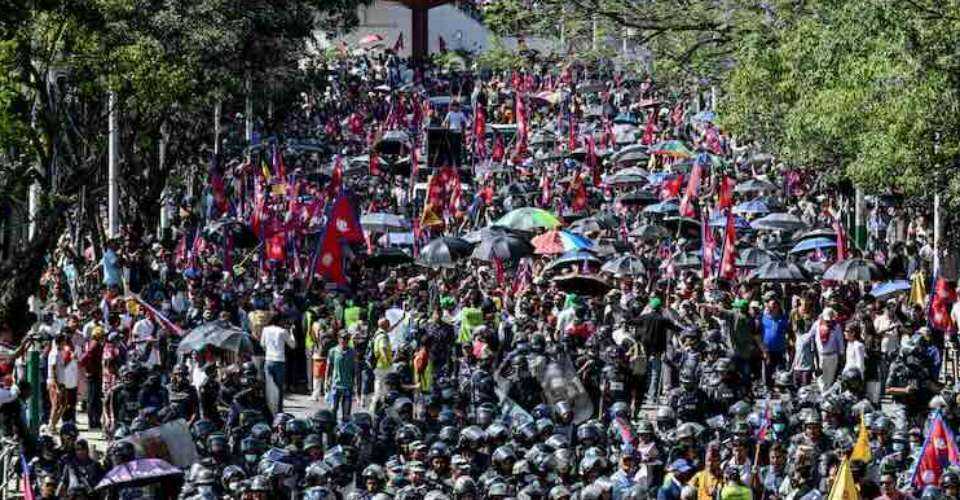
The call to restore the Hindu monarchy in Nepal has gained momentum, forcing authorities in Kathmandu to expand “prohibitory zones” to push demonstrators away from key administrative areas in the capital.
The pro-monarchy protests, led by 44 different groups, which seek to restore a Hindu king as head of state, have become a source of tension for the coalition government headed by K.P. Sharma Oli, a veteran communist leader of the Communist Party of Nepal.
Tensions escalated on June 1, when protesters attempted to enter a restricted zone near Oli’s residence. Police used batons and tear gas, resulting in the arrest of about six people, including Kamal Thapa, the former home minister and chairperson of the Rastriya Prajatantra Party-Nepal (RPP-N), a constitutional monarchist and Hindu nationalist party.
The arrested were released after a few hours of detention, but the incident marked a turning point. The Kathmandu District Administration Office issued a notice on June 3, banning all protests, sit-ins, hunger strikes, and gatherings in designated areas for the next two months.
Nepal’s political landscape has undergone significant changes in less than two decades.
In 2006, many of today’s republican leaders were themselves protesters, resisting the direct rule of the king and calling for the abolition of the monarchy. At the time, the state responded with force — bullets and batons — to suppress a growing people’s movement.
Despite casualties and arrests, the protests intensified, eventually compelling King Gyanendra Shah, the world’s last Hindu monarch, to step down in 2007, ending a 240-year-old monarchy.
In 2008, the interim legislature, constituted by inducting members of the dissolved House of Representatives and Maoist leaders, declared Nepal a secular, democratic republic.
Today, those who once defended the republic are in power — and being challenged by the very kind of movement they once led.
Monarchists, many of whom are young and disillusioned with the current system, are back on the streets, demanding a return to a constitutional Hindu monarchy. Their main goal is to restore the king to Narayanhiti Palace, which now functions as a museum commemorating Nepal’s royal past.
Nepal has experienced 14 different governments in 17 years. While democracy itself has not failed, many argue that the politicians have. Public frustration is growing over political instability, chronic corruption, unemployment, and a struggling economy. For some, monarchy represents a potential stabilizing force.
The latest corruption scandal involving Home Minister Ramesh Lekhak has further fueled outrage. He has been accused of accumulating 4 million Nepali rupees (US$29,141) daily, while immigration officials under him facilitated human trafficking under the guise of outbound tourism.
Thousands of young people, desperate to leave the country in search of job opportunities in Middle Eastern and European countries, were victims of this trafficking, reports show.
In June 2023, Bal Krishna Khand, a former home minister, was sentenced for sending Nepali youths to the United States by misrepresenting their travel documents as those of Bhutanese refugees.
A prominent group advocating for a Hindu state and a constitutional monarchy is the right-wing Rastriya Prajatantra Party (National Democratic Party). Swati Thapa, a member of its central committee, says they demand it “not as a step backwards but as a unifying and moral force above politics.”
“The federal system has a bloated bureaucracy without delivering services. The people need accountable governance, not constant political bargaining,” Thapa says.
She advocates a model where the king acts as a ceremonial guardian of national unity, while executive power rests with a directly elected prime minister.
The pro-monarchy movement has gained new momentum since the former king, Shah, made rare political remarks on National Democracy Day on Feb. 19, 2025, accusing republican leaders of failing the nation and appealing to the people for support.
Less than a month later, on March 9, thousands of the deposed king’s supporters gathered in front of Tribhuvan International Airport, chanting slogans such as “Come back king, save the country,” “vacate the royal palace for the king” in a symbolic show of strength.
Similarly, on March 28, a pro-monarchy rally turned into a violent protest, leaving two dead, including a journalist, and more than 100 injured.
Despite increasing public support, restoring the monarchy remains a distant possibility. Currently, that route is obstructed by constitutional and political realities.
The Constitution of Nepal prohibits the restoration of the monarchy without a two-thirds majority in parliament, a threshold that monarchist forces are far from reaching. Their only option is to generate enough public pressure to compel major parties to participate in political negotiations.
The monarchists will likely need to wait until the next general election in 2027 to significantly influence the system — unless they can galvanize a mass movement capable of shifting the national discourse.
Political analyst Bipin Adhikari, a law professor at Kathmandu University, believes that growing public discontent with the current government and support for an alternative regime could help increase the push toward a constitutional monarchy.
“If the republican leaders fail to build and strengthen the republic, they should be prepared for any alternative the people may choose,” he said.
Regionally, the monarchist cause is gaining indirect support through rising Hindutva sentiments, especially along the Nepal-India border.
While India has not officially endorsed restoring the monarchy, some right-wing actors have actively advocated for Nepal to be declared a Hindu state. Groups like the Hindu Samrat Sena (army of the Hindu king) have organized rallies, some of which were provocative and aimed at religious minorities, particularly Muslims and Christians.
Neighboring China also maintains cordial relations with Nepal’s major political parties but has not openly expressed a position on the restoration of the monarchy. However, both regional giants continue to exert significant geopolitical influence on Nepal’s political trajectory.
Religious minority leaders warn that dismissing or ignoring the monarchist movement could be dangerous.
“This is not just about restoring the king. It’s also about growing dissatisfaction with the current system,” says B.P. Khanal, Lead Commissioner of the Religious Liberty Commission, Nepal Christian Society.
As calls for a Hindu nation grow louder, anxiety among Nepal’s minorities is also increasing, with reports of rising attacks on Christian communities in the southern plains already surfacing.
There’s little chance the monarchy will return, but there is a real risk that secularism could be compromised,” warned the Christian leader. “That’s deeply worrying. We can’t afford to go backwards,” he said.
The article appeared in the ucanews
0 Comments
LEAVE A COMMENT
Your email address will not be published