

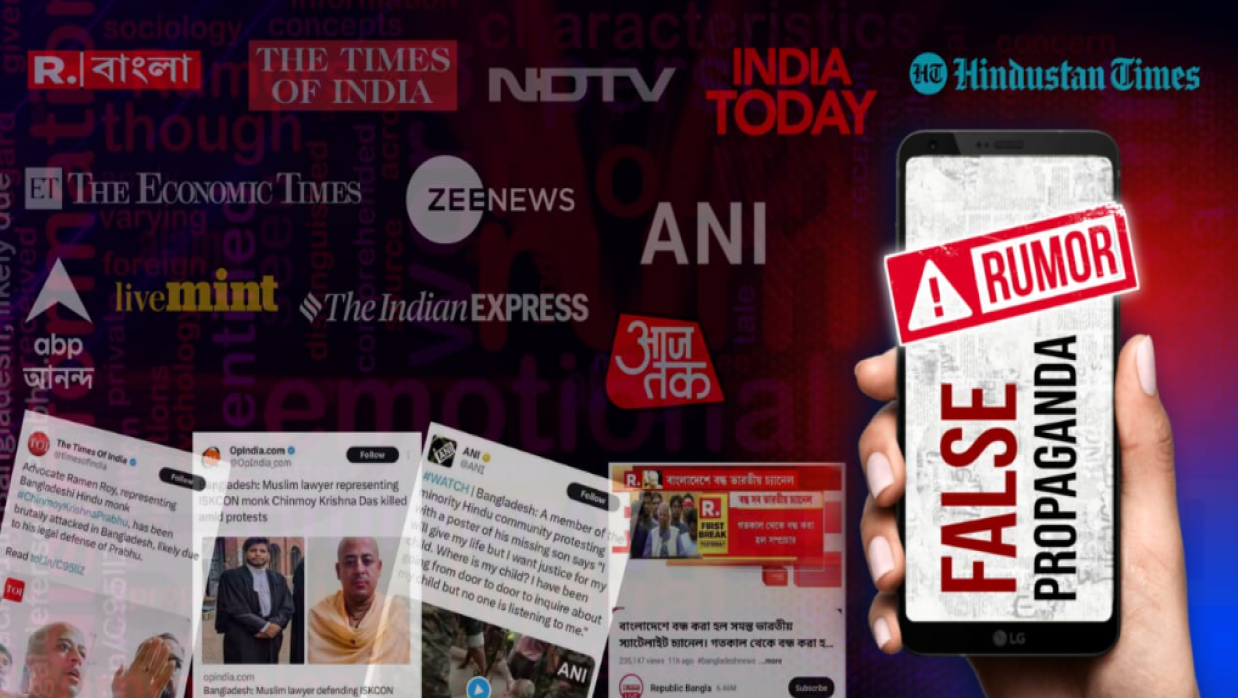
What was regarded as an exemplary relationship and a legacy of amity between the two countries is now being damaged by strident outbursts from many politicians and a large number of tabloid-style TV commentators and news channels. All point to a certain inability of many in India's political class to come to terms with developments and the state of politics in Bangladesh. Many feel no inhibition about adopting a patronizing, almost bully-like, tone towards what should be regarded as a sovereign country free to evolve as it sees fit.
A number of TV anchors and commentators, Palki Sharma of Firstpost being one example, and the wide range of news channels including Republic, Zee News, Times Now, and many others, play a very significant role in forming the views of a large cross-section of the Indian public on world issues, including geopolitics. It is difficult to avoid the conclusion that, at times, much of the commentary and presentation on Bangladesh serves the political class well.
Sections of the Indian television media increasingly resemble theatrical productions rather than serious platforms for international affairs. Anchors deliver dramatic monologues, issue sweeping judgments about neighboring countries and portray India as the unquestioned guardian of South Asia. Their presentations sometimes resemble Bollywood political thrillers, in which India assumes the role of a regional godfather entitled to discipline its smaller neighbors whenever they pursue policies that displease New Delhi.
It is commonly termed "Godi" media, to varying degrees, that is, subservient to and in favor of those in power. There is therefore a real danger of many such media houses being used to further various causes, political or nationalistic agitations, apply diplomatic pressure, and so on.
There are many fine and honest journalists, thinkers, diplomats and others in positions of political responsibility in India. Over the years, many very eminent and courageous men and women have fearlessly stood up to successive governments and acted in support of basic democratic principles. But they tend to be eclipsed by demagogues, for whom stoking fury and indignation is a sure recipe for attracting attention.
Most recently it seems that a BJP leader has made such outrageous remarks about Bangladesh. On 25 November 2026 he was reported to have said that by 16 December he expected to be able to announce the "occupation" of Bangladesh, in view of numerous murders of Hindus there.
Assuming the report is correct, it is difficult to conceive of a more reckless and irresponsible utterance by a politician. As 16 December was the day on which the Liberation War was successfully concluded in 1971 and is celebrated each year in Bangladesh, it shows a remarkable callousness and ignorance of events significant to the nation and its people.
India played a major role in the Liberation of Bangladesh, which is rightly remembered by many millions of people. They benefitted from various forms of help from the Indian State and people, including shelter for a very large number of refugees. But none of these gave India any right to act as a permanent guardian and decide the course of politics in the country.
It is a sovereign, independent state, with all appurtenant organs of the State, including its own military, foreign alliances, interests, and desires. Any threat to its territorial integrity, for any internal political gain, would go against the basic tenets laid down in the UN Charter for all member countries.
The treatment of the sizeable number of Hindus residing in Bangladesh is a matter of legitimate concern. All citizens of Bangladesh should be equally protected by the State, whatever their religion. Due inquiry should be made into all instances of violence against any group of citizens, with punishment meted out to the guilty, and protection afforded to those under threat. But this would not justify threats to Bangladesh's independence and sovereignty. As a country with its own problems about the treatment of various minorities and inter-communal harmony, India would be well advised not to make political capital out of such issues.
Relations have been further exacerbated over the fate of ex-PM Hasina. Following the fall of her regime in August 2024, she flew out of the country in an Indian Air Force plane to seek asylum in India. This has now become a major point of contention with the Government of Bangladesh.
She has been found guilty by the International Crimes Tribunal of various offenses in relation to the ruthless crackdown on protesters and others in 2024. Many tapes, films, eyewitness accounts, and other records document the atrocities committed. A wide range of serious abuses of human rights were recorded by the team appointed by the UN.
It should be self-evident to all politicians in India that many innocent people lost their lives, and others suffered terribly, for which somebody should be held responsible.
It is no answer that a similar court tried people charged with offenses related to events during the Liberation War while she was Prime Minister. Questions remain about the desirability of trials in the absence of adequate opportunities to defend oneself, the imposition of a death sentence, and so on, in all such cases.
If Sheikh Hasina and her followers wish to challenge these findings, there are appropriate courts in which she can appeal. As a state that has ratified the Rome Statute establishing the International Criminal Court (ICC) and the ICCPR, Bangladesh clearly has an obligation to prosecute certain crimes and provide appropriate standards of natural justice. In limited situations, the ICC could exercise jurisdiction over crimes against humanity, but this would not extend to acting as a court of appeal from decisions of the International Crimes Tribunal. Nor would the ICJ have jurisdiction to hear an appeal by an individual against his or her criminal conviction. Various other bodies could examine aspects of the trial procedure and call for greater protections for the accused, but none could overturn the decision. It seems India would have a role only in determining whether to extradite Hasina to Bangladesh, under the relevant treaty and its own law. Any issues arising from her conviction would have to be raised before the appropriate court or courts. No amount of political support and jingoistic press coverage would be a proper alternative to appropriate judicial determinations, so that those who suffered as a result could obtain justice, subject to the rights of the accused person.
India is well within its rights to fully consider the merits of its case under the relevant legislation and treaty. It would not follow, however, that India should be a safe haven for an ex-leader against all legal process. Similarly, the person would be entitled to due process and other basic rights once extradited and convicted.
There were also outbursts by sections of the Indian press on reports of abuse of Muhammad Yunus at JFK airport, New York. He appears to have been wheeled in a wheelchair around parts of the airport, with people jeering and calling him various names.
The incident drew extensive coverage across Indian television networks, newspapers, and digital platforms, including NDTV, India Today, The Indian Express, Hindustan Times, The Times of India, The Statesman, Zee News, Moneycontrol, and Organizer.
Most media gave considerable space to these and other allegations by various people, and referred to the event as a 'demonstration' or similar. A number went further, using highly inflammatory terms, describing him as a terrorist and responsible for various deaths. Many of these charges were leveled at him in connection with his actions and decisions as Chief Adviser.
Of course, there is a big difference between fairly relaying someone's accusations against another and giving them wide currency. People are entitled to demonstrate and voice political views, but this is no justification for abusing and threatening particular individuals. However much one may dislike an individual or consider him a subject of legitimate debate and criticism, one must carefully separate proven fact from unproven assertion.
Some Indian media outlets went so far as to state that there was no way to verify these charges. Some also referred to the Bangladeshi authorities' strong denunciation and their plans for legal proceedings. This is significant given the diversity of the media in India, which clearly cannot be regarded as a monolith.
There can be little doubt, however, that the weight of abusive language attributed to the various demonstrators would tend to color many people's reaction and views about the event. To this extent, at least some media outlets were acting to further a cause: portraying the event as a justified attack on a much-maligned politician.
It goes without saying that Mr. Yunus and the policies of his caretaker government would face wide criticism on a host of issues, including treatment of minorities, medical facilities and services, civil liberties, general management of government affairs, and so on. But these are very different matters from a barrage of unproven denunciations at an airport.
More generally, there is an alarming tendency to let nationalist and jingoistic outbursts replace reasoned, sensible approaches to other countries. The whole school of Indian statecraft and strategy, from Kautilya's Arthashastra onwards, suggests relying on subtle measures, spying, and the judicious development and nurturing of friendly relations. Much recent political rhetoric would suggest that little of this is uppermost in many minds.
One would expect a major country with India's many assets to appreciate that winning the goodwill and trust of other people complements its formidable military strength, large economy, and other geographic and strategic advantages. Strong official pronouncements, accompanied by strident TV coverage, may well be counterproductive to normal diplomatic objectives.
The various problems with neighboring states would seem all the more reason to act with greater restraint. All of India's immediate neighbors, such as Bangladesh, Nepal, Sri Lanka and the Maldives, have internal forces at work and good reasons to develop ties with other countries. Closer relations with China, Pakistan, the US, or others are unlikely to be designed to offend India.
Bangladesh and India share an extensive border, interconnected river systems, substantial commercial relationships, transportation networks, and deep cultural connections. Cooperation in water management, maritime commerce, energy security, regional connectivity, and climate adaptation offers enormous opportunities for both nations. These opportunities cannot be fully realized amid suspicion, political interference, and public humiliation.
India needs to decide what kind of country and regional power it wants to be, and whether it wants neighboring countries to look elsewhere for leadership and power. This will not be achieved by intimidation, long tirades on TV screens, or a sense of historical right and privilege, but by inspiring respect from others, trade and commerce, responsible state behavior and respect for law.
Bangladesh should be confident of its own institutions and avoid responding in kind to inflammatory language. No one has the right to dictate terms to it or to make concessions of sovereignty, matters to be decided solely by Bangladesh. It should continue working to establish strong, fair democratic institutions for all its people and an independent foreign policy.
The people of Bangladesh have no inherent hostility toward the people of India. Both nations possess extraordinary cultural, linguistic and historical connections. Their future should not be held hostage by sensationalist television personalities, opportunistic politicians or the political fortunes of a former prime minister.
The true test for India will be how far it is prepared to live in peaceful harmony with its smaller neighbors as equals. What South Asia requires is mature statesmanship rather than Bollywood acts, objective and fair reporting of events rather than jingoism, and diplomacy based on reciprocal respect, not desires to be hegemonic over others.


0 Comments
LEAVE A COMMENT
Your email address will not be published