

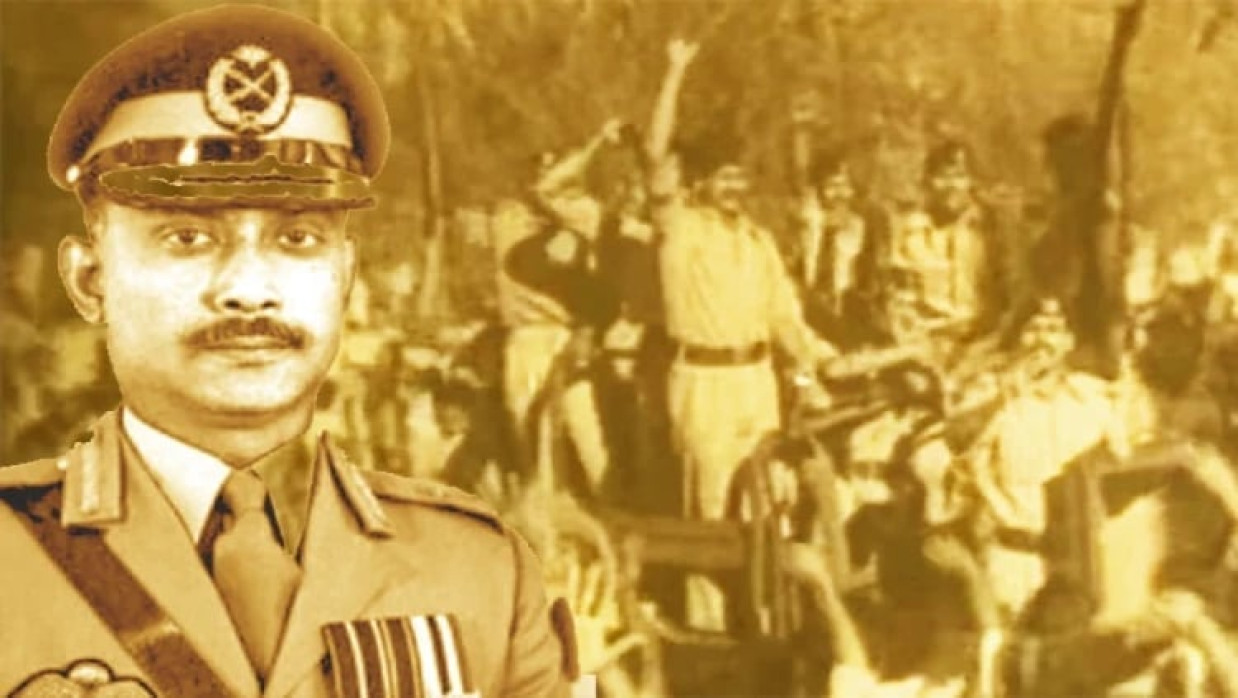
It has been half a century since a soldier revolt took control of Bangladesh's political setup. The legacies of Sheikh Mujib, Col. Abu Taher, and Gen. Ziaur Rahman are all vying for space in the minds of our people as we move toward democracy and a good relationship between the civilian and the military.
Was there ever a revolution on 7th November 1975?
Many celebrate it as National Revolution and Unity Day, while we know it as a mutiny by some army personnel against the then-president, which led to several flaws in our state.
The background of this event can be related to people’s dissatisfaction, as it failed to understand how the state should behave after a war of liberation. Issues included the government's structure, poverty and corruption, different wings of the military, and more.
Historian Prof. Salimullah Khan and political commentator Altaf Parvez have recently shed light on these matters. One could say that they contradict each other on some levels. But what can we conclude about November 7?
We will answer that once we see how our political leaders failed our country before and during the revolt.
From Liberation to Disillusionment
People had high expectations when Bangladesh won the liberation war. When you fight for independence, you hope for more than changing rulers from Pak to Bangla. You want equality, justice, human rights, and democracy in your new country.
Yet the transition from revolutionary struggle to nation-building proved exceptionally difficult.
The new government inherited devastated infrastructure, disrupted agricultural production, weakened institutions, and an economy heavily dependent on foreign assistance. The nationalization of major industries, particularly jute enterprises abandoned by Pakistani owners, created enormous administrative responsibilities without adequate managerial capacity.
Corruption, political patronage, smuggling, and declining public confidence aggravated the situation.
The 1974 famine became a defining national tragedy. Although flooding and food shortages contributed to the crisis, failures in food distribution, purchasing power, governance, and international assistance also played significant roles. The famine exposed ordinary citizens' vulnerability and undermined confidence in the government.
Political conditions deteriorated further when Sheikh Mujibur Rahman introduced the Bangladesh Krishak Sramik Awami League (BAKSAL) system in January 1975 through the Fourth Constitutional Amendment. This shift toward one-party rule, restrictions on the press, and the concentration of executive authority marked a profound departure from the democratic expectations of independence.
The assassination of Sheikh Mujibur Rahman and most of his family on August 15, 1975, subsequently plunged the country into a constitutional and moral crisis.
This incident raised questions about how different countries assessed the situation. Some politicians believe that India may have been worried about Sheikh Mujib due to his mass appeal. He was a very charismatic man whom the people adored. Whether they were Bangladeshi's or lived across the border, he became a great political force in the region. Though India helped free Bangladesh, there is no way to say that Sheikh Mujib would always follow what India wanted. Because of his strong character, he may have sometimes defied India's wishes for his country.
Another factor that played into this assassination was the lack of outrage from the public. As many know Sheikh Mujib was extremely well liked by the people of Bangladesh when gaining their freedom. So why did they not react? Well, many reasons come into play here. From poverty to corruption and disappointment with the current government. Bangladesh suffered for years under these problems. They were also afraid and unsure what would happen next when the military took over. Many theories have emerged, but no one can say for sure how the people reacted.
November 7: The Soldiers and the People
The coup of 7th November followed a series of events that unfolded over a short period. Military coups, assassination of politicians, and opposition ideologies nearly destroyed the newborn nation. When the military took control on 3rd November, it was because Brigadier Khaled Mosharraf wanted to take action against the military officers who took part in Sheikh Mujib's death on 15th August. The Chief of Army Staff, Major General Ziaur Rahman, was put under house arrest while different groups vied for power in the army and government.
When 4 national figures were killed in Dhaka Central Jail on 3rd November, the crisis only increased. Syed Nazrul Islam, Tajuddin Ahmad, A. H. M. Qamaruzzaman, and Muhammad Mansur Ali all played important roles in the Liberation War. Their deaths once again took the lives of those who played key roles in Bangladesh’s liberation. This plunged the country into a deep crisis.
On 7 November, a revolt by junior military personnel began, with some civilians taking part as well. Revolutionary soldiers from the underground Revolutionary Soldiers Organization, influenced by Colonel Abu Taher and connected to the Jatiya Samajtantrik Dal, were behind much of the uprising. This led to Ziaur Rahman's release from house arrest, which changed the course of events.
What happened on 7th November was much more than just a military takeover. Many reasons drove soldiers to rise up against their superiors. During the Liberation War, many felt that after gaining independence, things would be different. That there would be less of a divide between officers, soldiers, and the general public. Once the country became free, these divisions still existed, and many felt let down that nothing had changed.
Altaf Parvez believes these were what drove the revolutionaries on 7th November. Colonel Abu Taher and his group wanted an army that could better help the nation. Not only from a military perspective but also from an economic point of view. He felt that during peacetime, soldiers could help with agriculture, build roads, and other ways to benefit society. They wanted to be part of the people's army, not just sit around at military bases doing nothing.
Many have compared 7th November to the soldier revolt (sepoy mutiny) that occurred in 1857 against the British Raj. While many things about the two events are not alike, they share one thing in common. Regular soldiers were able to take control from higher-ranking officers.
One thing that worked against the revolutionaries on 7th November was that they had no true cause. No common idea that all sides shared about what they wanted for our country. Some wanted change in our military structure, and some just wanted stability back. Others wanted to eliminate their rivals and gain more power.
No common goals or ideas united everyone who took part in the uprising. Once the uprising began, it was obvious that the revolutionaries and Ziaur Rahman did not share the same views. After Colonel Abu Taher failed to gain enough support from those involved, he was quickly removed from the picture.
7th November changed Bangladesh for the better; it brought Ziaur Rahman to power. But it also failed to deliver what the revolutionists hoped for.
Abu Taher and Ziaur Rahman: The Contradictions of a Revolution
Perhaps the greatest irony of the November 1975 uprising lies in the contrasting political visions and eventual confrontation between Colonel Abu Taher and General Ziaur Rahman. Although the events of November 7 temporarily brought their interests together, the two men represented fundamentally different interpretations of the Liberation War and the political direction Bangladesh should pursue.
Colonel Abu Taher saw this rebellion as a second chance to advance and complete the social revolution Bangladesh had pursued since gaining freedom in 1971. Taher wanted more than just freedom from Pakistan's rule. He wanted Bangladesh to be a nation free from Pakistan's political and economic structures as well as the military. He wanted to establish a society where everyone was equal. People could play a role in their governments and had equal rights. The military would benefit more from a closer relationship with civilians.
Zia did not feel these ways as he was more of a military man. He wanted to establish more discipline within the military and make sure Bangladesh had a stable form of government. By doing this, he could keep a firm military rule over Bangladesh, which was in a state of chaos at the time. Colonel Taher wanted to promote a more revolutionary idea, which Zia opposed.
The uprising on November 7th led to Ziaur Rahman's release from custody, and he became one of Bangladesh's leading politicians. However, the soldiers and activists who stood for the cause soon realized they weren't aligned with Zia.
Things quickly fell apart between Taher and Zia. They fought against the current military rule, which soon turned into a revolution against it.
Colonel Abu Taher was subsequently arrested and tried before a special military tribunal, which sentenced him to death. He was executed by hanging on July 21, 1976, in what became one of the most controversial judicial proceedings in Bangladesh's post-independence history. Nearly 35 years later, on March 22, 2011, the Bangladesh High Court declared the military tribunal and its proceedings illegal and unconstitutional. The Court characterized Taher's execution as a politically motivated, premeditated killing and concluded that General Ziaur Rahman had determined his fate even before the tribunal was constituted. The full 198-page judgment, released on May 20, 2013, documented serious violations of due process and fundamental principles of justice.
Significantly, the judgment was delivered during the Awami League government of Prime Minister Sheikh Hasina, whose party had a longstanding political rivalry with the Bangladesh Nationalist Party founded by Ziaur Rahman. This political context inevitably raises questions about the relationship between judicial decisions and Bangladesh's deeply polarized political environment. However, while the timing and political circumstances of the ruling warrant critical examination, there is insufficient substantiated evidence to conclude that Prime Minister Sheikh Hasina personally influenced or directed the High Court's decision. The judgment must therefore be evaluated both in light of its documented legal findings and the broader political circumstances in which it was delivered.
Often, when you start a revolution, you will not be the one to benefit. When change happens, others may take advantage and rise to power.
In November 1975, General Ziaur Rahman became that person. After Colonel Taher and his men stood up for what they believed in, Zia took over Bangladesh. Changing many things about the way Bangladesh operated politically and economically.
Taher wanted to create a revolution, but ironically that led to him being killed by military rule. The 7th of November changed who ruled Bangladesh, but it also led to the downfall of Colonel Taher and his beliefs.
Foreign Influence and Cold War Geopolitics
Bangladesh's political turmoil unfolded against the broader strategic rivalry of the Cold War.
The United States had supported Pakistan during the 1971 crisis, while India and the Soviet Union played important roles in Bangladesh's emergence.
Consequently, Washington closely monitored developments in Dhaka, particularly Sheikh Mujibur Rahman's relationship with India, Soviet influence, and the growth of leftist political movements.
Professor Salimullah Khan's claims about American intelligence involvement and the actions of American embassy officers such as Philip Cherry warrant closer examination.
Historical records and released information should be studied to further these claims. But we need to look at documented facts that can show Americans were behind the assassinations of August or the following coup attempts.
The available discussion does not establish that distinction conclusively.
Bangladesh's strategic location near the Bay of Bengal, India, China, and important maritime routes undoubtedly made its political orientation significant to foreign powers.
Nevertheless, domestic institutional failures and competing political ambitions remain indispensable explanations for the events of 1975.
Ziaur Rahman and the Restoration of Political Order
Bangladesh saw many changes under his rule. He gradually moved Bangladesh away from its socialist economy and toward capitalism. He tried to improve the country's agriculture and build relations with Islamic nations and Western countries.
The Bangladesh Nationalist Party, established in 1978, became an enduring political institution.
Zia also facilitated the reintroduction of multiparty politics, although political liberalization occurred within a system shaped by military authority and restrictions on opposition.
His contribution to regional cooperation deserves recognition. Zia promoted the concept of South Asian regional cooperation that eventually contributed to the establishment of the South Asian Association for Regional Cooperation (SAARC) in 1985, four years after his assassination.
His presidency brought some administrative continuity, but it did not eliminate military factionalism. Zia himself was assassinated in Chittagong on May 30, 1981, illustrating the persistence of instability within the armed forces.
The Unfinished Promise of 1971
One could argue that what matters more about November 7 is why the dream of independent institutions was left unfinished, rather than who won that day.
Colonialism allowed Bangladesh to gain certain aspects of its institutions. After independence, Bangladesh could not mold those institutions to better serve its citizens.
Both Salimullah Khan and Altaf Parvez emphasize, in different ways, the consequences of political fragmentation, centralized authority, and the failure to establish durable democratic institutions.
The popular uprising of 2024 has renewed these historical questions. Once again, Bangladesh faces demands for institutional reform, accountability, political inclusion, and safeguards against authoritarian government.
The parallel should not obscure the differences between 1975 and 2024. Nevertheless, both periods reveal the dangers of concentrating political authority without sufficient institutional checks.
Conclusion: History Beyond Political Allegiance
The events of 7th November 1975 cannot be explained by taking sides with any political ideology that has prevailed in Bangladesh since its inception.
To some, it stands for independence and for Ziaur Rahman, a great leader who kept Bangladesh stable. To others, it means that a group of soldiers killed their own and ruined the dream of Colonel Abu Taher.
Both interpretations illuminate important aspects of a complicated historical reality, but neither fully explains the broader institutional crisis.
The fundamental tragedy was that Bangladesh's remarkable achievement of political independence was not accompanied by an equally successful transformation of governance, economic opportunity, and civil-military relations.
More than half a century after liberation, the country still confronts questions its founding generation could not resolve.
The lasting lesson of November 7 is that neither military intervention nor revolutionary enthusiasm alone can establish a durable democratic order. Such an achievement requires accountable institutions, civilian supremacy, economic justice, political tolerance, and citizens' participation in shaping their nation's future.
Bangladesh's unfinished revolution will reach its democratic destination only when those principles outweigh the individuals and political parties claiming ownership of its history.


0 Comments
LEAVE A COMMENT
Your email address will not be published