

South Asia Journal | Investigative Analysis
After almost 30 years since the peace accord was made in 1997, Bangladesh has had to come to terms with many issues of race, borders, militant groups, and other countries that are involved. The answer should not be to allow these people to break away from Bangladesh or allow them to have military power forever. Instead, it should allow our country to stand as one and provide justice for those who live in Bangladesh's far southeast corner.
A Region That Bangladesh Cannot Afford to Lose to Instability
The Chittagong Hill Tracts (CHT), comprising Rangamati, Khagrachari and Bandarban, occupy a uniquely sensitive position in Bangladesh's geography. Bordering India and Myanmar, the region is strategically important to national security, regional connectivity and the stability of India's northeastern states.
Since its formation, the hills have seen bloodshed. The killing of politicians, refugees, army actions, various ethnic groups claiming the territory, and allegations of Indian meddling. The Chittagong Hill Tracts peace agreement was signed on 2nd December 1997, but things have never really settled down.
Can Bangladesh maintain its hold on the hills? That's no longer the question. Can we create a political environment where the country can operate as a sovereign nation and where all citizens are protected?
In a YouTube interview with former Brig Gen Hasinur Rahman Bir Protik, which leaves many unanswered questions. It covers the insurgency, India's role, and the politics of how CHT has been governed. It is important to look into these statements made by other military and intelligence personnel who would know about such things in CHT.
But one's statements should not be mistaken for fact. Many allegations here need to be backed up with facts. Whether Indian intelligence played a role or what any politician may have wanted.
We need to remember one thing. That these hill tracts belong to Bangladesh. We cannot let them be used against us by any means, whether by a local politician or another country.
Who Are the Hill Communities, and Are They Indigenous?
One of the most contentious questions concerns the designation of the CHT's ethnic communities as indigenous peoples, commonly translated into Bengali as Adibashi.
The region contains numerous distinct ethnic communities, including the Chakma, Marma, Tripura, Mro, Tanchangya, Bawm, Chak, Khumi, Khyang, Lushai and Pangkhua. Depending on the classification adopted, contemporary discussions refer to 11, 12 or 13 communities. These figures should not be treated as interchangeable without explaining the classification.
Lars-Anders Baer identified 11 main indigenous groups in his 2011 UN paper. Others may consider more groups to be indigenous.
The Government of Bangladesh has denied these groups being classified as indigenous people. The Government prefers to use the terms ethnic minority, tribe, or a small ethnic community.
When asked about this issue, Foreign Minister Dipu Moni stated in July 2011 that these hill people were not indigenous people by definition and history. She explained how they migrated to the area and why they should not be considered indigenous people in Bangladesh.
While this point may have validity, there are some things to note.
First, Article 23A of the Bangladeshi Constitution states that the state will endeavor to safeguard and foster the unique cultures and traditions of the “tribes, minor races, ethnic sects and communities” that have existed since ancient times. It does not state that these peoples are “Indigenous peoples” or Adivasi. As shown above, the Constitution refers to them as tribes/ethnic groups, and not all ethnic groups believe these terms are correct; many want to be recognized as indigenous people.
Second, just because people migrated to an area does not mean they are not indigenous by today's definition. You do not have to show that you were the first people to live in that area to be considered indigenous. People can look at other aspects such as history, institutions, and identity.
Third, Bangladesh has ratified International Labor Organization Convention No. 107, which concerns indigenous and tribal populations. It has not ratified Convention No. 169. The International Labor Organization continues to examine Bangladesh's responsibilities toward the CHT communities under Convention No. 107.
Consequently, it would be legally inaccurate to claim that international standards concerning indigenous and tribal peoples have no possible application to the CHT.
Nevertheless, a legitimate constitutional debate remains about the precise terminology Bangladesh should adopt, the extent of collective rights, and the relationship between regional autonomy and national sovereignty.
Bangladesh can defend its constitutional terminology while recognizing that these communities possess distinct histories, traditions, and legitimate land rights. Equally, recognizing cultural and community rights does not automatically confer a right to unilateral secession.
A sensible approach separates cultural identity and legal protections from demands that could undermine Bangladesh's territorial integrity.
The Historical Origins of the Conflict
The roots of the CHT conflict predate Bangladesh's independence.
Under British colonial administration, the region enjoyed a distinct administrative arrangement. The Chittagong Hill Tracts Regulation of 1900 established special rules governing land administration, settlement, and traditional authority.
At the partition of British India in 1947, some hill leaders preferred accession to India rather than Pakistan. Nevertheless, the region became part of East Pakistan.
The construction of the Kaptai hydroelectric dam during Pakistan's rule profoundly altered the region's social and economic structure. Completed in the early 1960s, the project inundated substantial agricultural land and displaced tens of thousands of people.
According to the 2011 UN study, more than 100,000 inhabitants were displaced, and approximately 40 percent of the region's arable land was submerged.
These displacements created grievances that would shape subsequent political movements.
Following Bangladesh's independence in 1971, demands for constitutional recognition and regional autonomy became more prominent. The new state's emphasis on Bengali nationalism did not adequately accommodate the separate ethnic identities claimed by the hill communities.
The situation worsened in the late 1970s and early 1980s, when government-sponsored settlement programs brought large numbers of Bengali families into the hills.
The UN study estimates that approximately 400,000 Bengali settlers arrived under programs conducted between 1979 and 1984. These policies intensified competition over land and contributed to a prolonged insurgency.
Yet it is important to distinguish between governments' historical decisions and the rights of Bengali families who have lived in the region for generations.
Neither hill communities nor Bengali residents should be subjected to collective punishment, intimidation, or arbitrary displacement.
N. Larma: From Constitutional Politics to Armed Resistance
The modern political movement in the CHT is inseparable from Manabendra Narayan Larma, widely known as M. N. Larma.
Born in 1941, Larma emerged as an influential political organizer during the Pakistan period. He was elected to the East Pakistan Provincial Assembly in 1970 and subsequently to Bangladesh's Parliament in 1973.
He founded the Parbatya Chattagram Jana Samhati Samiti (PCJSS) in February 1972, advocating recognition of the hill communities' political and cultural identity.
Initially, his struggle took the form of constitutional and parliamentary demands. When these failed to produce the changes he sought, the movement increasingly embraced armed resistance.
The Shanti Bahini, the PCJSS's military wing, became the main insurgent organization confronting Bangladesh's security forces.
Larma's political philosophy centered on Jumma nationalism, intended to unite several hill communities under a shared political identity.
However, the movement eventually fractured over strategy, leadership, and the direction of the armed struggle.
On November 10, 1983, M. N. Larma was assassinated during internal factional violence. His death exposed divisions that had already weakened the movement.
His historical legacy is therefore complex. He was an influential advocate of ethnic political recognition, but the movement he helped establish also pursued armed confrontation with the state.
Both dimensions must be acknowledged in any serious historical assessment.
Shantu Larma: Peace Negotiator, Regional Leader and Controversial Figure
Jyotirindra Bodhipriya Larma, better known as Shantu or Santu Larma, is M. N. Larma's younger brother.
He became a central figure in the armed movement and subsequently assumed leadership of the PCJSS.
His most consequential political achievement was negotiating the 1997 Peace Accord with Sheikh Hasina's government.
The agreement established a framework for regional administration, the rehabilitation of displaced people, the settlement of land disputes, and the withdrawal of specified temporary military installations.
Shantu Larma subsequently became chairman of the Chittagong Hill Tracts Regional Council.
Yet his continued leadership has generated controversy. Critics question whether the Regional Council has developed effective democratic accountability, whether political representation has become excessively concentrated, and whether factional rivalry has undermined peace.
These are valid questions for the public to ask.
It has been claimed that Shantu Larma has obtained Indian Citizenship. No factual documents prove that he is an Indian Citizen. Shantu's travel to India is not proof that he is an Indian Citizen. It was made public that he traveled to India in May 2025 for medical reasons and religious reasons.
Therefore, it would be inappropriate to present the citizenship allegation as fact.
His political motives are similarly open to interpretation. Supporters see him as pursuing implementation of the Accord and greater regional autonomy. Critics argue that his continued political prominence has failed to produce genuine reconciliation or accountable local government.
The question at hand is whether all regional leaders abide by the rules. Not whether we allow Shantu Larma to voice his opinion on political matters. We need to know if they will refrain from using arms and respect Bangladesh as our constitutionally ruled country.
The Emergence of the UPDF and the Politics of Division
The United People's Democratic Front (UPDF) emerged in 1998, following dissatisfaction among sections of the hill political movement with the 1997 Accord.
Its founding leadership included Prasit Bikash Khisa, and the organization opposed what it regarded as an inadequate political settlement.
While the PCJSS accepted the Accord as a framework for negotiated autonomy, the UPDF advocated a broader form of self-government.
The resulting rivalry created another source of instability.
Over the years, competing hill political organizations have accused one another of intimidation, extortion, abductions, and politically motivated killings.
Shantu Larma himself accused the UPDF in 2005 of being supported by the Bangladesh government to undermine the PCJSS. The accusation illustrates the conflict's complexity: rival groups have blamed not only foreign powers but also domestic state institutions for manipulating divisions among factions.
Multiple competing organizations also complicate negotiations. An agreement with one political faction does not necessarily guarantee acceptance by the others.
Bangladesh must therefore develop a framework in which peaceful political competition is protected, but armed coercion, extortion and criminal violence are prosecuted irrespective of the organization responsible.
India, the Seven Sisters and the Strategic Importance of the CHT
India's northeastern region, historically known as the Seven Sisters, comprises Assam, Arunachal Pradesh, Meghalaya, Manipur, Mizoram, Nagaland and Tripura.
Of these, Tripura and Mizoram border the Chittagong Hill Tracts. Their proximity gives the region considerable strategic significance.
India's northeastern states have experienced decades of separatist movements, ethnic conflict and disputes over political autonomy. Geography, cultural connections and difficult terrain have historically allowed armed organizations to operate across international borders.
Indeed, the relationship between insurgencies in Bangladesh and India has never been entirely one-directional.
Historical research documents that Mizo insurgents used sanctuaries in what was then East Pakistan, including the CHT, during their struggle against the Indian government. The Mizo National Front maintained cross-border bases before Bangladesh's independence.
These historical precedents demonstrate why both countries have legitimate security interests in preventing armed groups from exploiting the border.
Brigadier General Hasinur Rahman's interview advances a more controversial argument: that India has sometimes benefited from maintaining political influence over the CHT and has allegedly supported organizations that can pressure Bangladesh.
Such allegations cannot be dismissed merely because they are politically uncomfortable. Intelligence services have historically used armed movements and borderland political organizations to advance strategic interests worldwide.
Nevertheless, the evidence examined for this article does not establish that India deliberately seeks permanent instability in the CHT.
There is also a substantial counterargument.
Instability along the CHT frontier could threaten India's own security, facilitate arms trafficking, complicate cross-border commerce, and create opportunities for armed movements operating in Mizoram and Tripura.
India therefore has strong practical reasons to prefer a peaceful, predictable frontier.
The more defensible geopolitical argument is that India has an enduring interest in influencing developments in the CHT, particularly where they affect the security of its northeastern states. That interest may not always coincide with Bangladesh's preferred policies.
It's also important to note that Bangladesh should not take for granted that India's interests will always be favorable towards it or that every insurrection is being orchestrated by India.
Bangladesh should conduct proper intelligence work, and if it finds evidence of cross-border assistance, it should act accordingly.
A sovereign Bangladesh should be able to cooperate with India on security matters without surrendering control over its internal political decisions.
Does Political Change Determine Peace in the Hills?
A recurring perception in Bangladesh is that the CHT becomes comparatively calm when the Awami League governs and more unstable when rival political forces assume office.
Historical factors explain why this perception developed.
The Awami League government signed the 1997 Peace Accord, establishing a political relationship with the PCJSS leadership. The BNP opposed the agreement at the time, arguing that it compromised national interests.
The UN's 2011 assessment recorded significant differences between successive governments' approaches to implementing the Accord.
However, it would be misleading to conclude that the Awami League years were consistently peaceful.
Political violence, factional clashes, land disputes and allegations of human rights abuses continued during the party's long period in office.
A 2026 academic examination of the conflict describes the post-Accord period as one in which formal peace coexisted with continuing violence and unresolved political grievances.
The political pattern therefore requires closer examination rather than assuming foreign orchestration.
A proper investigation should compare annual incidents of violence, killings, kidnappings, armed encounters, land disputes, and displacement across different administrations.
We need to see if there has been more violence after changes of government or movements in security or between gangs, etc. We have no proof that India turns up the heat when the Awami League isn't in power.
The possibility of political manipulation deserves investigation. But Bangladesh would weaken its own understanding of the problem by attributing every episode of violence to a single external explanation.
Foreign Missionaries, Religious Organizations and National Security
The presence of foreign religious and humanitarian organizations in the CHT raises another sensitive issue.
The hill communities include Buddhists, Christians, Hindus, and followers of traditional religions. Their religious identities form an important part of the region's cultural history.
Bangladesh has a legitimate interest in monitoring foreign organizations operating in sensitive border districts, particularly where external funding, political mobilization, or contact with armed organizations may raise security concerns.
However, religious affiliation alone is not evidence of wrongdoing.
There is insufficient verified evidence to conclude that foreign Christian or Buddhist missionaries, as a category, are responsible for the CHT conflict.
Furthermore, Article 41 of Bangladesh's Constitution protects religious freedom, including religious communities' rights to establish and maintain institutions.
The appropriate response, therefore, is not a blanket prohibition on religious grounds.
Bangladesh should require all foreign-funded religious and non-religious organizations to comply with registration procedures. If they violate laws on illegal donations to political parties, aiding armed groups, or breaking land laws, the government should prosecute them.
Existing regulatory frameworks already provide for special oversight of NGO activities in the CHT, including respect for local traditions and the maintenance of communal harmony.
Such oversight should apply equally to Christian, Buddhist, Hindu, Muslim and nonreligious organizations.
An organization providing education, medical treatment, or humanitarian assistance should not be treated as a security threat merely because it has an international religious affiliation.
Conversely, humanitarian or religious credentials must never provide immunity from investigation where credible evidence of unlawful activity exists.
Bangladesh's national security is best protected through transparent and impartial regulation, not religious discrimination.
The Peace Accord: Achievement or Unfinished Promise?
Since the 1997 peace accord was established, it has been considered the most important agreement in CHT history.
It ended most major insurgencies and allowed the government and political institutions to be built in the area.
However, the implementation of this peace accord has been debated.
As of September 2026, the Bangladesh CHT affairs minister said 65 of 72 articles have been implemented, with the remaining 7 yet to be completed.
By contrast, the PCJSS has argued that many fundamental provisions remain unfulfilled, particularly those involving land restitution, regional authority and meaningful political representation.
The disagreement is not simply numerical. A provision concerning administrative procedure may be relatively straightforward to implement, while unresolved land disputes can affect thousands of families.
The ILO's 2026 observations similarly identify land disputes, local council elections and the harmonization of regional legislation as continuing challenges.
Consequently, counting implemented clauses without assessing their practical consequences provides an incomplete picture.
The Accord should be evaluated by whether it has improved security, restored confidence in the administration, protected legitimate landownership, and created functioning representative institutions.
The government must also confront a difficult question: how can the Accord be implemented in a manner that respects the legitimate rights of both hill communities and Bengali residents?
A sustainable settlement cannot depend on denying either population equal protection under the law.
The Role of Bangladesh's Armed Forces
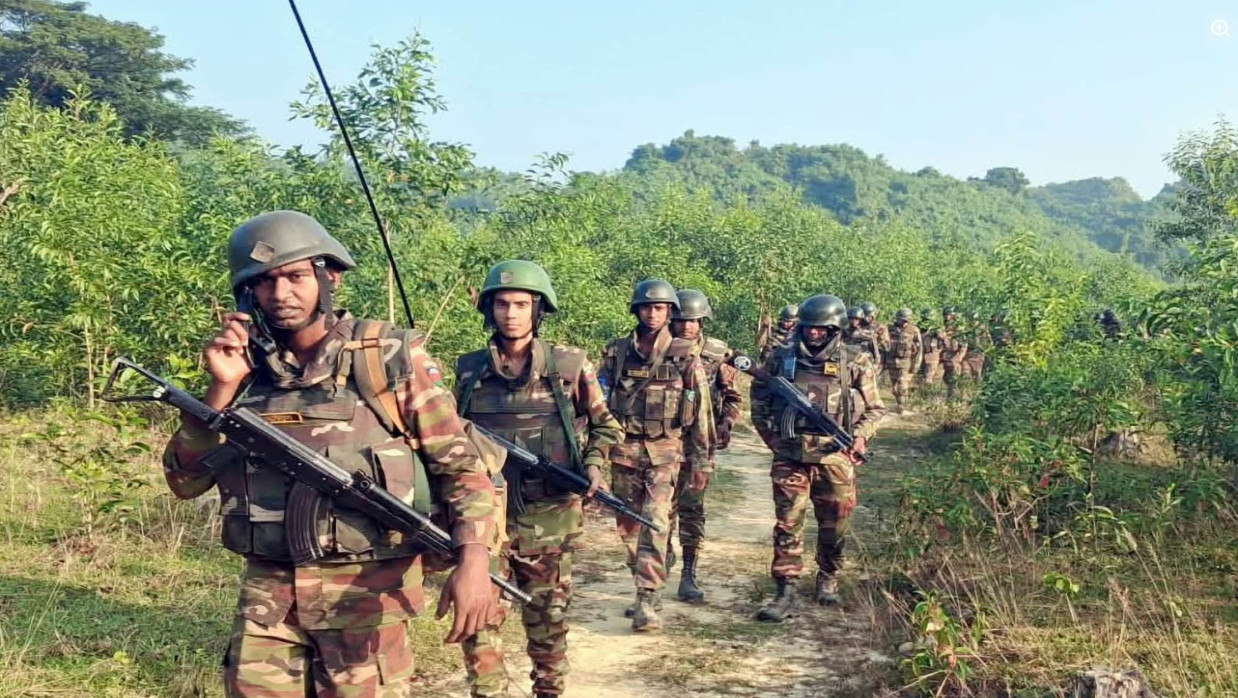
Bangladesh's armed forces have played a central role in maintaining state authority in the CHT.
Many soldiers served under exceptionally difficult conditions involving mountainous terrain, poor communications, disease, and guerrilla attacks.
Their sacrifices deserve recognition.
At the same time, the history of the conflict includes serious allegations of unlawful detention, forced displacement, excessive use of force, and other human rights violations.
These allegations cannot be ignored merely because security operations were conducted in defense of national sovereignty.
The 1997 Accord envisaged the phased withdrawal of specified temporary military installations while retaining designated permanent establishments and border-security arrangements.
Current threats, the capabilities of civilian law enforcement, and the need to protect vulnerable communities should determine the appropriate security posture.
Military deployment should not replace political governance.
Bangladesh needs capable border forces, professional intelligence services, and a credible civilian administration. It also needs institutions that can investigate abuses without political interference.
Security and justice are not competing objectives. In a region with a history of armed conflict, each is essential to the other.
A New National Strategy for Lasting Peace
Nearly three decades after the Peace Accord, Bangladesh needs a comprehensive CHT strategy that rises above party politics.
First, the government should establish a permanent, professionally staffed mechanism to monitor armed organizations, investigate cross-border security threats, and coordinate intelligence between civilian and military agencies. Its operations should remain subject to legal and parliamentary oversight.
Second, there needs to be a legitimate way to address land issues. By implementing legal procedures, we can assess traditional land-owning practices, written proof of ownership, and cases of forced relocation. People should not be able to evict others, regardless of ethnic group.
Third, representative institutions should also include some form of democracy. As long as regional and district assemblies are appointed, people will never trust them. If these offices were open to election and had proper budgets and operating procedures, we could reduce current leaders' power to control the area.
Fourth, Bangladesh should develop an economic strategy that makes peace materially beneficial to ordinary residents. Better education, medical services, roads, communications, agricultural opportunities and employment could reduce the attraction of militant organizations.
Development projects must nevertheless respect environmental constraints, legitimate land rights and the interests of local communities.
Fifth, the government should insist on effective border-security cooperation with India and Myanmar. Bangladesh must not permit its territory to be used against neighboring states, and it should expect reciprocal commitments from those governments.
Finally, the country's political parties must establish a common national position on the CHT. The region should not become an arena in which successive governments reverse one another's policies, cultivate rival armed factions, or compromise national security for short-term electoral advantage.
Conclusion: Peace Must Serve Bangladesh and All Its People
This conflict has continued to this day for many reasons. This includes a history involving multiple ethnicities, ownership of land, political groups with weapons, as well as foreign interest from nearby countries.
With India nearby and its past national security interests, we should examine why it may have wanted to destabilize the region. We cannot just assume this is true based on common knowledge about geopolitics.
As for the indigenous people, we should look into why the conflict began and why they want recognition. There are many ways to approach this.
Shantu Larma, the PCJSS, the UPDF, and other political organizations must be judged by their actions, their commitment to peaceful politics, and their accountability to the people they claim to represent.
The Bangladeshi state bears an equally substantial responsibility to provide justice, security and representative government.
No foreign power should determine the CHT's political future. No armed organization should exercise authority through intimidation. No religious institution should enjoy immunity from legitimate law enforcement, and no religious community should face collective suspicion.
Above all, Bangladesh must recognize that it cannot secure its citizens' loyalty and confidence through military strength alone.
The CHT must remain peaceful because peace serves Bangladesh's national interest and the interests of everyone who lives there, not because any political party or neighboring country finds temporary advantage in its stability.
That is the foundation upon which a lasting settlement must be built.


0 Comments
LEAVE A COMMENT
Your email address will not be published