

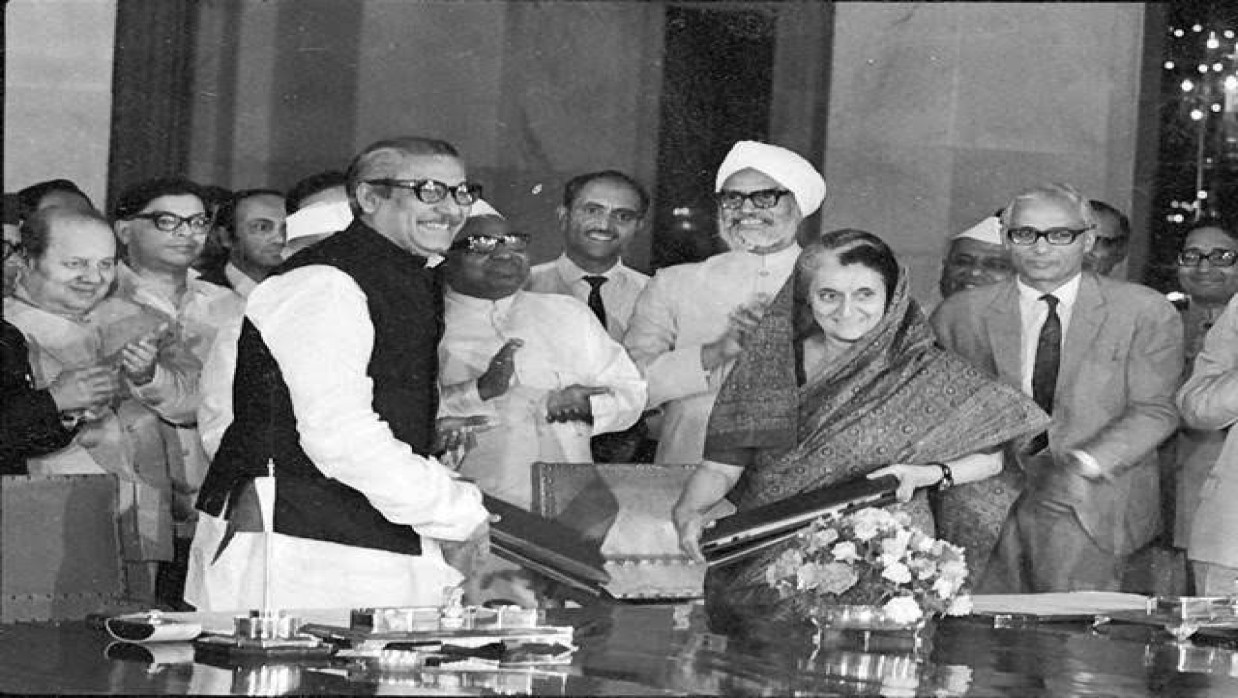
Indian Scholar Iqbal Chand Malhotra's allegations have raised new questions about Sheikh Mujib and his ties to the Indian spy agency at the time of Bangladesh's inception. Questions remain about how and why India got involved in the Agartala conspiracy case, and what its motives were, before the 1971 war.
The history of Bangladesh’s independence has been written and rewritten many times, often reflecting the political interests of those telling the story. For more than half a century, Sheikh Mujibur Rahman has occupied a central position in that narrative as the leader who guided the Bengali people toward independence from Pakistan. Yet an interview attributed to Indian author and historical researcher Iqbal Chand Malhotra has reopened a sensitive chapter of that history: the possibility that Mujib’s relationship with Indian intelligence began as early as 1961, long before the dramatic events of 1971.
Malhotra alleged that Sheikh Mujibur Rahman was an agent of the Indian IB since 1961 and India helped him in his political endeavors. He connected it to the Agartala Conspiracy case in 1968, where Pakistan alleged Mujib and various military and civilians of Bengali ethnicity were in collusion with India to create a breakaway East Pakistan.
This would be a major allegation if credible documents supported it. It could shed light on the politics and espionage going on before Bangladesh's independence. There is a difference between having contact with Indians politically, getting aid from them, and being an agent for them. All we know for sure is the first one.
The Secret Contacts Before 1971
The possibility of early contact between Mujib and Indian officials is not entirely new. Indian diplomat Sashanka S. Banerjee provided a revealing account in an article published by the London School of Economics' South Asia blog in February 2021. Banerjee described a secret meeting with Sheikh Mujibur Rahman during the night of December 24–25, 1962.
According to Banerjee, Mujib was accompanied by Tofazzal Hossain Manik Miah, the influential editor of The Ittefaq. The meeting reportedly lasted several hours and concerned the possibility of Indian assistance for an eventual struggle to establish an independent Bangladesh.
Banerjee also recalled that Mujib gave him a letter to then-Indian Prime Minister Nehru. To help in the liberation movement. This leads one to believe Mujib was thinking about breaking away from Pakistan years before his Six-Point Program in 1966.
Something to ponder on. Was Mujib seeking help from India of his own accord, because he thought he could no longer achieve his goals in Pakistan constitutionally? Or did India already have him on their intelligence roll, as Malhotra claims?
Of course, if you're a political figure looking for assistance from another country, it doesn't make you a spy. But it shows that the crossing of borders took place much earlier than what most believe, which was in 1971.
The Agartala Conspiracy Case Reconsidered
Another key element in the story was the Agartala Conspiracy Case. In January of 1968, the Pakistani government claimed that Sheikh Mujib was a part of a conspiracy with Bengali soldiers, civil servants, and Indians.
It was claimed by the prosecution that the accused were attempting to take East Pakistan from the country with the help of India. This was said to have taken place in Agartala, which is the capital of Tripura in India.
Mujib had been under arrest since May 1966. The conspiracy trial started in June of 1968 and grew to include 35 accused. Many protests erupted across East Pakistan after this case. Most Bengalis felt the trial was a way to silence calls for greater political and economic freedom.
The mass uprising of 1969 forced the Pakistani government to withdraw the case, and Mujib emerged with greatly enhanced political stature.
For decades, the Agartala proceedings have frequently been described as a politically motivated prosecution designed to discredit Bengali nationalism. That interpretation has substantial historical grounding, particularly given allegations of coercion against prosecution witnesses and the trial's political circumstances.
But with previous secret meetings with India, we can't say that there was never any conversation about separation. This alone does not prove that what the prosecution claims is true or that the defendants did what they are accused of.
Malhotra wants us to look at the evidence we have on hand and not automatically believe what Pakistan initially claimed or what later politicians claimed.
India’s Strategic Interests in East Pakistan
It should come as no surprise that India was taking an interest in East Pakistan. While it may have involved intelligence activities, India's interest wasn't limited to that. Since partition, there has always been some kind of dispute or hostility between India and Pakistan.
Because East Pakistan was separated from West Pakistan, India could take advantage of the situation. If India could gain control of an independent East Bengal, it would have many benefits. This would mean less military force bordering its eastern side and a possible ally in the region.
Indian policymakers would have recognized these considerations well before 1971. However, strategic interest alone does not prove that India designed or controlled the Bengali nationalist movement.
Powerful domestic reasons also drove Bengali dissatisfaction with Pakistan. Economic disparities, unequal political representation, the language controversy, military domination, and the concentration of administrative authority in West Pakistan had generated widespread resentment.
The Language Movement of 1952, the political developments around the United Front victory in 1954, and subsequent demands for provincial autonomy showed that Bengali nationalism had deep indigenous roots.
Consequently, any suggestion that Bangladesh's independence was simply an Indian intelligence project would disregard the political aspirations and sacrifices of millions of Bengalis.
India may have recognized and supported a developing nationalist movement without having created it.
Was Indian Assistance Extended to Mujib's Electoral Politics?
One of Malhotra's more controversial allegations concerns Indian assistance to Mujib's electoral activities. This claim deserves particular attention because political support and electoral financing represent different levels of foreign involvement.
By the end of the 1960s, the Awami League was becoming the main voice for the Bengali people. When they won in Pakistan's general elections in December 1970, they became the biggest party in parliament, and therefore Mujib should have been allowed to take over the country.
Did India help fund or aid the Awami League in any way during this time? Yes, we can ask that question, but how would you know if they helped them win? Did they give money? Did any intelligence information state that? Maybe even someone who could testify.
None of the recent reports examined establish the existence of such records.
This distinction matters because the Awami League's electoral success can also be explained by the widespread popularity of its Six-Point Program and growing public opposition to Pakistan's centralized political system.
Foreign assistance, even if later documented, would not automatically invalidate the electoral preferences of millions of East Pakistani voters.
Intelligence Cooperation or Political Dependence?
The most sensitive aspect of Malhotra's allegations is the suggestion that Mujib was an Indian intelligence asset.
In intelligence terminology, recruitment ordinarily implies a relationship involving direction, assigned responsibilities, reporting, or some form of operational control. Maintaining secret contact with foreign officials alone does not satisfy that definition.
This distinction becomes particularly important when examining Mujib's conduct after independence.
In January 1972, according to Banerjee's published recollections, Mujib requested the early withdrawal of Indian military forces from Bangladesh. India subsequently withdrew its troops by March 1972.
This is evident in this incident. While Mujib had to rely on India for freedom, the newly formed government also wanted to show its independence from India.
In this account, Banerjee says Bangladesh would have a parliamentary system. He states that Indian officials wanted to steer Bangladesh towards this decision, but one can only assume how much power they had.
The Need to Revisit the Historical Archives
This should open up further research on the subject. Not create another nationalist argument. Many questions need to be asked. What did the intel show about Mujib's recruitment in 1961? Where did the letter said to have been sent to Nehru in Dec. 1962 go? Did Indian officials ever pay money to Bengali groups? What did the Pakistanis know that led them to start the Agartala case?
British and American diplomatic archives may also contain valuable assessments of Indian activities in East Pakistan during the 1960s.
Another important institutional detail is worth noting. India's Research and Analysis Wing, commonly known as RAW, was established in 1968. Therefore, any intelligence recruitment occurring in 1961 would have involved the Intelligence Bureau or another existing institution, not RAW.
The available November 2026 reporting does not establish Malhotra's allegations as historical fact. Indeed, one Bangladeshi examination noted the lack of direct documentary evidence and the difficulty of independently verifying the original remarks.
History Must Be Examined Beyond Political Loyalties
Bangladesh was born out of a political and economic struggle for many years until March 1971, when the military took over and massacred Bengalis. We cannot ignore those facts because someone claims Indian intelligence had something to do with it.
However, just because we accept that Bengali nationalism was valid does not mean we should shy away from looking into any covert operations that may have occurred.
Mujib was a Bengali nationalist; he was also a politician living in a time when other countries influenced politics worldwide. So yes, we need to look into whether he dealt with Indian intelligence, but in the context of those times.
The question has been brought up again after Malhotra's interview. This is not about discrediting Mujib or clearing him of suspicion, but about finding the truth.
Bangladesh's history should belong to Bangladeshi and no political party or country should claim ownership over it. Secret diplomacy took place during Bangladesh's struggle for freedom. Only more research can confirm whether Malhotra made a discovery or just added fuel to an already arguable topic.


0 Comments
LEAVE A COMMENT
Your email address will not be published