
A Review of Habib Siddiqui’s Us and Them: State Power and Minority Lives in India and Bangladesh
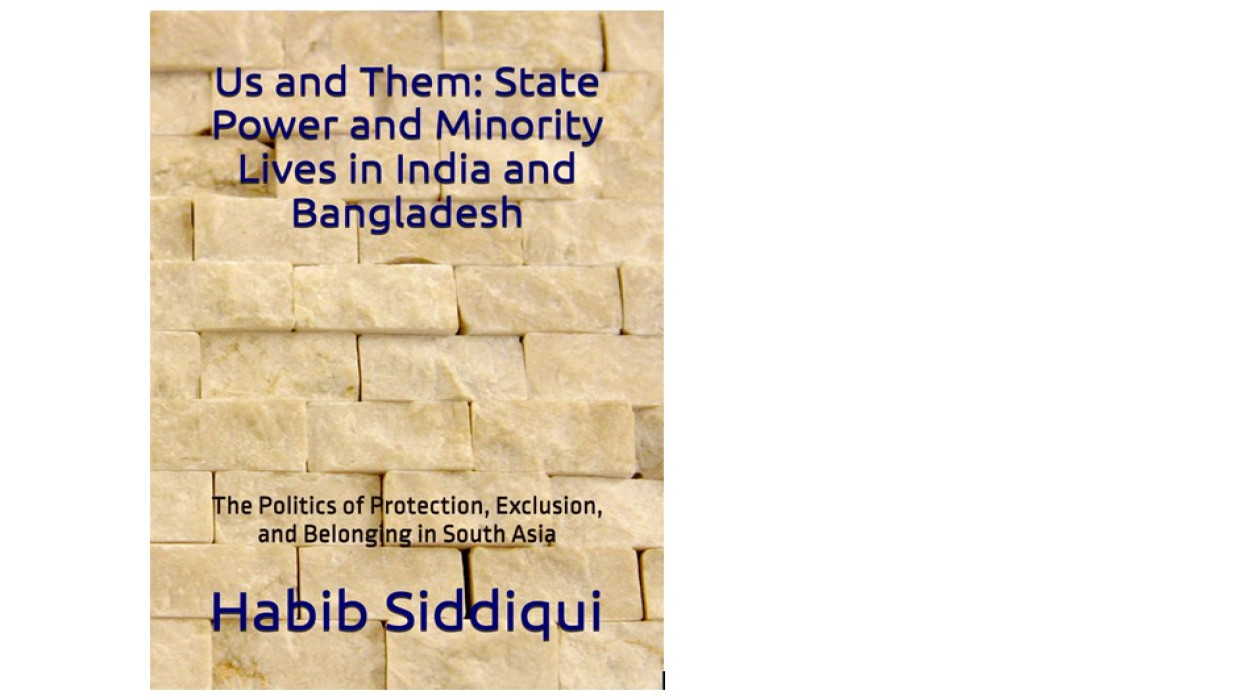
Book: Us and Them: State Power and Minority Lives in India and Bangladesh: The Politics of Protection, Exclusion, and Belonging in South Asia
Author: Dr. Habib Siddiqui
Publication Date: June 16, 2026
Length: 211 pages
ISBN-13: 979-8181790490
One of the hottest debated topics when it comes to politics in South Asia is that of religious minorities. In his book Us and Them: State Power and Minority Lives in India and Bangladesh, Dr. Habib Siddiqui looks at how both India and Bangladesh handle their religious minorities. As you can see, both countries were once under British rule and had to deal with the aftermath of partition in 1947. Siddiqui argues that it isn't the hatred towards other religions that affects the well-being of minorities but rather the actions of their state.
He mainly focuses on the Hindu population in Bangladesh and the Muslim population in India. These are the two groups affected by migration, war, population growth, and how people view each country as a nation. He argues that although Bangladesh has a smaller Hindu population, Hindus have maintained a strong financial presence and access to jobs within the country. Meanwhile, India's Muslim population has grown to be much larger than Bangladesh's Hindus and is facing discrimination, a small proportionate representation in the economy, and does not feel safe in their own country.
The book revolves around this proposition. Siddiqui goes on to state that communalism does not always arise from religion but can also be due to governments. Whether minority citizens can feel secure as equal citizens depends on law enforcement, the courts, politics, and even the decisions made by those in office. Siddiqui also discusses how a country's history has shaped relations between its communities. From Colonial times in Bengal to the partition of British India, migration and politics have shaped Bangladesh's current state. There has always been some level of insecurity about who you are as a person and your rights to property and citizenship. Siddiqui argues that we cannot separate these issues from how a state was created and gained legitimacy.
The book's discussion of modern-day India is especially important. He discusses interreligious riots and citizenship laws that affect certain religions. Police discrimination against minorities, the tearing down of houses, living in segregated areas, and the rise of majoritarianism. He states that institutions can help promote communalism and separate people from each other, although they have constitutional rights of all religions being equal. He warns that these rights can decline if the incentive becomes separating different religions.
Siddiqui has many positives to say about Bangladesh. He states that Hindus still run businesses, schools, governmental jobs, and work in society. This could be taken with caution because Bangladesh has suffered many communal riots, and Hindus have had their property stolen, threatened, and at times stripped of their rights. Because some Hindus in Bangladesh are higher up in society, we cannot assume that they are safe as a whole. More factors come into play when comparing these two countries. For example, whether a country allows all religions and what jobs people hold.
One of this book's biggest challenges is analyzing this topic. When factors like population size, government structure, migration history, and economic status come into play, comparing the two countries can be difficult. Siddiqui likely argues that governments can help or harm vulnerable populations in many ways.
As mentioned earlier, Siddiqui draws on personal experiences related to this topic. Since he grew up in East Pakistan and went to school in North America, he has seen what it is like to be a minority in other countries. He has also advocated for people being persecuted around the world. Such as the Rohingya people of Burma.
Because the author claims to have used demographic statistics, history, court documents, human rights reports, and seven annexures, this reads as a more data-driven analysis. However, we should read the book's bold comparisons with caution, as governments and human rights groups can interpret statistics politically.
Us and Them tackle a subject that goes beyond India and Bangladesh. Can democracies rise above majoritarianism and provide equal citizenship to all their citizens, no matter what religion they practice? This book allows us to think about these issues at an institutional level rather than stereotype communities.
A must-read for anyone who follows South Asian politics, be it policymakers, academics, or general readers. Siddiqui has added to this discussion that needs to happen more often. Ultimately, a country's democracy should be judged by how it treats minorities.


0 Comments
LEAVE A COMMENT
Your email address will not be published