

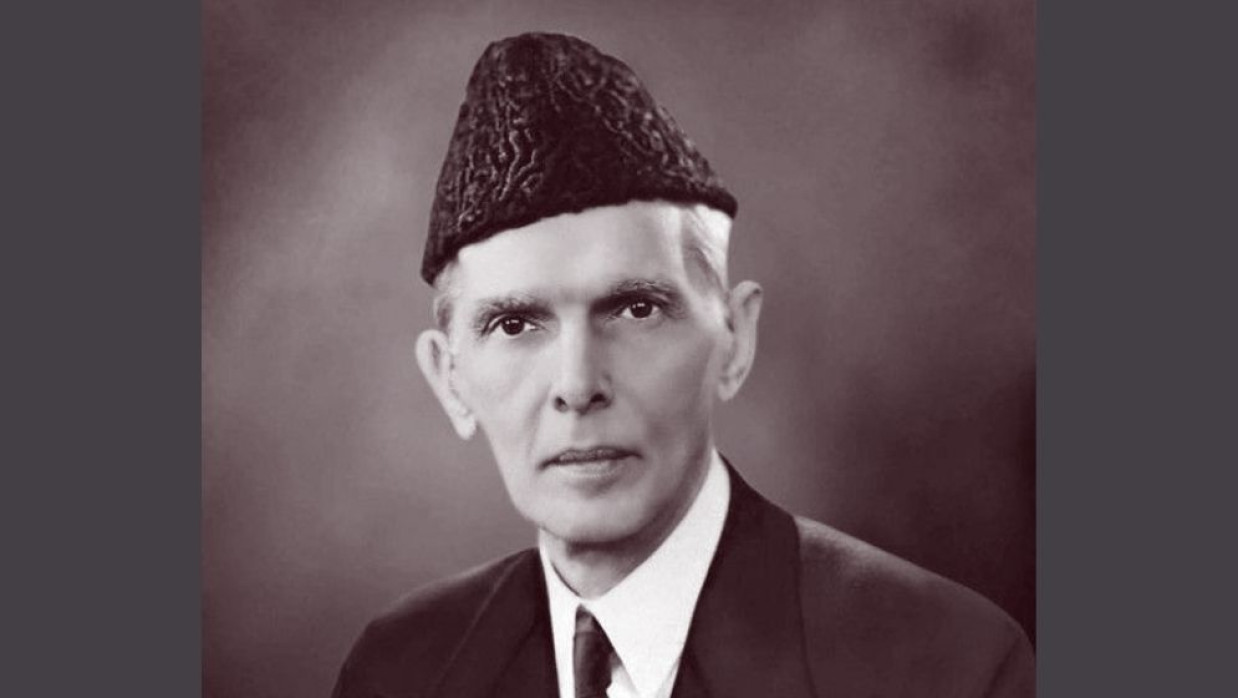
A photograph of Muhammad Ali Jinnah should not be powerful enough to destabilize a nation. Yet in Bangladesh today, an image of a man who died in 1948 has reopened arguments about 1947, 1952, 1971, India, Pakistan, Bengali nationalism, Islam, the Awami League, and the meaning of Bangladesh itself.
It began when the Dhaka University Central Students' Union renovated its museum and added pictures of Jinnah. The pictures showed his visit to Dhaka in March 1948, when he stated that Urdu should be the national language of Pakistan. One student, Abu Tayeb Habiladar, tore off the pictures of Jinnah, saying he should not be glorified or placed in such positions for declaring only Urdu as our language. Abu Tayeb was not identified as belonging to a political party or student-party organization when he tore down Jinnah’s photographs. The most specific reporting says that he contested the 2025 DUCSU vice-president election as an independent candidate. He was a Dhaka University Urdu Department student from the 2001–02 session and received only 10 votes in that VP election.
It then grew beyond the museum when Chhatra Dal, a wing of BNP that is currently in power, said they also did not approve. When asked about the situation, DUCSU stated that this is history and that they were not trying to glorify him.
That distinction is fundamental. A museum is not a shrine.
Displaying Winston Churchill does not require endorsing British colonialism. Displaying Hitler in a European museum does not celebrate Nazism. A museum devoted to the history of Dhaka University cannot reasonably tell that history while eliminating every individual whose actions subsequent generations condemn. Jinnah came to Dhaka, addressed its people and its university, and made statements about language that became enormously consequential. That alone makes him part of the institution's history.
Removing him would take away from the Language Movement's story. If we remove these leaders, how will Bangladeshi's know why they stood up against Pakistan's rule over our language?
The real question, therefore, is not whether Jinnah should appear in Bangladesh’s historical record. He unquestionably belongs there. The question is how he should appear.
For half a century, Bangladesh's political history has frequently been narrated as though everything meaningful began with the Language Movement, advanced through the Six-Point Movement and mass uprising, and culminated inevitably in the Liberation War of 1971. Those events are indispensable to the national story. But Bangladesh did not materialize historically in 1971. Before Bangladesh came East Pakistan; before East Pakistan came British Bengal; and Bengali Muslims themselves played an enormous role in the political movement that produced Pakistan.
The Lahore Resolution of 1940 was, after all, moved by A.K. Fazlul Huq, one of Bengal's towering Muslim political leaders. The Muslim League developed an enormous Bengali Muslim constituency. Huseyn Shaheed Suhrawardy, Khawaja Nazimuddin, Abul Hashim and numerous other Bengali leaders participated in the politics surrounding Pakistan. Millions of ordinary Bengali Muslims supported Pakistan because they believed it offered political and economic security in a post-colonial subcontinent.
One may conclude that Pakistan ultimately failed those expectations. That does not mean the expectations never existed.
This is precisely why the argument over Jinnah is larger than one photograph. It concerns where Bangladesh chooses to begin its national biography. Is 1971 the beginning of Bangladesh's history, or the culmination of a much longer political evolution?
1947 and 1971 can both fit in the same history.
Jinnah himself also resists the convenient caricatures imposed upon him. He was neither the uncomplicated secular hero some admirers imagined nor merely the anti-Bengali villain of later nationalist memory. His political career evolved dramatically. He had once been associated with Hindu-Muslim cooperation and constitutional politics before becoming Pakistan's principal advocate. The historical debate over responsibility for Partition remains considerably more complicated than the proposition that one man divided India.
An extraordinary illustration came not from Pakistan but from senior Indian politician Jaswant Singh. His 2009 book Jinnah: India Partition Independence challenged India's conventional interpretation by arguing that responsibility for Partition could not rest solely with Jinnah. Singh controversially argued that Jawaharlal Nehru's preference for a strongly centralized India contributed to the political breakdown that culminated in Partition. The consequences were remarkable: Singh was expelled from the BJP, while Gujarat's BJP government initially banned the book.
That episode should interest Bangladeshis for reasons extending beyond Jinnah. It demonstrates how national histories become politically guarded territory. Once a historical interpretation becomes connected with national legitimacy, questioning it can be treated almost as political disloyalty.
Bangladesh must avoid that trap.
Jinnah's language policy deserves particular scrutiny. During his 1948 visit, he insisted that Urdu should be Pakistan's state language. Yet the materials supplied for this essay also correctly highlight a distinction often lost in political retellings: Jinnah acknowledged that the people and elected representatives of East Bengal could determine their province's language.
That distinction does not make his Urdu-only position at the federal level politically wise. With Bengali spoken by the majority of Pakistan's population, refusing Bengali equal national recognition proved profoundly damaging. Whatever Jinnah's motivation national cohesion, fear of provincialism, administrative convenience, or concern over external interference the policy underestimated language's emotional and political power.
History supplied the verdict. The Language Movement became one of the foundations upon which Bengali political consciousness developed.
But acknowledging Jinnah's error does not require deleting Jinnah from history. Quite the opposite: his error is one reason he belongs in the museum.
Bangladesh should not write a different version of myths either. Writing a mythological history against that of the Awami League would only lead to another false history being constructed where Pakistan was good, Jinnah was great, and what led to 1971 never happened.
There were many wrongs done by the Pakistani leadership to their eastern province. Whether it be unequal distribution of political power, the economy, lack of autonomy for Bengalis, failure to accept the results of 1970, and lastly the genocide in 1971. We can't pretend these didn't happen when writing about Bangladesh's birth.
Mujib was and should continue to be recognized as an important figure in Bangladeshi history. Just because his daughter has taken on more tyrannical tendencies does not mean we can write him out of our history. He belongs to Bangladesh, not the Awami League. The same way we cannot write Zia off as just a BNP leader or say Jinnah belongs to Pakistan or the Jamaat.
When discussing this topic, we need to consider Bangladesh's current politics. Rumors suggest former Awami League members in certain organizations are trying to overthrow BNP rule. There is also strong suspicion that India is involved. There may be some truth to these things, but until proven, they should not be portrayed as fact. We create another false narrative if we keep suspecting everything around us.
The weakness of institutions presents a more serious problem than the identity of any photograph hanging in a museum. Bangladesh inherited a bureaucracy, police establishment, judiciary, and security structure that spent many years operating within an intensely politicized environment. Reforming those institutions is essential. But reform must mean restoring professional neutrality rather than conducting another partisan purge and filling vacancies with loyalists of the new government.
If every incoming government replaces one political bureaucracy with another, Bangladesh will never possess a state independent of the party controlling it.
India likewise occupies an unavoidable place in this debate. Bangladesh should neither deny India's decisive military role in 1971 nor pretend that Indian governments have never pursued their own strategic interests in Bangladesh. States act according to interests. Bangladesh's answer should not be permanent hostility toward India any more than permanent dependence upon it. A sovereign Bangladesh should be able to maintain productive relations with India, Pakistan, China, the United States, and others without allowing any of them to dictate its historical identity or domestic politics.
Perhaps that is the deeper meaning of the Jinnah photograph controversy.
Bangladesh is trying to decide whether history belongs to the state, to political parties, or to the people.
The correct answer should be the people.
With the recent issues at the DUCSU museum, we have already seen this happen. The university took issue with some of what was displayed, and students came forward to protest, and DUCSU felt that it should be left there because of its history. There can be an argument about these things, but when photos are brought out, they should be paired with books and information as well. Not destruction.
Let Jinnah's photograph remain, but place the full story beside it. Show his contribution to creating Pakistan. Explain Bengal's enormous contribution to the Pakistan movement. Display the Lahore Resolution. Include Fazlul Huq and Suhrawardy. Then display Jinnah's Urdu declaration. Beside it, place Dhirendranath Datta's demand for Bengali, the Language Movement, Salam, Barkat, Rafiq and Jabbar, the Six Points, the 1970 election, the military crackdown, the Liberation War and the emergence of Bangladesh.
Do not remove inconvenient history. Surround it with more history.
Bangladesh is mature enough to acknowledge that Jinnah contributed to creating Pakistan, that Bengali Muslims helped create Pakistan, that Pakistan subsequently failed catastrophically to accommodate Bengali political aspirations, and that Bangladesh emerged from both experiences.
Recognizing all four truths is not contradictory.
A confident nation does not fear photographs. It does not need to smash portraits, rewrite museums whenever governments change, or transform historians into political combatants. It looks directly at its past, including the parts that hurt.
The photograph of Muhammad Ali Jinnah should therefore remain neither an object of worship nor an object of hatred. It should become what it actually is: a historical document.
Bangladesh's greater challenge is to build a political culture that can look at that document without tearing either the photograph or the country apart.


0 Comments
LEAVE A COMMENT
Your email address will not be published