

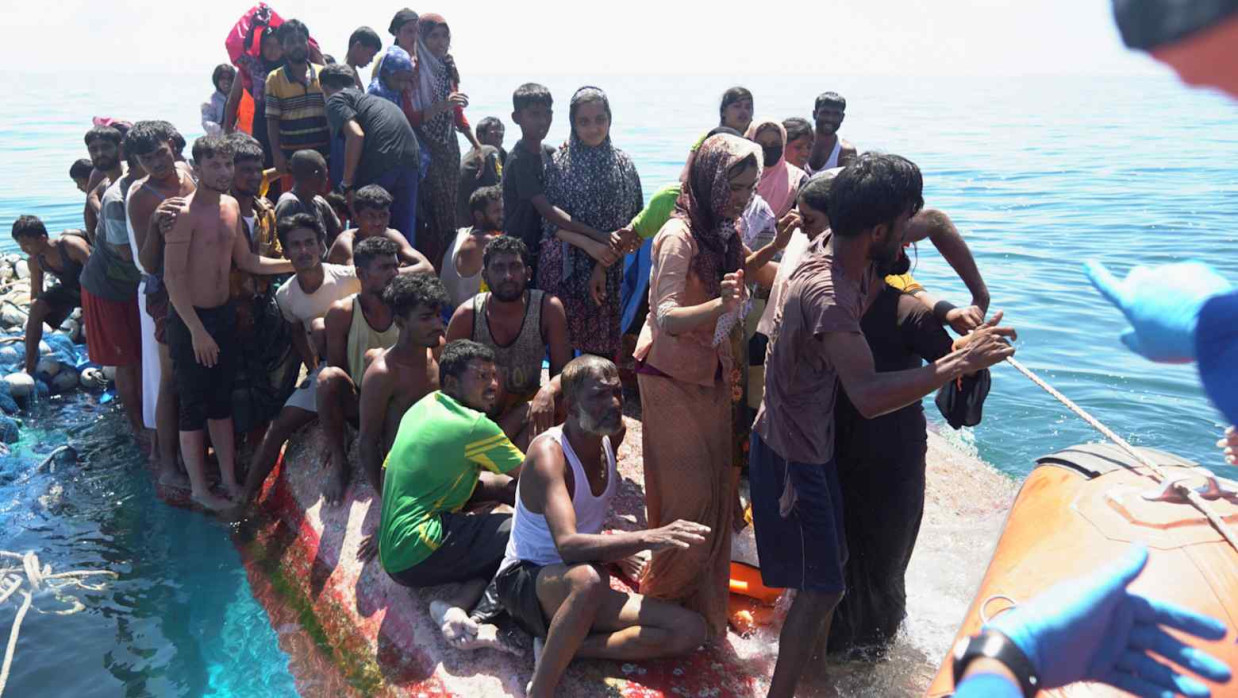
The Rohingya crisis has entered a dangerous new phase. Nearly nine years after the mass expulsion of 2017, Bangladesh continues to shelter approximately one million Rohingya, while further arrivals have added to the pressure on Cox’s Bazar and surrounding communities. Humanitarian funding is declining, insecurity inside the camps is increasing, and conditions in Myanmar remain wholly unsuitable for safe, voluntary and dignified repatriation. The United Nations warns that Rohingya in both Myanmar and Bangladesh face shrinking protection and diminishing prospects for a durable solution.
Bangladesh cannot resolve this crisis alone. Yet it is the country best placed to assemble the international coalition required to resolve it. Dhaka has the geography, humanitarian credibility, regional relationships, and direct security interest that no outside power can match. Its task is not simply to ask the world for assistance but to become the diplomatic architect of a settlement one that gives every major power a practical reason to support the restoration of Rohingya rights in Myanmar.
This will require a departure from conventional diplomacy. Repeating appeals for repatriation, issuing statements at international conferences and presenting lists of refugees for verification have not produced meaningful returns. Bangladesh now needs a coordinated political strategy that engages China, India, the United States, the European Union, ASEAN, Japan, Türkiye and the Muslim world around a common proposition: a stable and inclusive Rakhine State is in the economic and security interests of them all.
A Changing Rakhine Requires a New Strategy
Earlier repatriation initiatives were based on the assumption that Myanmar’s central government and military controlled northern Rakhine State and could therefore guarantee the return of the Rohingya. That assumption no longer reflects realities on the ground. The Arakan Army has gained control over most of Rakhine and the Myanmar-Bangladesh frontier, while the military retains the ability to conduct air attacks and disrupt civilian life. Rohingya communities have suffered abuses at the hands of the military, the Arakan Army, and Rohingya armed groups.
As a result, no deal struck bilaterally with Myanmar’s military leaders will ever guarantee durable returns. Dhaka should continue talking state-to-state with Myanmar. But it must also engage diplomatically, directly or through partners, with those holding de facto power in Rakhine. Engagement is not the same thing as political recognition. It is how states pursue matters of common interest, such as border security, humanitarian access, civilian protection, and conditions for return.
Bangladesh should simultaneously engage Myanmar’s democratic opposition, including the National Unity Government, ethnic political organizations, and civil-society representatives. The objective should be to establish a broad consensus that any future political order in Myanmar must restore Rohingya citizenship, freedom of movement, access to education and employment, property rights, and representation in local administration.
The Rohingya won’t be able to return safely just because Myanmar says it will accept some number of “verified” refugees. If they’re sent back without rights, it won’t be repatriation. It will be moving refugees out of camps in Bangladesh and into prisons or persecution camps in Myanmar. Citizenship and equal protection before the law therefore need to be treated as prerequisites for repatriation, not bargaining chips to be hashed out later.
Making Enemies Invest in Solutions
Humanitarian arguments are rarely enough to make great powers cooperate. They’ll come together when a settlement serves their interests, or when a lack of resolution starts threatening them. For that reason, Bangladesh needs to frame the Rohingya problem as much a trade barrier, a threat to maritime security, and a drag on investment and connectivity as a humanitarian crisis.
China has the greatest external leverage over Myanmar’s military and maintains relationships with several ethnic armed organizations. It also has major economic interests in Rakhine, including the Kyaukphyu deep-sea port and oil and gas pipelines connecting the Bay of Bengal to Yunnan. Continued war, communal hostility and displacement threaten these investments and weaken the stability of China’s western maritime corridor.
Dhaka needs to push Beijing to do more than just periodically convene failed repatriation talks. China can facilitate talks on humanitarian access, non-discrimination, and local community security guarantees in northern Rakhine. Bangladesh can incentivize regional trade initiatives that are conditioned on measurable progress on security and Rohingya rights. The message needs to be firm but hopeful: infrastructure will never reach its strategic intent if neighboring communities aren't prosperous, in place, and at peace.
India must be approached through a different lens. New Delhi views Myanmar as a gateway to Southeast Asia and has invested in the Kaladan Multi-Modal Transit Transport Project. It is also concerned about insurgency, arms trafficking, irregular migration and Chinese influence along its eastern frontier. Bangladesh should argue that permanent Rohingya exclusion will deepen precisely these dangers. A stable Rakhine would protect Indian connectivity projects, support development in India’s northeast and reduce opportunities for criminal and extremist networks.
China and India need not agree on every dimension of Myanmar’s future. Bangladesh only needs to establish a limited area of convergence: neither benefits from a chronically unstable Rakhine State. Dhaka could propose a China-India-Bangladesh working group on humanitarian access, border stability, economic reconstruction and conditions for voluntary return. Even if political rivalry prevents a formal mechanism, parallel consultations built around an identical framework could produce useful pressure.
The United States, European Union, United Kingdom, Canada and Japan each bring different tools of leverage. These governments are donors of humanitarian aid, influential voices in multilateral development banks, and champions of accountability efforts. In 2022, the United States formally declared that Myanmar’s military had perpetrated genocide and crimes against humanity against the Rohingya.
The Gambia has separately filed a lawsuit against Myanmar in the International Court of Justice for genocide. Bangladesh can urge this grouping to provide a united Western response that combines humanitarian aid, targeted sanctions/diplomatic pressure, and positive incentives for action. Targeted sanctions should target military-owned enterprises, arms dealers, and rights abusers- not broad brushstrokes that hurt Myanmar's civilian population. Simultaneously, a multiyear international package for the reconstruction of Rakhine could be created, with financial releases tied to unbiasedly measured benchmarks on freedom of movement, provision of documents, humanitarian access, and return of land.
The challenge will be balancing sticks and carrots. Sanctions can breed defensiveness; rewards without conditions can sanction discrimination. The negotiating process must make clear that democracy and economic renewal go hand in hand.
Giving ASEAN and the Muslim World Defined Responsibilities
ASEAN cannot be ignored simply because its Five-Point Consensus on Myanmar has produced limited results. Myanmar is an ASEAN member, and the organization provides a regional framework through which Indonesia, Malaysia, Thailand and other states can act without appearing to impose a Western solution.
Bangladesh needs to urge ASEAN members to form a Rakhine contact group, instead of seeing the Rohingya problem submerged into the larger Myanmar question. Muslim-majority Malaysia and Indonesia can provide political connectivity; Thailand can help with humanitarian logistics and quiet diplomacy; Singapore could provide experience in funding oversight and reconstruction. Eventually, ASEAN's humanitarian structure can help monitor return areas, though it will need greater access and autonomy than previously allowed.
Türkiye, Saudi Arabia, Qatar and the Organization of Islamic Cooperation should also be assigned concrete functions. Muslim solidarity has too often taken the form of declarations followed by inadequate implementation. The OIC has supported The Gambia’s case at the ICJ, but legal accountability must be supplemented by sustained political and financial engagement.
Türkiye has potential roles in education provision, health care and mediation. Saudi Arabia and Gulf countries could provide long-term development finance for shelter and livelihoods creation in Rakhine, provided sufficient safeguards are in place. Qatar and Oman have previous experience mediating in delicate circumstances and could provide good offices for dialogue between parties who do not yet feel able to meet openly. Malaysia and Indonesia could help strengthen regional protection mechanisms against trafficking and dangerous sea journeys.
The objective should not be to create an exclusively Muslim bloc. That would risk reinforcing Myanmar’s portrayal of the Rohingya as outsiders in a Buddhist-majority country. Muslim states should work inside a wider coalition that also includes Buddhist-majority Asian countries, Western governments and the United Nations. The central principle must be equal citizenship, not religious competition.
Rohingya Participation Without Militarization
No sustainable agreement can be reached on the Rohingya crisis without the Rohingya themselves. Bangladesh should facilitate the formation of an elected, civilian Rohingya consultative council that includes elders, women, youth, civil society leaders, teachers, religious leaders, and Rohingya living abroad. The process should be transparent and designed so that armed groups, criminal elements, or a few self-selected individuals cannot take control.
This council should advise Bangladesh and international mediators on citizenship, documentation, land restitution, education, security and return arrangements. It should also be given a meaningful role in international conferences and negotiations concerning Rakhine.
That being said, political empowerment does not equal militarization. Terror attacks, killings, and forced recruitment in the camps have already been fueled by armed groups and criminal networks. Bangladesh should not allow the camps to become safe havens for insurgents. But it should also not crack down on all Rohingya political activity. Closing civic space only invites extremism. Allowing armed groups to organize puts Bangladesh’ security at risk. Meaningful civil society leadership accountable under the rule of law is the solution.
Education is another key priority. Future generations raised without accredited schooling, livelihood training, or hope for the future will be susceptible to trafficking, radicalization, and other forms of crime. Investments in Myanmar curriculum education, language courses, computer literacy, and vocational training would benefit both eventual repatriation and rebuilding efforts. Please do not frame these initiatives as an attempt to permanently integrate Rohingya into Bangladesh. They are opportunities to invest in individuals who will one day need to help reconstruct Myanmar.
A Bangladesh-Led International Compact
Dhaka should present the international community with a detailed “Rakhine Peace, Return and Reconstruction Compact.” Instead of requesting separate and occasionally contradictory commitments from different governments, the compact would organize their contributions around one framework.
It needs to include several components: An immediate humanitarian-cessation of hostilities agreement providing aid to all of Rohingya communities in Rakhine; a monitoring presence by a mutually agreed-upon international or regional body to protect civilians; acknowledgment of Rohingya identity and a legitimate route to citizenship; return of lost land and property, or compensation; voluntary repatriation that starts with pilot returnee communities that are carefully monitored; security assurances that address forced recruitment and violence against civilians; and a multibillion-dollar reconstruction effort that supports both Rohingya and ethnic Rakhine citizens.
Nothing will be given to the Rohingya at the expense of Rakhine citizens. Any agreement must include assistance and development for that state’s deeply impoverished Buddhist majority. If deals are perceived as solely assisting the Rohingya, they will fuel further backlash and risk recreating the crisis. Infrastructure such as roads, hospitals, and schools, as well as electricity, fisheries, and job programs, should be extended to all communities. Envisioned dialectically, the package should offer rights to the Rohingya, development to the Rakhine, and stability to the region.
If there is agreement on such a roadmap, it must be enacted through quantifiable benchmarks. Refugee returns must not be rushed to check a box. Third-party monitoring should confirm conditions on the ground in prospective return areas. Rohingya refugees should be allowed safe passage to voluntarily visit and learn about conditions on the ground prior to making their decision, and upon return should have access to monitoring bodies and clear pathways for grievances. Funding should be dispersed gradually as negotiated benchmarks are met.
The special envoy could head up a permanent Rohingya Response Office in Bangladesh. It should include representatives from the foreign, home, disaster-management, defense, and finance ministries to coordinate international efforts, communicate with Rohingya leaders, release regular progress reports, and help prevent setbacks during political transitions. Effective diplomacy isn’t conducted by seasonal missions built around conferences; it requires an enduring organization.
From Frontline Host to Diplomatic Architect
Bangladesh’s traditional principle of “friendship to all, malice toward none” suits this challenge particularly well. Dhaka need not choose between China and the United States, between India and the Muslim world, or between ASEAN and the United Nations. Its comparative advantage lies precisely in its ability to speak to all of them.
But friendship with all must not mean passivity toward everyone. Bangladesh should use access to markets, ports, connectivity projects, diplomatic cooperation, and regional forums to encourage action. It should make clear that the Rohingya crisis is inseparable from the Bay of Bengal's future security and prosperity.
The Joint Response Plan for 2026 asks for US$710.5 million to provide aid to 1.6 million Rohingya refugees and people from Bangladeshi host communities. Humanitarian aid is crucial, but yearly emergency appeals are not a replacement for a political solution. The longer the refugee crisis drags on, the more acute the risks of donor fatigue, outbreaks of violence in the camps, trafficking, irregular migration, and friction with host communities. Bangladesh has shown great humanitarian leadership so far. Now it must provide strategic direction. If Dhaka can align Chinese capital with Indian infrastructure, Western political and economic leverage, ASEAN legitimacy, the goodwill of the Muslim world, and Japanese technical expertise, along with Rohingya feedback, its mediation can focus these divergent agendas toward a diplomatically brokered outcome.
Bangladesh has already shown great humanity. Now it must show strategic vision. Withholding Rohingya repatriation until their safety can be guaranteed. By harnessing Chinese investment with Indian connectivity, Western diplomatic and economic weight, ASEAN legitimacy, Muslim-world support, Japanese technical expertise, and Rohingya input itself, Dhaka can focus otherwise divergent interests around a negotiated objective.
There is no guarantee that this diplomacy will quickly overcome Myanmar’s conflict or its deeply rooted ethnic exclusion. But without such an initiative, the Rohingya will remain trapped between persecution in their homeland and permanent dependency in exile. Bangladesh must therefore cease being treated merely as the country that shelters the victims. It must become the country that designs the coalition, defines the conditions and keeps the powers at the table until a just settlement is achieved.
That is how Bangladesh can turn an unbearable national burden into an act of regional statesmanship and ensure that the Rohingya return not simply to Myanmar, but to rights, security and a homeland.


0 Comments
LEAVE A COMMENT
Your email address will not be published