

Bangladesh faces both great danger and great opportunity in constitutional reform. Bangladesh's constitutional struggle has reached a critical juncture. The people power uprising of July–August 2024, the resulting reform process, the signing of the July National Charter in October 2025, and the constitutional referendum of February 12, 2026 combined to open a unique window to restructure institutions that had grown susceptible to authoritarian capture. But now, almost seven months after the Bangladesh Nationalist Party came to power, the key constitutional amendments the electorate voted for remain unrealized, caught in a deadlock over how best to adopt them legally.
Timing matters. There was never a “July 2023 referendum” or a “July 2024 referendum”. The people’s uprising happened in July- August 2024 and toppled Sheikh Hasina’s regime on 5 August. The interim government of Professor Muhammad Yunus established six commissions on reforms related to the Constitution, elections, the judiciary, public administration, the police, and anti-corruption agencies. The National Consensus Commission worked out consensus on its recommendations and drafted the July National Charter 2025.
National Consensus Commission and most political parties engaged in the dialogue, including BNP, signed the Charter on 17 October 2025; some parties submitted reservations/dissent notes. The Charter includes more than 80 reform recommendations, with almost half addressing the Constitution. Proposed reforms include a bicameral Parliament; limiting the prime minister's power and tenure; judicial independence; stronger parliamentary checks on the executive branch; reforms to the caretaker government system; expanding fundamental rights; and protecting against authoritarian aggrandizement of executive power.
Through the July National Charter (Constitutional Reform) Implementation Order issued on November 13, 2025, members elected at the upcoming parliamentary election were to also form a Constitution Reform Council immediately after their first session. The council was tasked with completing the reforms mandated by the order within 180 working days of formation. The package was put to referendum alongside that year's parliamentary election on February 12, 2026. According to the revised official results, about 68.8 percent of participating voters voted for the reforms.
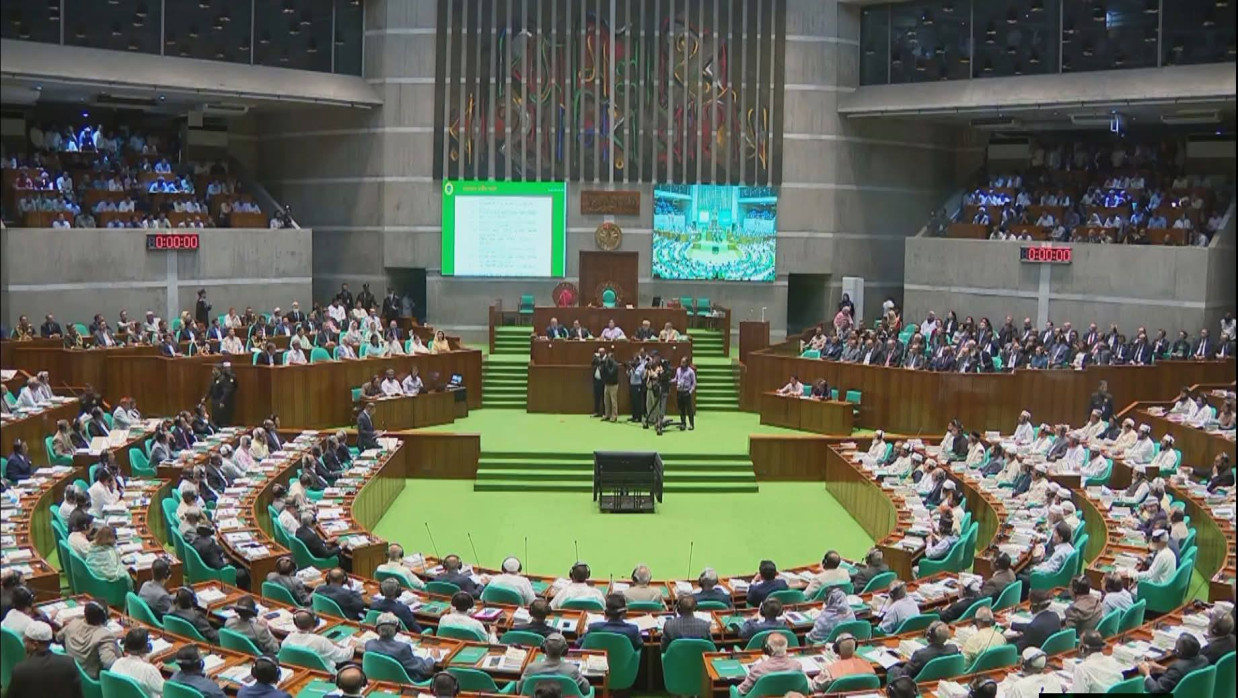
The referendum therefore produced a substantial political mandate, but it did not settle the central legal dispute. The BNP, which won a commanding parliamentary majority and formed a government under Prime Minister Tarique Rahman on February 17, maintains that constitutional change must proceed through Parliament under the procedures prescribed by the existing Constitution. BNP members consequently took their oaths as members of Parliament but declined to take the additional oath contemplated for members of the Constitution Reform Council. Jamaat-e-Islami, the National Citizen Party and some allied opposition representatives took both oaths and have demanded that the council be convened in accordance with the referendum.
Neither side will easily give way in this conflict. It cannot be reduced to political egomania either – partisan interests are clearly at play on all sides. The BNP position is that executive order from an unelected interim government cannot establish a body to make a new constitution nor can it legally bind a future Parliament; opponents claim that by signing the Charter, campaigning for a “Yes” vote and taking seats within the approved body, the BNP is politically and morally bound to accept the people's choice. Parliament has debated the issue, but no consensus has been reached, and attempts to appoint a special parliamentary committee have failed to resolve the deadlock.
Bangladesh's basic-structure doctrine is at the heart of this dispute. The Supreme Court said that Parliament cannot amend any part of the Constitution that forms its basic structure in Anwar Hossain Chowdhury v. Bangladesh (the Eighth Amendment case), decided in 1989. If it did destroy or alter the fundamental framework of the Constitution or its essential features, the amendment shall be void. Essential features include constitutional supremacy, democracy, the republic's unitary character, judicial independence, and separation of powers.
The basic-structure doctrine ensures that elected majorities cannot amend the Constitution to kill constitutional government. History is one reason this doctrine became necessary in Bangladesh. Whenever there was a need to centralize power, reduce institutional checks, or influence voting results, major constitutional shifts followed.
Nevertheless, it is too categorical to claim that the Supreme Court has ruled that all fundamental reform necessarily requires a constituent assembly. The Court has limited Parliament’s amendment power, but Bangladesh’s Constitution does not provide a clearly defined procedure for convening a constituent assembly or replacing the Constitution altogether. Nor is it certain that calling an elected Parliament a “Constitution Reform Council” automatically gives it unlimited constituent authority. A new constitution created outside the existing amendment procedure might claim revolutionary or popular legitimacy, but it could still face questions about its legal foundation, inclusiveness and democratic authorization.
The referendum makes things even more complicated. It provides immense democratic legitimacy to the reform project but puts a large bundle of proposals before voters and gives them one choice: either vote "Yes" or vote "No" on the entire package. Different parts of the reforms had different levels of political consensus. Moreover, parties had negotiated clear disagreements on several provisions. Questions have also been raised about the legality of the Implementation Order and referendum process itself. None of these issues invalidates the democratic mandate that the public has given, but they do highlight the importance of proceeding in a manner that is both transparent and constitutionally defensible.
Bangladesh must therefore avoid two dangerous extremes. The first is to treat the 1972 Constitution as untouchable regardless of how political experience has exposed its weaknesses. Although the Constitution emerged from the ideals of the Liberation War, it has subsequently undergone numerous amendments, suspensions and judicial interventions. Respect for its history should not prevent reforms necessary to protect democracy, human dignity and accountable government.
At the opposite extreme lies the belief that the revolutionary moment created by the uprising confers an unrestricted mandate to reconstruct the state. Any new constitutional settlement must derive legitimacy not only from the moral authority of the 2024 uprising but also from broad public participation, legal certainty, protection of minority rights, durable democratic institutions, and political support extending beyond a single electoral cycle. Otherwise, measures intended to prevent renewed authoritarianism could themselves create new avenues for arbitrary rule.
The principal responsibility for breaking the deadlock now rests with the BNP government. Its parliamentary majority gives it both the institutional capacity and the democratic responsibility to initiate a credible implementation process. At a minimum, the government should publish a timetable identifying which Charter provisions it accepts, which require further negotiation, and the legal procedures through which each reform will be enacted. Opposition parties should participate constructively through parliamentary committees and sustained constitutional dialogue. Women, ethnic and religious minorities, smaller parties, civil society organizations, young people, and families affected by political violence and repression must also be meaningfully represented.
We cannot honor the memory of those who gave their lives in the 2024 uprising by hastily adding some celebratory text to the Constitution. We can only honor them by building safeguards into our institutions that end enforced disappearances, politically motivated prosecutions and arrests, stolen elections, impunity, and unchecked power. The longer we avoid making these reforms, the easier it will become to revert to familiar bad habits.
Bangladesh faces no simple choice between preserving and discarding the 1972 Constitution. Its deeper challenge is to reconcile constitutional continuity with democratic transformation. The July Charter and the 2026 referendum expressed a powerful public demand for change, but they did not eliminate the need for a lawful, participatory, and consensus-oriented reform process. If the government and opposition can translate that mandate into a credible constitutional settlement, Bangladesh may emerge with stronger institutions and more durable safeguards against authoritarianism. If they fail, the promise of July will fade, and public frustration may increasingly seek expression outside Parliament.


0 Comments
LEAVE A COMMENT
Your email address will not be published