

A Regime Loses Control
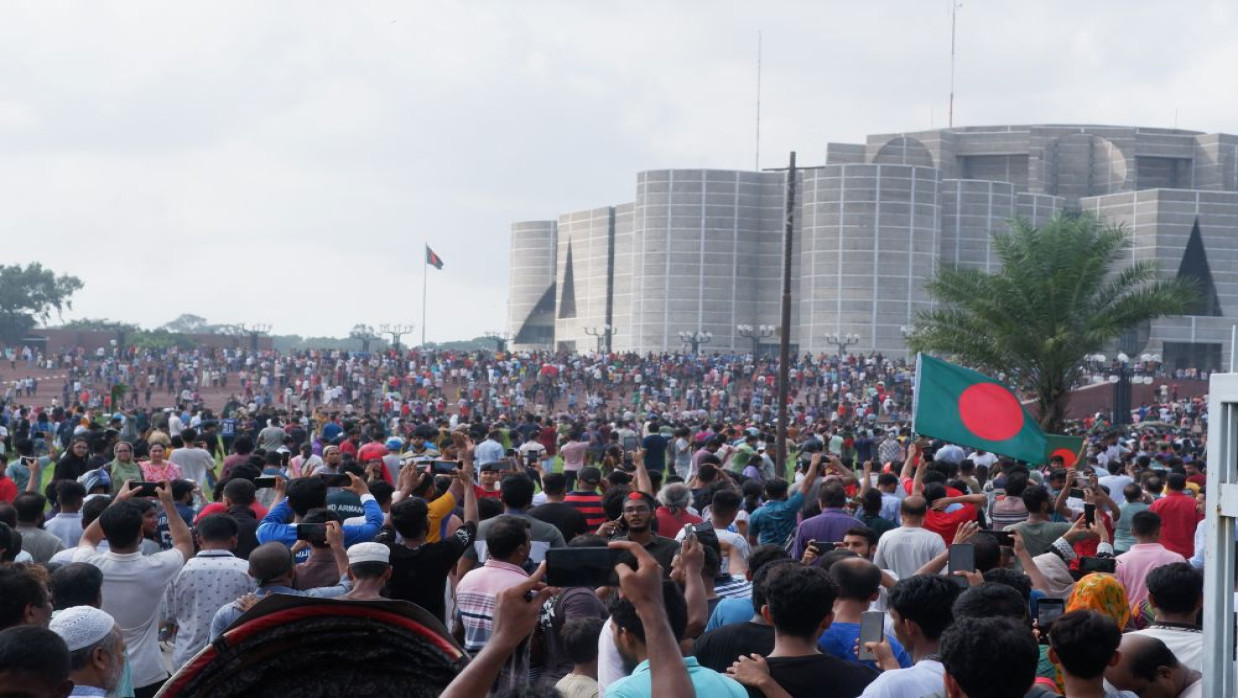
The last nail in the coffin of Sheikh Hasina’s regime was not hammered in one fell swoop. Played out over a lightning succession of high-drama political blunders, popular agitation and protests, violent street battles, top military-level meetings, and shadowy backroom diplomacy during August 1-5, 2024, the writing had been on the wall since mid-July, when a student-led protest movement over government job quotas morphed into calls for Prime Minister Sheikh Hasina to step down.
Addressing tens of thousands of supporters at the Central Shaheed Minar on August 3, Students Against Discrimination leaders put forward their "one-point demand": Sheikh Hasina and her government should step down. Psychologically, it was a knockout punch. Overnight, it changed a reform campaign into a revolt against the political system Hasina had built up over fifteen unbroken years in office.
By this point, the government’s efforts at coercion were backfiring. Curfews, internet blackouts, arrests and deadly force hadn't quelled the uprising. The killing of protesters, especially young students, had broadened support and transformed a small movement into a nationwide rebellion.
A later UN report stated that they had reasonable grounds to believe that senior officials from the deposed government, members of security forces and violent elements of the Awami League movement had committed serious human-rights violations to crush dissent. They estimate that up to 1,400 people may have died between July 1 and August 15, 20{22}, with many more injured. This was said to be part of a concerted effort to cling to power amidst widespread discontent. United Nations Human Rights Office of High Commissioner
The political question, therefore, is not simply why Hasina left. This is why the government continued to send its supporters and security personnel into confrontation, even as its senior leadership may already have been preparing for defeat.
The Leadership Escapes, the Cadres Remain
Sheikh's family member Sheikh Fazle Noor Taposh (mayor of Dhaka South City Corporation) was reportedly among several other family members and high-profile Awami League personalities who left Bangladesh in phases when the crisis grew.
One would have to check each report separately. But the general trend is undeniable: high-ups with government connections managed to flee Bangladesh (seeking safety in the cantonment or going underground), while mid- and low-level leaders and activists faced the wrath of the people.
Hasina was also accused of smuggling bundles of foreign currency, gems and secret documents when she left office. An independently published and verified inventory has yet to corroborate these allegations. As such, they should not be reiterated as fact. However, their continued propagation reflects the level of mistrust citizens have in a government accused of corruption, of capitalizing on the country, and of politicizing state agencies.
The more serious charge involves Awami League orders reportedly given on August 4. Although the government's prospects were rapidly fading, party loyalists were sent to face protesters. Fighting erupted in various regions, and August 4 became one of the bloodiest days of the uprising. Reuters
Had senior leaders believed an exit-negotiated deal was inevitable, sending in party foot soldiers would have been particularly reprehensible. Yes, a political party can demand loyalty from its membership. But honest leadership does not use regular members as fodder to protect the interests of those best positioned to bail themselves out.
That gap between elitist survival tactics and mass sacrifice facilitated Awami League's organizational breakdown after August 5. Grassroots activists found that while the party’s leadership could mobilize them for resistance, it could do little to shield them when the state's coercive powers stopped working for the party.
Major General Akbar’s Account
Retired Major General Fazle Elahi Akbar has provided one of the most detailed personal accounts of the military-political negotiations during the final hours of Hasina’s rule. Akbar, a former security adviser to Bangladesh Nationalist Party chairperson Khaleda Zia, said he was contacted shortly after midnight on August 5 and informed that Army Chief General Waker-Uz-Zaman wanted to meet him.
According to Akbar, he arrived at the army chief’s residence at approximately 10 a.m. General Waker asked him to help bring representatives of the principal political parties to Army Headquarters. Akbar’s connections with opposition leaders made him a useful intermediary at a moment when the army required civilian participation but could not depend upon the existing government to organize it.
Akbar’s recollections illuminate the improvised character of the transition. Bangladesh did not have an established constitutional mechanism for removing an entrenched government under pressure from a mass uprising. Nor could the army simply seize power without provoking domestic opposition and international condemnation. It therefore needed to quickly create a political consultation process to keep pace with events in the streets.
The army chief’s reported objective was to avoid further bloodshed. That concern was both humanitarian and institutional. Soldiers had already been deployed across the country, but many officers reportedly opposed firing upon protesters. Had the army attempted to preserve Hasina’s government through large-scale violence, it could have faced disobedience within its own ranks, public hostility and long-term damage to its international reputation.
Akbar’s statement still reads like that of an insider rather than a sanitized official record. Others may recall the timing and content of meetings differently. But he gives an overall picture that aligns with what we can see publicly: political leaders were contacted, the service chiefs were brought in, Hasina was allowed a safe exit from Bangladesh, and General Waker later announced that a caretaker government would be established. – The Business Standard
The Army’s Decisive Choice
The critical institutional decision appears to have been the army’s refusal to carry out an unlimited crackdown. Once the armed forces would no longer guarantee Hasina’s political survival, her government had no workable means of containing the march on Dhaka.
On August 5, huge crowds moved to the capital defying curfew. Hasina left Ganabhaban with her sister Sheikh Rehana on board a military helicopter. She was flown to India and given a reception at Hindon Air Force Station outside Delhi. General Waker declared her resignation and that the army would help form a caretaker government. Reuters
Her flight avoided a premature confrontation at the Prime Minister's residence but did not put all constitutional questions to rest. Her having signed and tendered a resignation letter was later called into question. In fact, her departure, the vanishing of her cabinet and the army chief's statement did away with her regime.
The army’s role has been described in sharply different ways. To its defenders, it refused an unlawful or morally indefensible order to massacre civilians and helped prevent Bangladesh from descending into civil war. To its critics, it acted as an unelected political arbiter, decided who would be consulted and created a protected escape route for a leader accused of grave abuses.
Both views have some merit. The army’s choice likely prevented loss of life. However, when the military oversees a political transition, it always leaves one wondering about who is held responsible. Avoiding bloodshed doesn’t make operational decisions immune from civilian scrutiny later.
India and the “Safe Exit”
The most sensitive element of Akbar’s account concerns reported communication between the Bangladeshi and Indian army chiefs on the morning of August 5. Communication would not, by itself, prove improper collaboration. Once Bangladesh’s prime minister was expected to enter Indian territory aboard a military aircraft, coordination concerning airspace, landing permission, identification and security would have been unavoidable.
India had cause to be concerned about allowing some potentially crazed or unknown military aircraft to cross its border. Bangladesh also had reason to want confirmation from its destination that Hasina would be welcomed rather than turned away. Tight operational security under these conditions may have been responsible crisis management.
The lack of clarity, though, has permitted sinister interpretations to gain ground. Who asked for safe passage? Did Hasina tender her resignation to Bangladesh’s army before being flown out? What deals were struck with New Delhi? On what terms was she allowed into India? Was any civilian agency in Bangladesh consulted?
Questions may arise, but do not merit labeling the armed forces as collaborators with India in the absence of proof. What they do merit, however, is an independent investigation. An accountable state should be able to investigate a former head of state’s foreign-aided exit-scenario without jeopardizing bona fide military secrets.
India's intimacy with Hasina also bred mistrust. New Delhi saw her government as a reliable security ally. It appreciated Dhaka's crackdown on northeastern insurgents, cooperation on connectivity and transit, and opposition to elements India saw as hostile. But many Bangladeshis thought India turned a blind eye to authoritarianism and flawed elections because Hasina guarded Indian interests.
Her reception in India consequently appeared to critics not merely as humanitarian refuge but as protection extended to a longstanding ally.
Student Leaders and the First Political Settlement
Although students created the uprising, they were not fully represented in the earliest consultations at Army Headquarters. Traditional political parties, religious organizations and established personalities initially had easier access to the military command than the young organizers who had mobilized the country.
That gap could have led to a conventional transfer in which one political elite replaced another, while the movement’s reform agenda was neglected. The students, however, quickly asserted themselves. They rejected a military-controlled administration and proposed Nobel laureate Professor Muhammad Yunus as chief adviser.
On August 6, President Mohammed Shahabuddin dissolved Parliament. Khaleda Zia was released, and discussions among the president, military leaders, and student representatives laid the foundation for the interim government. Yunus took office on August 8. Reuters
The events shown in the clip prove that students might have been sidelined during the initial hours but were not part of the final deal. Their agitation altered the head and stated mission of the interim government.
RAW, DGFI and the Problem of Verifiable Evidence
Allegations of extensive Indian intelligence penetration into Bangladesh’s security institutions long predated Hasina’s departure. Critics claimed that India’s Research and Analysis Wing, or RAW, enjoyed exceptional access to Bangladeshi decision-makers and cooperated closely with the Directorate General of Forces Intelligence.
A particularly serious allegation was that RAW personnel used space within the DGFI headquarters. For years this claim was repeated largely through partisan commentary and unattributed reports. It acquired greater public significance in February 2026, when former Army Chief General Iqbal Karim Bhuiyan reportedly testified before Bangladesh’s International Crimes Tribunal that RAW officials had used a meeting room at DGFI headquarters as an office. New Age
That testimony warrants investigation, but it must be precisely understood. Intelligence services of neighboring countries often maintain liaison relationships, especially concerning terrorism, border security and transnational crime. A liaison arrangement, even an unusually close one, is not automatically evidence that a foreign agency controlled its host institution.
Did any of these individuals continue to have access to classified networks? Were they involved in spying inside Bangladesh? Did they have any sway over military promotions? Did they order attacks on Bangladeshis or operate without official knowledge here? Those are questions that can be answered with paper evidence, interviews, and internal documents.
Bangladesh turning into another Sikkim sounds scary, but that's not accurate. Sikkim joined India in 1975 due to its unique monarchy. There was internal political struggle. There were Indian troops stationed there and a referendum conducted under dubious conditions. As of 2024, Bangladesh is a recognized sovereign republic state that maintains its military and institutions with active political engagement from the masses.
If the statement is referencing fear of having less power than India, then that's valid. But using that as ammunition to claim territory should not be done without factual backing.
The Investigation Bangladesh Needs
Bangladesh must have an impartial, nonpolitical investigation into the last days of the Hasina regime and the politicization of its security forces. The scope should include the orders given on August 4 and 5; who authorized the use of force and how those orders were communicated; the circumstances surrounding Hasina's resignation and exit from the country; talks with Indian officials; the shielding of politicians; and claims that foreign intelligence operatives acted within Bangladesh's ministries.
Its purpose should not be to create treason prosecutions or criminalize intelligence liaison work. It should figure out where cooperation ended, and inappropriate foreign influence began. Release the findings, save for the narrowest of national-security concerns.
Neither can foreign influence be used to justify the actions of Bangladesh’s own agencies. Secret detentions, enforced disappearances and surveillance of political opponents were facilitated by domestic bodies. Rooms used for detention have been found on DGFI complexes as part of investigations. Documents have been destroyed, allegedly after August 5. A state’s sovereignty is violated when foreign powers intervene, but also when its institutions are weaponized for illicit oppression.
A Transition Still Awaiting Its Full History
Sheikh Hasina's ouster was at once a mass uprising, a crisis of authority, and a coup-directed transition. No single narrative captures it. Students supplied the moral and political momentum; citizens supplied the mass; the military's unwillingness to crack down indefinitely provided the edge; politicians brokered an interim deal; and India offered the port from which Hasina could disembark so quickly.
The safe exit may well have averted large-scale mayhem. But even operationally necessary decisions should be subject to democratic oversight. Bangladesh needs to know exactly what happened. How did our institutions behave? Who did they take orders from? What understandings were reached with a foreign government?
The nation should not allow conspiracy theories to become accepted history, nor should it silence valid questions under the guise of stability. Only when facts are allowed to speak for themselves, institutions are accountable to civilian authority elected by the people, and no political leader can manipulate the power of the state to protect a failing personal power structure will Pakistan ever be able to preserve its sovereignty.


0 Comments
LEAVE A COMMENT
Your email address will not be published