

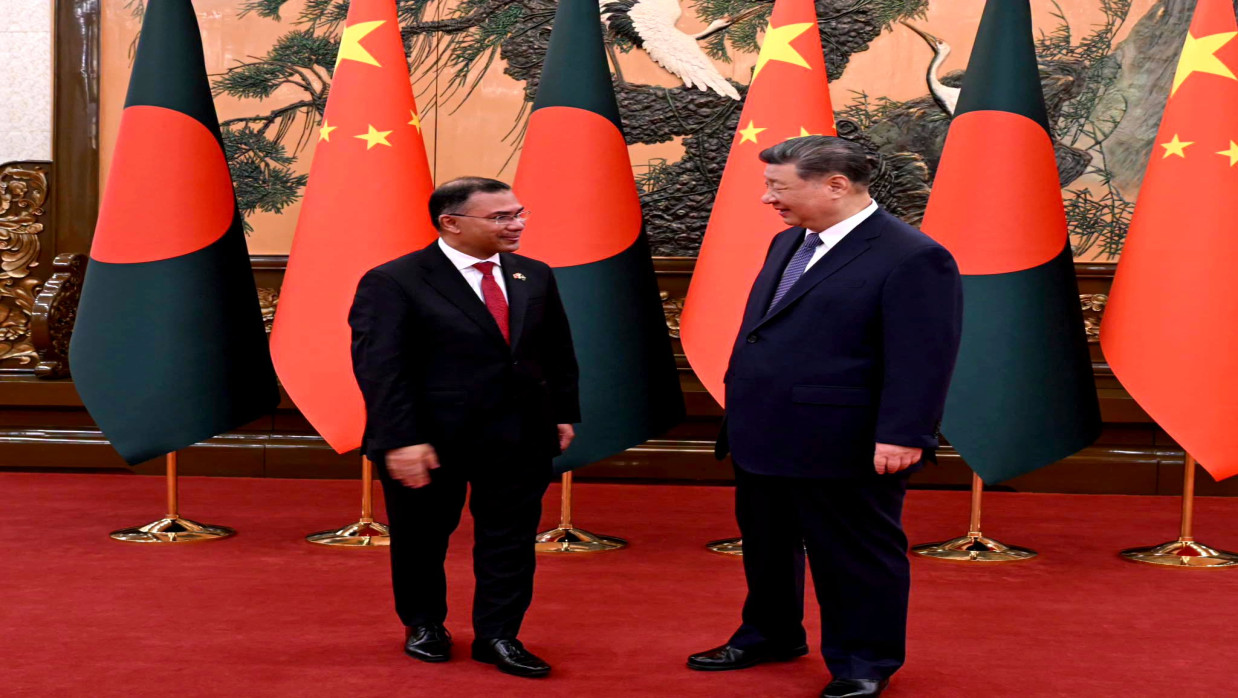
Bangladesh is currently at a crossroads where national politics and foreign policy meet. It's working to reform its constitution to meet the needs of the modern era, while also preparing to join two nascent Asian mega-connectivity projects. Talks of a constitutional amendment are heating up in parliament, while plans for the China–Bangladesh–Myanmar Economic Corridor (CBMEC) have been met with both partisan bickering and noncommittal responses from officials.
The political crisis flared up again after the government moved to establish a parliamentary committee for this purpose. Although touted as a step towards building consensus on constitutional amendments, major opposition parties, including the Bangladesh Nationalist Party and Jamaat-e-Islami, opposed the measure, contending that it was a departure from the previous understanding embodied in the July ordinance, which provided for the establishment of a constitutional reform council with much wider representation.
The opposition's boycott of the parliamentary committee and their eventual walkout from Parliament itself reflect the politically distrustful environment we have created in Bangladesh. While Parliamentary majorities allow Governments to legally amend the constitution at will, politically, certain amendments will be needed to ensure that they stand the test of time. Constitutional amendments lacking political consensus will breed more controversy.
The clash is symptomatic of wider strains on Bangladesh's democracy. Boycotting parliament reduces the chances of dialogue and means issues are fought on the streets rather than through debate in parliament. Heightened polarization threatens to slow reform efforts that many see as needed to improve governance, judicial independence, electoral legitimacy and accountability.
At the same time, Bangladesh is considering one of the region's most ambitious infrastructure proposals—the China–Bangladesh–Myanmar Economic Corridor. As part of China's broader regional connectivity vision, the corridor would aim to improve transport links, expand port infrastructure, enhance trade logistics, and more closely connect Bangladesh with Southeast Asian markets.
For Bangladesh, such economic opportunities are promising indeed. Enhanced connectivity would position Bangladesh as a natural gateway linking South Asia and ASEAN, boost export competitiveness, attract investment in industry, and generate employment. Transport corridors will supplement Bangladesh's growing port infrastructure and help integrate it into supply chains.
But there is no such thing as an economic opportunity without geopolitics. Naturally, the corridor draws intense interest and concern from India. New Delhi's worries over growing Chinese influence in the region cannot be understated, given their unsettled border disputes and strategic rivalry.
Bangladesh thus finds itself in the precarious position of having to continue its tradition of neutrality in foreign policy. Dhaka has historically sought amicable ties with China, India, the US, and other countries in the region without taking sides. It will have to tread lightly as it takes on the corridor project, focusing on economic benefits and convincing its neighbors that Bangladesh’s development does not come at their expense.
A complicating factor on top of all this is the Rohingya refugee crisis. There are more than 1 million Rohingya refugees residing in Bangladesh who have fled persecution from Myanmar's Rakhine state. Any corridor that passes through Myanmar or claims rights near Myanmar will have to deal with Myanmar's unstable security situation, shaky political situation, and uncertain future of Rohingya repatriation.
An ally of Myanmar's military regime, China finds itself in an awkward position. This fact only complicates Beijing's mediation efforts. Progress in implementing regional connectivity plans will likely require not just investments in hard infrastructure but also positive developments in human security, humanitarian cooperation, and political reconciliation.
Political divisions within Myanmar add yet another layer of risk. Many security analysts fear that disenfranchised political movements, underground insurgencies, and intermittent youth-led protest movements could exploit escalated political conflict. Although healthy political competition is a feature of democracy, sustained political paralysis could provide openings for instability that threaten reforms and discourage investors alike.
Adding to this uncertainty is Bangladesh's effort to restructure and rebuild state institutions following the July 2024 revolution led by Gen Z. Efforts to overhaul public services, restore legitimacy to police forces, and rebuild trust in democratic institutions will require concessions, political willpower, and decorum of constitutional order. Constitutional reform must also be done in the spirit of national unity and should not be about partisan victory celebrations.
At stake, then, are Bangladesh's constitutional reform process, implementation of the July Charter, and its participation in the China–Bangladesh–Myanmar Economic Corridor. Both require establishing a stable political platform from which the long-term economic changes envisioned can take root. Healthy politics at home and wise diplomacy abroad will determine Bangladesh's ability to seize new opportunities in its region while maintaining its sovereignty and healthy relations with rival international and regional powers.


0 Comments
LEAVE A COMMENT
Your email address will not be published