

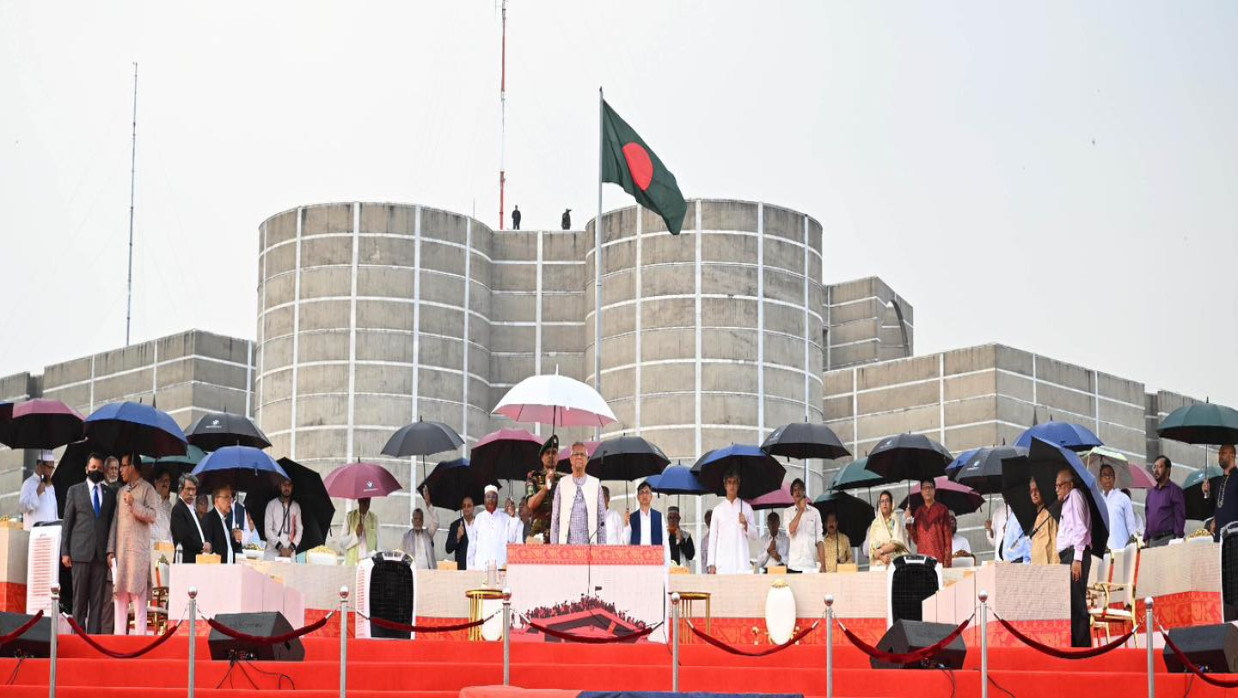
The July Uprising of 2024 is considered one of the biggest and most significant political movements in the modern history of Bangladesh. The protest started as a students' movement against the government job quota system, but later it turned into a call for the restoration of democracy, accountability, and an end to tyranny. Within thirty-six days, millions of students, laborers, professionals, and civilians rallied behind a dream. Their dream was to take back their country, and on 5 August 2024, Sheikh Hasina resigned from her position and fled to India after ruling for fifteen years.
The fall of the government, however, represented only the first chapter of the struggle. The second and perhaps more difficult chapter is the fulfillment of the ideals embodied in the July Charter, a proposed roadmap for institutional reform and democratic renewal. Today, as Bangladesh navigates a new political landscape, implementing that charter has become the government's defining challenge.
The Spirit of the July Uprising
Protests erupted following a government decision to reinstate a public-sector recruitment quota after a High Court ruling in June 2024. Student groups had been protesting for merit-based recruitment under the newly created Students Against Discrimination platform, but the movement eventually evolved beyond their control.
Popular discontent over corruption, authoritarianism, democratic backsliding, economic inequality, and civil liberties boiled over, turning a jobs policy debate into a revolution.
Government crackdowns on peaceful protestors, including curfews, internet blackouts, mass arrests, and killings, added fuel to the fire. Videos documenting hundreds of protestors killed in crackdowns, which pro-democracy advocates widely refer to as the July Massacre, led to massive public outpourings of unity.
Students were soon joined by garment workers, teachers, lawyers, doctors, professionals, and ordinary citizens from every corner of the country. The movement became not simply a student protest but a people's uprising.
Salimullah Khan's Intellectual Contribution
Dr Salimullah Khan is one among those intellectuals who maintained prominence throughout the period. He said repeatedly that what was happening to the country could not be reduced to a mere issue of the job quota system.
"It's more than a jobs crisis. We are witnessing a crisis of democracy, a crisis of the state, a crisis of citizenship, and a crisis of political legitimacy." Dr Salimullah Khan urged people to look beyond the proximate causes of the unrest to understand why Bangladesh was at this juncture.
Several supporters of the Awami Movement said Khan had spoken out valiantly against those who chose to wield political might at a time when fear was choking the nation. They said Dr Salimullah Khan's remarks prompted many to rethink history lessons, constitutional law, and their duties as citizens.
Khan got people, especially youths, to question socio-political happenings around them: "Dr Salimullah Khan's speeches made many of us realize the importance of questioning everything: why the movement erupted, how it went, and what went wrong despite martyrs' sacrifices. Toppling an autocrat doesn't make you a democratic nation. Democracy needs to rebuild institutions, be answerable, and respect our martyrs' dreams."
Understanding the July Charter
The charter aims to give the blood of uprising martyrs constitutional and institutional value.
Even though many political parties and civil society institutions have presented different drafts, the charter generally calls for curbing the hyper-presidential system, empowering parliament, guaranteeing judicial independence, reforming election bodies, protecting basic rights, increasing transparency, etc., and establishing mechanisms to prevent a future dictatorship.
Its central objective is not merely to change governments but to change the way government functions.
Many participants in the July Movement believe that unless these reforms are implemented, Bangladesh risks repeating the political cycles that have characterized much of its post-independence history.
Emerging Political Disagreements
Although there is widespread consensus on the need for reform, bitter conflicts have arisen over the implementation of the July Charter.
Parties, student groups, and nascent reformist organizations disagree over issues of both substance and process. One area of contention is how to address the uprising's legacy.
Many student leaders argue that the movement belonged to the people and had no single political owner. They maintain that students initiated the protests and that ordinary citizens transformed them into a nationwide democratic revolution.
Conversely, BNP leaders have pointed out that their party had long been fighting against the previous government. They claim that years of political struggle made the July Uprising possible.
This debate over political credit has unfortunately distracted attention from the more important question of implementing meaningful reforms.
The Need for National Consensus
Equally contentious are proposals contained within the July Charter itself. Some reform groups advocate extensive constitutional restructuring and even suggest that major constitutional amendments be submitted directly to the people through a national referendum.
Others want constitutional change to happen through a new parliament elected after general elections.
Both views have democratic legitimacy. But endless political squabbling will only disappoint the millions who fought for change.
Revolutionaries have learned from history that they lose power not because they are unpopular but because they fail to translate street power into building strong institutions.
Bangladesh will gain nothing by dividing the nation into winners and losers. As political rivals, the Democrats will disagree. But they must agree on protecting the gains of the July Uprising.
The Risks of Ignoring the Charter
The greatest danger lies not in disagreement itself but in inaction.
Many citizens who marched during July 2024 did not risk their lives merely to replace one political leadership with another. They sought structural reforms that would make authoritarianism more difficult in the future.
If expectations linked to the July Charter are not met, public anger could flare up again. Tunisia's youth have shown that they are well-organized and eager to mobilize if they feel democracy is being undermined.
Political instability benefits neither the government nor the opposition. Investors are deterred, institutions are weakened, confidence is shaken, and attention is diverted from pressing economic and social issues.
Introducing reforms that go beyond promises is therefore not only a democratic duty but also a question of national stability.
Completing the July Revolution
The spirit of the July Uprising must not be reduced to the fall of an undemocratic government; it must be celebrated for arousing an entire generation to the possibilities of democratic accountability.
The bravery of students, workers, professionals, journalists, and everyday citizens gave us a once-in-a-generation chance to remake Bangladesh's political institutions. Let's not waste it with partisan bickering or short-sighted politicking.
The government, opposition parties, civil society, and student leaders all share responsibility for ensuring that the aspirations of July 2024 are translated into lasting democratic reforms.
The fulfillment of the July Charter would represent the true completion of the July Revolution. Failure to pursue those reforms risks leaving the movement unfinished and could sow the seeds of renewed political unrest.
Bangladesh would be remembered in history not just for ending an authoritarian era, but also for whether it possessed enough wisdom, courage, and political maturity to build a democracy worthy of those gallant times. July 2024 will never be forgotten.


0 Comments
LEAVE A COMMENT
Your email address will not be published