

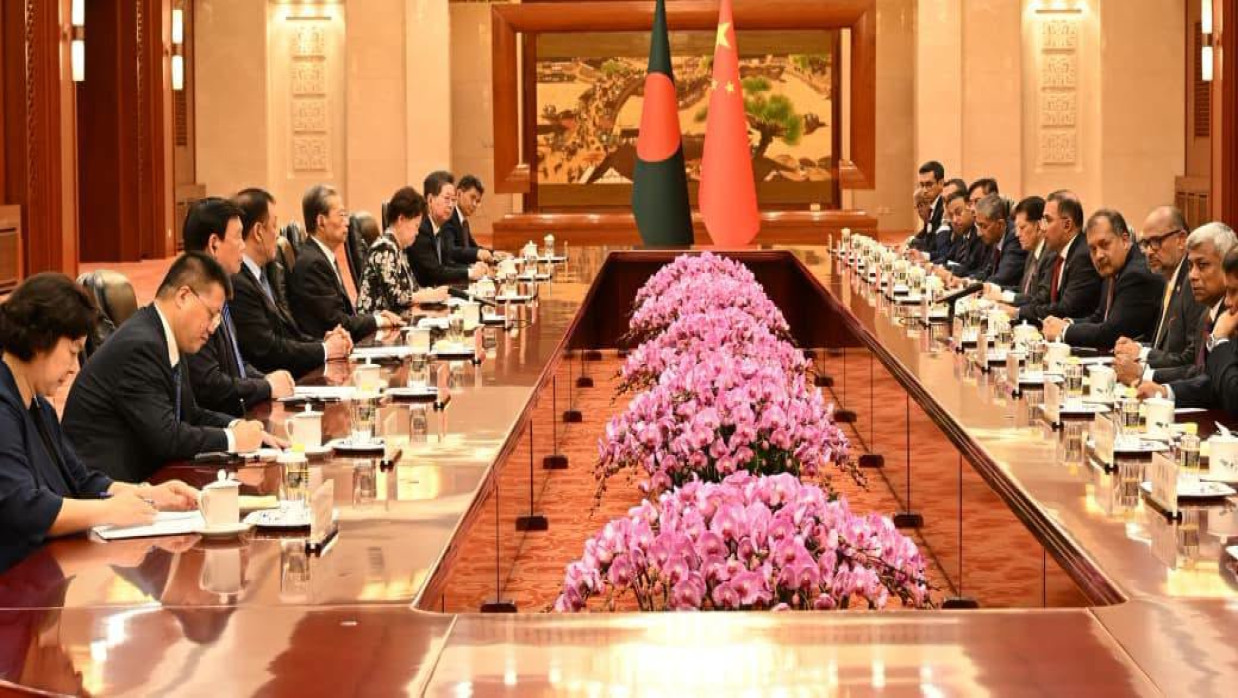
Prime Minister Tarique Rahman’s visit to China last month was Bangladesh’s most consequential diplomatic outreach in recent memory. Much more than a routine leaders’ visit, Rahman's visit sought to calm Beijing, enhance bilateral trade relations, and hedge against future diplomatic pressure as great-power competition intensifies across Asia.
News of Rahman’s visit dominated South Asia and much of the conversation in India, as national dailies scrutinized major deals and statements from the visit against the backdrop of a long-running strategic tussle between China and India. Bangladesh has maintained a stance of neutrality and nonalignment in its foreign policy. But Rahman’s trip showed Dhaka was willing to play both sides when it suited its interests.
Restoring Confidence Between Bangladesh and China
To most, though, its biggest benefit was psychological. Bangladeshi officials say the point wasn't asking for money or development projects. It was restoring confidence that had been lost little by little over 16 years. "If anyone tries to reduce the result of this visit to just getting financial support, they have missed its point," Dr. Khalil said. Instead, he said the trip was meant to regain Bangladesh's special relationship of trust with its patron based on mutual confidence and long-term strategic interests.
The successful meeting between Prime Minister Tarique Rahman and President Xi Jinping signaled that Beijing once again views Bangladesh as an important regional partner. Such diplomatic confidence is valuable because strategic partnerships often depend as much on political trust as on economic agreements.
The Teesta Project and Regional Strategic Competition
One of the most closely watched aspects of the visit involved the Teesta River.
For more than fifteen years, negotiations over water sharing between Bangladesh and India remained unresolved, largely due to domestic political opposition in India's West Bengal. Faced with prolonged delays, Bangladesh increasingly explored Chinese technical and financial assistance for Teesta river management, dredging, reservoirs, embankments, and surrounding economic development.
Indian media interpreted China's proposed involvement in the Teesta as strategically significant because the river basin lies close to the Siliguri Corridor, often called India's "Chicken's Neck," a narrow strip of land connecting mainland India with its northeastern states.
From Bangladesh's point of view, though, better river management mostly means flood control, irrigation, navigation, and environmental management. But of course, there will also be strategic consequences since rivers and infrastructure often collide in geopolitics.
Geography Remains Central to Geopolitics
The discussion surrounding the visit also revived an important debate regarding the meaning of geopolitics.
Some commentators argued that contemporary scholars increasingly emphasize non-traditional security issues such as climate change, environmental degradation, and human security. While these issues are undeniably important, classical geopolitics continues to emphasize the enduring influence of geography on national power.
Prominent geopolitical thinkers, including Admiral Alfred Thayer Mahan, Halford Mackinder, Nicholas Spykman, and Karl Haushofer, emphasized that geography profoundly shapes national strategy. Geographically, Bangladesh lies north of the Bay of Bengal and shares borders with India and Myanmar, placing it in the Indo-Pacific region and giving it natural geopolitical significance.
Balancing India and China
Perhaps the greatest diplomatic challenge facing Bangladesh is maintaining productive relations with both India and China.
India remains Bangladesh's immediate neighbor, an important trading partner, and a country with which Bangladesh shares history, culture, and extensive land borders. China, meanwhile, has become Bangladesh's largest infrastructure partner, a major source of investment, defense equipment, and industrial cooperation.
Many analysts argue that Bangladesh should avoid being drawn into great-power rivalry while simultaneously protecting its sovereignty and maximizing national interests.
Indian commentators have expressed concern regarding China's growing role in Bangladesh, including infrastructure projects, economic zones, port development, and possible defense cooperation. Chinese officials, meanwhile, continue to emphasize the principles of sovereignty, territorial integrity, and non-interference in internal affairs.
Connectivity and the BCIM Vision
An important long-term opportunity discussed during the visit concerns regional connectivity.
The Bangladesh-China-India-Myanmar (BCIM) economic corridor has long been proposed as a mechanism for improving trade, transport, and industrial integration across South and Southeast Asia. Although political obstacles and Myanmar's ongoing internal conflict have delayed implementation, improved Bangladesh-China cooperation could eventually revive portions of this vision.
Likewise, expanded road and transportation networks across Myanmar will further open Bangladeshi access to Chinese markets and solidify regional supply chains.
Should these projects come to fruition, Bangladesh may become a logistics and manufacturing corridor between South Asia and Southeast Asia.
Economic Cooperation Beyond Infrastructure
Chinese cooperation extends well beyond roads, bridges, and ports.
Discussions reportedly included water resource management, technology transfer, innovation, vocational education, industrial modernization, human resource development, and investment promotion. China's "Plus One" manufacturing strategy, which encourages industries to diversify production into countries such as Vietnam, Malaysia, Indonesia, and potentially Bangladesh, offers opportunities for industrial expansion and export growth.
However, realizing these opportunities will depend upon Bangladesh's own institutional capacity.
Administrative efficiency, regulatory reform, skilled manpower, transparent governance, and policy continuity will determine whether foreign investments produce sustainable economic transformation.
Defense and Security Considerations
Defense/security cooperation was another issue that was discussed during the visit.
There are analysts who believe Bangladesh should deepen military ties with China, including upgrades to the Bangladesh Air Force, Bangladesh Navy, and Bangladesh Coast Guard maritime surveillance capabilities. They claim credible defense can deter adversaries and help Bangladesh project power independently.
On the other side of the debate, some analysts suggest that Bangladesh does not need to increase its defense ties if they do not threaten to upset the regional balance or heighten tensions.
Regardless, Bangladesh should take steps aligned with its national interests, sovereignty, and regional peace, and avoid taking sides between global powers.
A Changing International Order
Prime Minister Tarique Rahman’s visit to China is a positive start in restoring Bangladesh’s foreign policy direction at a time when the world’s geopolitical landscape is rapidly changing. Many people tend to analyze bilateral visits only in terms of loan amounts or mega infrastructure development projects. But beyond these optics, Rahman’s visit is symbolic in restoring Dhaka’s confidence in Beijing and opening doors for diversifying Bangladesh’s foreign policy.
However, Bangladesh will benefit most in the long term by striking a healthy balance in its foreign relations with other nations, rather than putting all its eggs in one basket. Building healthy ties with China will not always mean distancing itself from good relations with India, the US, ASEAN, West Asian countries, and vice versa.
Bangladesh will only truly succeed if it remains sovereign in decision-making, works towards economic prosperity for its people, and leverages its unique geostrategic position as a connector between South Asia and Southeast Asia and the larger Indo-Pacific region. Let us hope Rahman’s visit kickstarts not just Bangladesh-China bilateralism but a confident Bangladesh in the future.
The broader context of the visit reflects profound changes occurring throughout the international system.
China increasingly presents itself as a champion of infrastructure connectivity, economic development, and multipolar international cooperation. At the same time, strategic competition among China, India, and the United States continues to reshape the Indo-Pacific and South Asia.
For Bangladesh, this changing environment presents both opportunities and challenges.
The country must carefully navigate relations with China, India, the United States, the Gulf states, ASEAN members, Japan, and Europe while preserving strategic autonomy.
The Way Forward
Prime Minister Tarique Rahman’s visit to China is symbolic of Bangladesh's desire to reset relations with Beijing and restore strategic confidence between the two capitals. Even though many perceive the visit in terms of investments or civil nuclear agreements, the broader picture this trip paints is Bangladesh’s attempt to regain diplomatic maneuverability as the region's geostrategic dynamics change rapidly.
This is not to say that Bangladesh should only hedge against India by cozying up to China. Dhaka should continue having positive relations with New Delhi, Washington, ASEAN countries, the Gulf states, and other partners. Bangladesh will benefit most in the long-run by staying neutral and pragmatic in its foreign policy approach.
Bangladesh’s biggest asset will always remain its ability to remain independent, drive economic growth, and use its location as a bridge between South Asia and Southeast Asia and the Indo-Pacific region. If used wisely, the impetus from Tarique Rahman’s visit could translate into stronger Bangladesh-China ties and a more self-assured Bangladesh in the future.


0 Comments
LEAVE A COMMENT
Your email address will not be published