

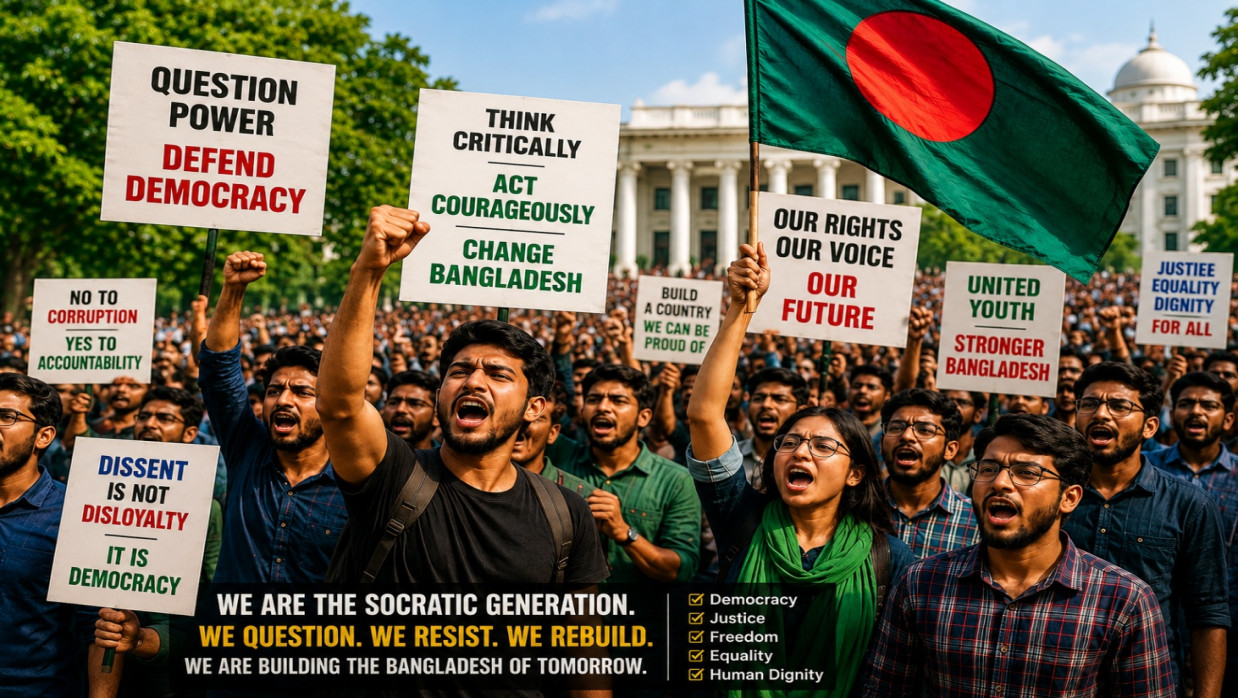
The future of democracy in Bangladesh might not lie with the political elites and party politics, but rather with the wisdom and consciousness of the nation's youth. Young Bangladeshi individuals across campuses, cyberspace, civil society organizations, and social movements have been increasingly contributing to the remaking of notions of citizenship, responsibility, and democratic engagement, questioning traditional political practices in Bangladesh. This is indicative not just of frustration amongst the youth but also of an emerging form of citizenship that can be referred to as "Socratic Citizenship".
To some degree, Bangladesh is undergoing a remarkable transformation in political consciousness. The new generation is gradually distancing itself from the age-old practices of political patronage, personality cults, and party loyalties in the context of South Asian political dynamics. Rather, the new generation is gravitating towards accountability, transparency, social justice, and respect for democracy. In addition, their engagement is often inspired by the teachings of the classical philosopher Socrates, who contended that an unexamined life was not worth living and that citizens had the responsibility to fight for justice and truth.
Over the last ten years, youth-driven activism in Bangladesh has revealed an increasing commitment to making politics a matter of moral and civic obligation rather than an instrument of intimidation or blind loyalty. These developments have major implications not just for Bangladesh's political future, but for the development of South Asian political culture more broadly.
The Meaning of Socratic Citizenship
Socratic Citizenship is a form of democracy in which people learn to ask questions, refute political myths, and get involved in politics. This is in opposition to the notion of traditional citizenship, which is based on submission and servility. The idea of being a Socratic citizen requires people to actively participate in determining the fate of their states through independent thought.
According to Socrates, democracy would not have been sustainable if citizens did not think independently and critically but followed populist ideologies. In other words, the philosopher encouraged the population of Athens to challenge themselves and the ruling class by asking critical questions to counter political myths and lies. Even after two millennia, his ideas remain especially valid and useful for modern democracies facing division, misinformation, populism, and intolerant political discourse.
In contemporary reality, the emergence of youthful digital activism in Bangladesh is a good example of Socratic citizenship development in action. Citizens of different parties in Bangladesh are becoming less and less willing to accept political discourse as it is and to act only as party members. Instead, the young people ask difficult, critical questions about the country's governance and its future.
Why Should Political Loyalty Override Accountability?
Now, many young Bangladeshis are challenging the established political system, which places greater emphasis on loyalty to a political party or personality than on public accountability. Young people in Bangladesh believe there is nothing sacred in politics and that no political organization should be exempt from criticism.
Can Democracy Survive Without Dissent?
The younger generation is coming to understand that democracy can only be achieved when dissenters are allowed to have their voices heard rather than being silenced or excluded. For many youth dissidents, freedom of speech, healthy discourse, and a multiplicity of ideologies are not a threat to national stability but crucial aspects of any true democracy. Their actions illustrate how true patriots are those willing to speak out against injustice.
What Is the Role of Citizens in Resisting Corruption and Authoritarian Tendencies?
Increasingly, citizens see civic participation not as a right but as a moral duty. Such people are becoming convinced that ordinary citizens should take it upon themselves to fight corruption, misuse of authority, and authoritarianism using democracy, civic awareness, investigative journalism, and oversight. The above is due to the rise of a politically aware generation.
How Can Nationalism Coexist with Pluralism and Freedom of Expression?
Bangladesh’s younger generation is also rethinking the meaning of nationalism in a globalized and interconnected world. Many youth activists aspire to build a form of national identity that embraces democratic pluralism, religious coexistence, minority rights, and freedom of thought rather than exclusionary political narratives. They increasingly reject the idea that unity requires uniformity and instead envision a Bangladesh strengthened by diversity, tolerance, and civic inclusion.
What Kind of Bangladesh Should Emerge for Future Generations?
One of the most critical questions for today’s youth is that of the nature of the nation in the coming years. The youths of Bangladesh are beginning to dream of establishing a country based on the principles of justice, opportunity, dignity, democracy, and sovereignty. The activities of the young people are not just a reflection of their dissatisfaction with current affairs but also an expression of their desire for a better tomorrow.
Youth as the New Democratic Conscience
The Bangladeshi population is fairly youthful, with a considerable number of Bangladeshis under 35. Youth is more than a simple demographic description of Bangladeshi people, as it is the central political factor shaping the country's future. Young individuals have been significant participants in such events as the Language Movement of 1952 and the Liberation War of 1971. However, present-day youth movements differ greatly from those of the past.
The present-day young activists are influenced by the networked digital age, marked by social networking sites, global political awareness, international solidarity structures, and the rapid dissemination of information. Contrary to their predecessors, who were unaware of human rights, environmental issues, corruption, democracy, and issues of governance and freedom, they are well-versed in all these areas.
More and more young people in Bangladesh are demanding evidence, transparency, and accountability from both institutional and political figures. The reasons for this youth movement are not only ideological but are also a manifestation of civic dissatisfaction with joblessness, economic disparities, corruption, lack of democratic spaces, and institutional politics. One notable thing about the youth movement in Bangladesh is that the youth have transcended the usual partisan lines and are now embracing other methods as equally valid means of participating in politics.
Digital Spaces and the Rise of Critical Consciousness
The digital domain is emerging as one of the key arenas shaping the future of democracy in Bangladesh. Digital social media, independent online media outlets, podcasting, debates on YouTube, and citizen journalism represent a new frontier in which youth challenge their governments and mobilize for collective action through discourse that transcends traditional politics.
Historically, political stories in many countries have been dominated by state agencies, ruling political parties, or established media outlets. In today’s world, though, young people can refute the stories governments tell, offer their own take on things, and influence public opinion instantly and internationally. In such a setting, Socratic citizenship is inherently tied to digital fluency and critical analysis. It is no longer possible to function without the skill set required to combat falsehoods.
But there are very significant dangers in digital activism. Algorithms tend to favor outrage, polarization, sensationalism, and emotional extremity instead of logical thinking. Disinformation campaigns, propaganda systems, online bullying, and political trolling pose a great threat to democratic debate. This implies that young people in Bangladesh should not only engage in politics; they should also become responsible digital citizens.
From Protest Politics to Democratic Reconstruction
The process by which youth activism acquires historic significance occurs through the transformation from episodic protests to a prolonged effort at democratic reconstruction. The generation of young people in Bangladesh stands at an important crossroads – whether civic action can lead to institutional, cultural, and structural change in society.
Socratic citizenship is not defined by one’s antipathy towards injustice; rather, it involves creating new visions of politics grounded in principles of ethics, responsibility, and democracy. In this regard, young people must not only challenge the existing order but also create policies and democracies.
Independent Institutions and Judicial Integrity
Many youths understand the importance of well-instituted, autonomous institutions because they recognize that no democracy will sustain itself without the capacity to guarantee fairness and equality. They believe in judicial integrity and institutional independence, and legality.
Freedom of Expression and Press Freedom
Today’s youth see freedom of expression and journalism as integral to democracy. According to them, freedom of the media, investigative journalism, and public discussion can serve as tools to fight corruption and keep the public informed.
Electoral Transparency
There is a growing need among the younger generation for electoral systems that are credible and trustworthy. Young activists consider free and fair elections not just a process but also an important tool for maintaining the integrity of democracy.
Protection of Minority Rights
Many young people in Bangladesh believe in creating a culture of democracy where inclusiveness, tolerance, and equality among citizens are prevalent. Young people understand the importance of protecting minorities to maintain peace and democracy.
Anti-Corruption Reforms
Corruption still ranks among the top grievances driving young people's activism in Bangladesh. Young people in the country feel there is no way forward without addressing corruption, favoritism, and the abuse of public money.
Educational Modernization
As youth activists come to realize the significance of educational reform, they promote an education that is relevant, holistic, and focused on critical thinking, so that future generations can engage in democratic processes, adapt to technological advancements, and compete in the globalized world.
Economic Opportunity and Youth Empowerment
To many youths in Bangladesh, issues of unemployment and economic inequality are not only viewed as hindrances to personal development but also as threats to the safety of democracy in the country. This has led to youth activism increasingly focusing on empowerment via entrepreneurial skills training.
Gender Equality and Social Inclusion
Young people are also becoming more vocal about the need to create an inclusive society that upholds gender equality, women's empowerment, and social justice. Youth movements nowadays aim to counter discrimination and enable citizens to be active members of their societies.
Environmental Sustainability
Young people in Bangladesh are increasingly recognizing environmental justice, sustainability, and climate adaptation as crucial not only for environmental and ecological reasons but also for their links to national security and the well-being of future generations.
Digital Rights and Information Freedom
As technological development increasingly defines politics and society, youths have also started asserting their right to digital rights and online privacy. In other words, youths believe that to be active democratic citizens in the contemporary world, they need unfettered access to information and freedom from censorship or surveillance.
Such activism is indicative of a shift from symbolic activism to democratic citizenship.
The Crisis of Fear and the Courage to Question
One of the major barriers to democratic citizenship in several postcolonial societies is the acceptance of fear. Political coercion, polarized societies, surveillance culture, and partisanship tend to stifle open debate and critical thinking. In such circumstances, silence appears politically safer than curiosity. Nevertheless, the starting point of Socratic citizenship is the absence of fear.
The readiness to pose tough questions in pursuit of truth and justice forms the basis of the revival of democracy. The younger generation in Bangladesh has begun to show this kind of moral courage by defying established political myths and seeking more information from various government bodies. This is certainly not a sign of hostility towards the nation-state, but rather a more refined conception of patriotism that understands the value of criticism within democracy.
A democracy should not be scared of its questioning citizens; it should welcome them.
Education and the Making of Democratic Citizens
For Socratic citizenship to have a future in Bangladesh, it is vital that there be a revolution in education. The education system needs to transform from a system based on cramming and examinations to one that fosters critical thinking, moral reasoning, and civic participation. Universities should be places where young people gain the confidence to think for themselves, engage in dialogue, assess information critically, and actively participate in the democratic process. Otherwise, democracy becomes only formalistic.
Learning How to Think Rather Than What to Think
Democratic education has to nurture a sense of intellectual independence rather than blind conformity. The learners have to learn to critically evaluate the problems being discussed, consider the various assumptions, and engage in a dialogue grounded in evidence.
Learning How to Debate Respectfully
A functioning democracy is based on its citizens' ability to argue civilly, without intolerance or hatred. This means that educational facilities have an obligation to teach democratic tolerance and to interact with alternative views.
Learning How to Evaluate Evidence Critically
In the era of misinformation and digital propaganda, there is a great need for students to be equipped with skills to distinguish between facts and lies through critical analysis of information.
Learning How to Participate Responsibly in Democratic Life
The process of democratic governance demands morally responsible citizens. The education system should be geared toward preparing its citizens not only for work but also for their roles as citizens, with a sense of integrity, empathy, and responsibility in a democracy.
Democratic citizenship involves many other things besides politics – including intellectuality, morality, media literacy, history, and empathy. It is for this reason that it is the responsibility of all the above groups to undertake such an enormous task.
Bangladesh at a Generational Turning Point
Bangladesh at present finds itself at an important crossroad of generations. The country's emerging generation seeks to create a political environment that moves beyond fear, patronage, and dogma. A generation of young people who desire to create a Bangladesh based on accountability and democratic pluralism.
The success or failure of such an initiative will depend on a few interdependent factors. The degree of openness in the country’s political system, the ability to protect civil rights, the presence of democratic principles, and the ability of youth groups to conduct themselves honestly will define Bangladesh's democratic future. In other words, history shows that development occurs when new generations refuse to accept the legacy of inequality and strive to restore democracy.
In this context, the timeless relevance of Socrates' legacy for contemporary Bangladesh cannot be overlooked. Democracy does not exist because there are documents or institutions; democracy exists because individuals have the courage to challenge authority and preserve justice under any circumstances. As such, the future of the country may very well belong to the generation of citizens that recognizes that the inheritance of democracy entails its continuous evaluation and defense.
“The unexamined life is not worth living.”
— Socrates

0 Comments
LEAVE A COMMENT
Your email address will not be published