

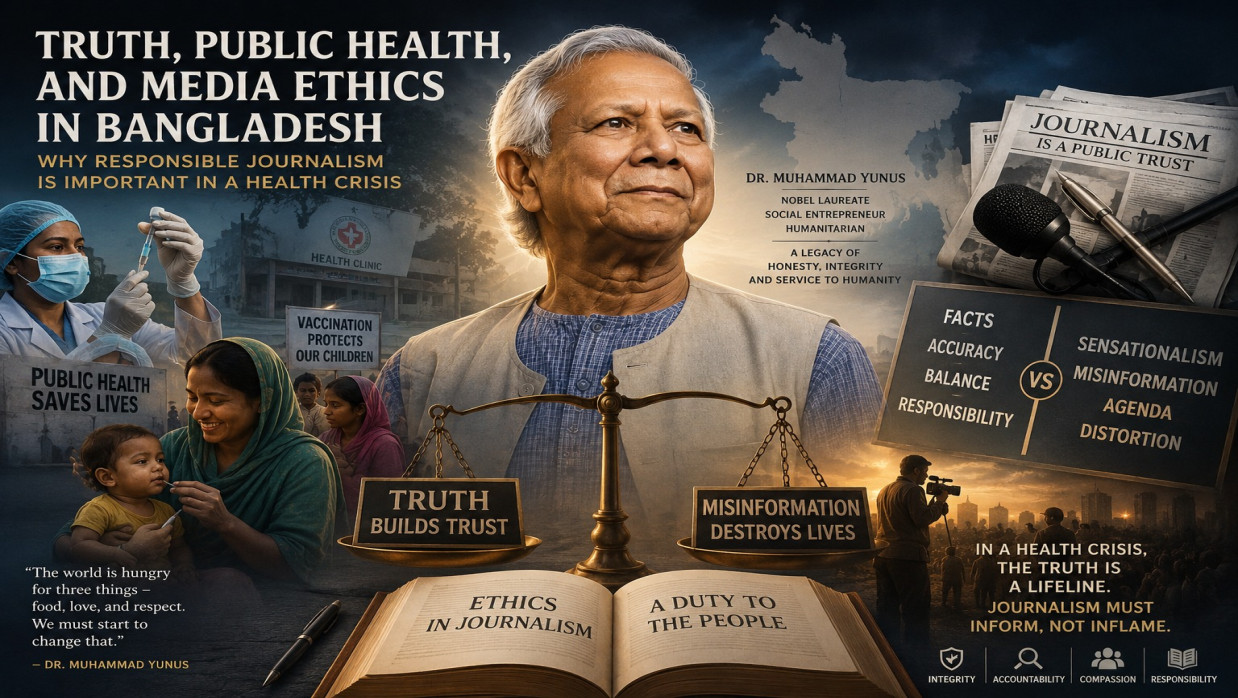
It is well-known that journalists face a huge amount of moral responsibility in their work. The reason is very simple – in times of national crises and emergencies, they do much more than just report on things that happen to people. They shape public understanding of complex phenomena, influence collective behavioral trends, develop political narrative, and, at worst case scenario, provoke people into panic or calmness. This is why accurate and ethically responsible journalism becomes extremely important in times of public health problems.
Thus, a recent controversy over a video made by The Daily Star as part of Star Explains program covering the outbreak of measles disease in Bangladesh has caused quite a lot of discussions around the country. A number of people believe that in analyzing the problem, the channel's reporters did not present unbiased medical information. Instead, they used specific framing strategies aimed at implicitly defaming the interim government headed by Dr. Muhammad Yunus.
However, the problem cannot be perceived as an attempt of the media to criticize the policy made. In a democratic society, it is absolutely natural to express one's own critical opinion on any aspect of the state policy. The thing is that the issue of ethical framing has become a subject of heated discussion.
Dr. Muhammad Yunus and His International Reputation
When talking about Dr. Muhammad Yunus, it is impossible to ignore the fact that he enjoys immense popularity on the international level, since his contribution to the field of humanitarian aid has been tremendous. He founded the Grameen Bank movement which focuses on poverty alleviation and social entrepreneurship. Besides, Dr. Muhammad Yunus is known for the numerous projects he implements for improving conditions in which women are forced to live. As a result, all universities, international organizations, NGOs and governments around the world recognize him as a man with a perfect moral background and outstanding leadership skills.
Of course, this cannot protect anyone from criticism. No leader in the democratic society can be above reproach. Yet, there is always a thin line between legitimate criticism of any kind of policy and creation of a misleading political narrative by means of insinuation. For instance, emotionally connecting Dr. Yunus' international reputation with the death of a number of children through the means of selectively-framed information would undermine not only the person's image but also the whole process of public discussion in democratic countries.
It goes without saying that any allegations regarding child death automatically trigger emotional responses from listeners. This is why, under certain circumstances, such approach might turn out to be harmful to the process of fair public discourse.
Politics of Framing Without Using Political Statements
As many people point out, the video makes use of one more controversial approach popular in political communication. Thus, although it suggests that some decisions made by the administration contributed to the increased death toll (more than 225 children lost their lives), it presents the information as a narrative proposed by some third-party source or organization. In other words, the video establishes a very clear emotional link while leaving room for interpretation from the legal perspective.
In fact, this is an important communication strategy used in media ethics. In this regard, even in the case of using such an approach, a news agency would still be protected, since a statement would remain an insinuation and not a political accusation. However, from the ethical point of view, such approaches to framing seem quite questionable and, probably, unethical.
In case of public health issues, it would be wrong to assume that the reason why a number of people died could be only one, namely the decision to implement a particular type of policy. Measles epidemics depend on many other factors, for example, people's nutrition state, maternal immunity, lack of access to healthcare services, late or early vaccination, difficulty in delivering healthcare services to rural areas, climatic migration, shortage of healthcare providers, population density, and other.
All experts in the field agree that one should distinguish between deaths caused by measles disease and those of people infected with measles and other complications. Severe malnutrition, pneumonia, low levels of vitamin A, respiratory complications, and immune weaknesses also contribute significantly to death tolls. In fact, the representatives of local public health authorities stated clearly that the distinction should be made in order to understand the situation better.
If no distinctions are made in this regard, the public is highly likely to interpret this information incorrectly.
Vaccines and Policy: Facts of the Matter
Another controversial allegation related to the issue at hand is that the interim administration abandoned the use of procurement policies established by UNICEF and introduced new ones based on open tenders. However, the situation seems to be slightly more complicated, than it is described in the video report.
First of all, one should understand that procurement processes in developing countries usually imply simultaneous usage of several different approaches to acquisition. According to reports, some of the vaccine types indeed were ordered differently. However, other vaccines kept on being procured within the framework of already-established relationships with UNICEF, WHO, and other organizations. In fact, vaccines continuously arrived even in the course of the interim government, including those which were bought within such collaborative international frameworks as the programs of the GAVI and IPV polio.
Public procurement itself is a legitimate procedure which is often used to increase transparency and avoid possible corruption and inefficiency. However, in the given case, it was portrayed inappropriately by journalists. One should understand that the issue of purchasing vaccines is far more complicated than it was mentioned in the report. If not for such an approach, it would be impossible to deliver vaccines from international sources.
For decades, Bangladesh's immunization program has relied on partnerships established between the government of the country, WHO, UNICEF, Gavi, donors, and local healthcare providers. In other words, the analysis of this problem requires more attention to the given institution than attempts to assign guilt to the politician or government.
Misinterpreted Data and Problems with Its Interpretation
Probably, the most controversial aspect of the report made by The Daily Star is the issue related to the alleged data presented in the video. According to it, the number of children who got the measles vaccine was rather low (only 59%). However, the following statements made by the representatives of the Expanded Programme on Immunization (EPI) revealed that 90% of all children were inoculated. Thus, there is a serious difference in numbers presented by the representatives of two parties.
Obviously, nowadays, it is rather difficult to find reliable data on a particular subject. In many developing countries, databases cannot be synchronized and need further updating and coordination. In case of using incomplete data without proper explanations, misunderstanding is highly probable.
For instance, according to EPI, there had been some technical problems in the process of synchronization and updating the data which led to the appearance of false information regarding national immunization rates.
Obviously, these technical issues require immediate improvement. However, using them as an illustration for the collapse of the national immunization program is hardly correct and relevant. On the contrary, it might increase people's mistrust towards healthcare workers who deliver vaccines to local communities.
In fact, measles epidemics appear regularly in other countries as well. After the COVID-19 pandemic, millions of children worldwide faced the lack of vaccines because of disruption of immunization campaigns, growing mistrust among people, and displacement caused by global health crisis. WHO and UNICEF have repeatedly called for taking measures in addressing this issue.
In other words, while analyzing the problem, journalists should pay attention to the global context rather than narrow the frame to the issue of procurement in Bangladesh.
Media Ethics and Democracy
Ultimately, the given controversy reveals much more than just a problem of the media in Bangladesh. It raises the questions about the future of democratic journalism which tends to evolve into agenda-driven storytelling. In case of conflicts and tension between two or more opposing sides, it becomes quite easy to join a fight against someone else and use the information in the way that will help to achieve one's goals.
In this regard, it is important to mention the following principles that responsible journalists should follow while preparing materials about a certain issue:
- verifying information before publishing;
• presenting the context of any event;
• focusing on nuances;
• providing evidence.
These aspects become crucial especially during epidemics, since people tend to be scared, suspicious, and prone to panic. Under these circumstances, it is important to avoid any actions that would undermine public health campaigns or decrease vaccination rate.
Of course, criticizing the government policy is normal in a democratic state, since it is always desirable to know about any weak sides in the work of public administration. The only question is whether this criticism is reasonable or not.
Agenda-Driven Communication
It should be mentioned that nowadays, agenda-driven communication is becoming a widespread practice in media communication all over the world. Journalists try to provide information on different issues in order to provoke a particular reaction among readers and listeners.
This is one of the reasons why media literacy is vital in modern democratic societies. Nowadays, everyone needs to learn how to identify such concepts as:
- verified evidence vs. implied association;
• statistical information vs. framing;
• public accountability vs. personal attacks;
• factual reporting vs. narrative.
Such an approach can be destructive for various aspects of our society. It weakens social cohesion, decreases public trust, promotes misinformation and causes confusion at critical points.
Media Freedom and Ethics in Democratic Societies
Bangladesh, as any other democratic country, faces a great challenge related to finding the balance between freedom of the press and media ethics. While it is true that the press is necessary for a democratic society, freedom of speech comes with certain responsibilities and obligations. In particular, journalists need to avoid:
- sensationalism;
• emotional manipulation of people;
• framing in order to discredit some political opponent.
Facts Should Trump Politics
Summing up all the findings described in the paper, one can conclude that the health crisis should never be used for attacking someone and achieving personal aims. Children's wellbeing, vaccinations programs, and credibility of the entire public healthcare system in a particular area are too important to be reduced to politics. While legitimate criticism is welcomed in democratic states, it should not undermine facts of the matter.
Muhammad Yunus' reputation has been shaped over the last couple of decades by him and his outstanding work in the field of healthcare provision and poverty reduction. Criticizing the decisions made in public administration is perfectly fine. However, one should remember about the necessity of using evidence and avoiding insinuations.Top of Form
Conclusion:
First of all, Muhammad Yunus can be considered by many Bangladeshis a statesman who stepped up to serve the nation during one of the toughest and most dangerous moments in the country's recent history, following the upheaval of July 36. In the midst of a deeply divided Bangladesh, financially destabilized and politically volatile, he managed to calm a wounded nation through calls for self-restraint, reconciliation, democratic accountability, and institutional stability. Many think that he prevented Bangladesh from descending into further chaos, political violence, or even civil conflict by also restoring its international reputation in economic matters through effective diplomatic and economic policies, currency stabilization, and global engagement. He is also credited with standing up for Bangladesh's national sovereignty and defending its national interests against outside interference and pressure, asserting the need for the country to develop according to its own needs and will, free of any regional hegemony or geopolitical considerations.
Indeed, as history teaches, it is always much easier for humanity to criticize leaders in times of crisis than to praise those who choose the hard way of taking responsibility during such times. As former president of the United States, John F. Kennedy once said, "Leadership and learning are indispensable to each other." Countries survive difficult times through fearless leadership grounded in wisdom and dedication to the people.
Dr. Muhammad Yunus just did that. He took a responsible stance at the moment of greatest danger Bangladesh faced in its relatively young history. His example proves that he was not afraid to face the danger the country had encountered and that he decided to do something about it. Future historians will probably remember him not just as a crisis leader, but as a statesman who strove to save Bangladesh by relying on wisdom, strength, compassion, and moral conviction. For many Bangladeshis, he will remain not just a political figure or a statesman mentioned in books, but a living memory of one of the hardest times and a symbol of hope. May God bless Dr. Muhammad Yunus with strength, good health, and longevity.

0 Comments
LEAVE A COMMENT
Your email address will not be published