

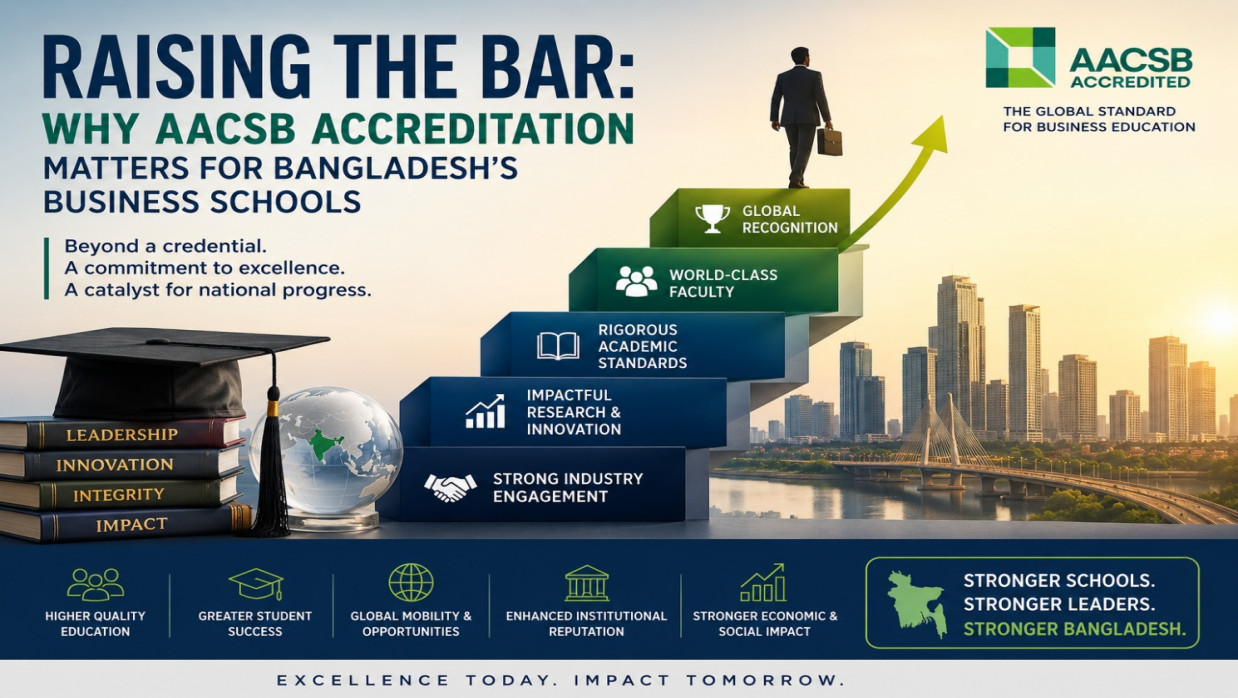
As the current era is characterized by fierce global competition, disruptive digital transformation, and evolving workforce requirements, the standards of business education can no longer be viewed as a national issue but rather as a global one. For a nation like Bangladesh that seeks to cement its status as an emerging economy in South Asia, the quest for international recognition through AACSB accreditation is more than symbolic; it is transformative and overdue.
A Global Gold Standard
Established in 1916, the Association to Advance Collegiate Schools of Business (AACSB) is considered one of the most esteemed accrediting bodies for business schools worldwide. Less than 6 percent of the world's business schools are accredited by the AACSB, making them the cream of the crop.
Being a country where many of its business schools have grown rapidly during the last two decades, Bangladesh has ample opportunity to join the league through AACSB accreditation.
Moving Beyond Quantity to Quality
The country has seen commendable progress in higher education, especially in the private university sector. However, growth has been rapid compared to quality assurance. AACSB accreditation forces universities to move away from their focus on numbers and facilities toward academic strength, faculty quality, and learning outcomes.
Such a change in orientation towards result-oriented education is essential. Not only should graduates have degrees, but they should also be competent in analysis, ethics, and leadership.
Enhancing Faculty Excellence and Research Culture
One of the key strengths of the AACSB standards is its focus on faculty qualification and scholarly activities. Many business schools in Bangladesh are struggling with research output and international presence in academic circles.
The AACSB requires both AQs and PQs faculty members in the right proportion. The AACSB also encourages continuous development and the generation of new knowledge, leading to a research-based teaching process that enhances international cooperation.
Bridging Academia and Industry
Perhaps the biggest criticism of business education in Bangladesh is the disconnection between theory and practice. The concept of engagement, innovation, and impact of AACSB aims to solve such issues quite effectively.
The institutions need to include practical elements such as internships, consultancy, and the case method in their curricula, as this will make their students knowledgeable in both theory and practice.
Strengthening Global Recognition and Student Mobility
AACSB accreditation enhances the institution's reputation. Programs offered by this type of accredited institution are internationally recognized, thus providing opportunities for international careers, studies, and research.
This works well for Bangladeshi students seeking international experience. It also opens the door to collaboration with leading educational institutions worldwide.
Leading the Way: Business Schools Poised for AACSB Accreditation
A number of colleges in Bangladesh have already established themselves as having both the academic prowess and the institutional preparedness required for AACSB accreditation. They have certainly built up a solid base of work in curriculum design, faculty training, research, and collaboration:
- North South University (NSU) School of Business and Economics – A leader in international collaboration, research productivity, and outcome-based education.
- Institute of Business Administration, University of Dhaka – A historic center of excellence with a distinguished alumni network and a strong tradition of leadership development.
- BRAC University BRAC Business School – Combining academic rigor with social innovation through the BRAC ecosystem.
- Independent University, Bangladesh School of Business and Entrepreneurship – Advancing sustainability, innovation, and entrepreneurship education.
- East West University Faculty of Business and Economics – Known for academic consistency, structured programs, and strong graduate outcomes.
- University of Dhaka Faculty of Business Studies – A major academic hub with deep intellectual capital and experienced faculty.
- Daffodil International University (DIU) Faculty of Business and Entrepreneurship – Recognized for its strong emphasis on entrepreneurship, digital innovation, and industry-linked education, DIU has cultivated a dynamic learning environment that integrates technology, startup incubation, and global exposure—aligning well with AACSB’s principles of engagement, innovation, and impact.
Collectively, these institutions represent the vanguard of business education in Bangladesh, capable of driving the country toward globally recognized standards of excellence.
A Case in Point: North South University’s Accreditation Momentum
Among the prominent institutions in Bangladesh, NSU stands out as an example of how strategic vision and systematic planning can enhance preparedness for AACSB accreditation.
Leading the way in this trend is the School of Business and Economics at NSU, which continues to develop into one of the most innovative and progressive business schools in the country. With its focus on excellence and internationalism, the School offers a structured and practical curriculum, a distinguished faculty, and a wide range of research publications and partnerships worldwide. This school is now increasingly incorporating topics such as data analysis, digitization, entrepreneurship, and ethical leadership, thereby demonstrating its commitment to international best practices in business education.
No less important is the university’s dedication to effective learning assurance programs, curriculum evaluation, and hands-on education through partnerships and industry collaborations. All these strengths, combined, indicate a shift towards a more results-oriented teaching style that not only ensures students are ready for the job market but also that they will be leaders within it.
It should also be noted that NSU’s drive to obtain accreditation is strongly supported by the University’s visionary Board of Trustees (BoT), whose commitment to AACSB accreditation recognizes that this process goes beyond institutional achievement and becomes a transformational agenda.
As Mohammad Shahjahan, Member of the BoT, observes:
“AACSB accreditation represents a commitment to excellence that goes far beyond compliance. For NSU, it is about building a culture of continuous improvement, where teaching, research, and industry engagement are aligned with global best practices.”
A.A. Kaiser Tito, Chairman of the BoT, underscores the strategic imperative with clarity and conviction:
“In today’s intensely competitive and globally interconnected higher education landscape, AACSB accreditation is not a luxury—it is a strategic necessity. For North South University, it marks a decisive step toward securing our place among the world’s leading business schools, while significantly strengthening our ability to contribute to Bangladesh’s economic transformation and global competitiveness.”
Abdul Hannan Chowdhury, Vice Chancellor, North South University:
“AACSB accreditation is the gold standard of global business education, a powerful affirmation that an institution meets the highest benchmarks of academic rigor, relevance, and impact. It is not merely a credential, but an enduring commitment to excellence, one that ensures graduates are prepared to lead with distinction in an increasingly competitive and interconnected world.”
NSU’s example demonstrates a critical truth: accreditation success requires not only academic readiness but also strong, visionary governance.
Teamwork Drives NSU Growth
The growing success of the School of Business and Economics at North South University does not arise from lone efforts but is an embodiment of a deeply rooted culture of collective effort, in which the Board of Trustees, university management, faculty members, and staff work together in perfect harmony. With a vision of achieving excellence, the BoT provides guidance and full support, while academic leaders ensure their efforts bear fruit by formulating plans. The faculty and staff then make it happen through their dedication, innovation, and constant interactions with their students and industry partners. It is this wonderful combination of vision, effort, and action that has led to the emergence of the School of Business and Economics at NSU as one of the most dynamic schools of business studies in Bangladesh and the entire region. It is a beautiful example of the saying of Helen Keller, "Alone we can do so little; together we can do so much."
Challenges on the Path to Accreditation
The path to AACSB accreditation is rigorous. It demands investment in faculty development, research infrastructure, curriculum redesign, and institutional systems. For many Bangladeshi institutions, these requirements present real challenges.
However, the cost of stagnation is far greater. Without alignment to global standards, institutions risk falling behind in an increasingly competitive and interconnected academic landscape.
Strategic support from policymakers, including the University Grants Commission (UGC), alongside public-private collaboration, will be essential in enabling institutions to meet these standards.
A Strategic Imperative for Bangladesh
With Bangladesh on the path to becoming an upper-middle-income country and striving to build an innovative knowledge-based economy, the need for leaders with international capabilities in business management and entrepreneurship will grow exponentially. The economic situation of Bangladesh is characterized by GDP growth, a vibrant export industry led by the ready-made garments sector, a developed digital sector, and rapid growth in startups. The future needs leaders who possess technical skills, strategic thinking, values, and global awareness. Business schools in the country should play a pivotal role in creating such leaders.
But then again, moving from a labor-based to a knowledge-based economy requires a fundamental shift in the quality of business education offered by institutions themselves. They must shift from traditional modes of learning to internationally recognized benchmarks that focus on critical thinking, innovation, data analysis, and ethical leadership. It is here that the AACSB accreditation comes into its own.
AACSB offers an internationally recognized, thoroughly evaluated set of standards that aligns business education with the requirements of the contemporary world. These standards encourage best practices in faculty qualifications, academic research and its impact, the relevance of courses offered, and business involvement. It is even more important to note that the AACSB's emphasis on engagement, innovation, and impact ensures that business schools make valuable contributions to society and the economy.
Therefore, for Bangladesh, AACSB accreditation means more than just academic prestige. The AACSB accreditation becomes a tool through which national advancement can be achieved in terms of raising the level of global respect for Bangladeshi universities, improving employment prospects for graduates, developing international relations, and attracting foreign investments, thus allowing Bangladesh to become a competitive player in the world economy of knowledge. In this way, AACSB accreditation is a goal that extends beyond the academic sphere.
Conclusion: From Aspiration to Transformation
Obtaining AACSB accreditation needs to be viewed as a necessary task, not a voluntary one, if there is to be any development in higher education in Bangladesh.
In an era when information is a source of competitive advantage, there is no room for substandard business education in Bangladesh. Institutions need to take action, not follow others, but lead the way.
AACSB accreditation will bring change, and for Bangladesh, that change may well be revolutionary.

0 Comments
LEAVE A COMMENT
Your email address will not be published