

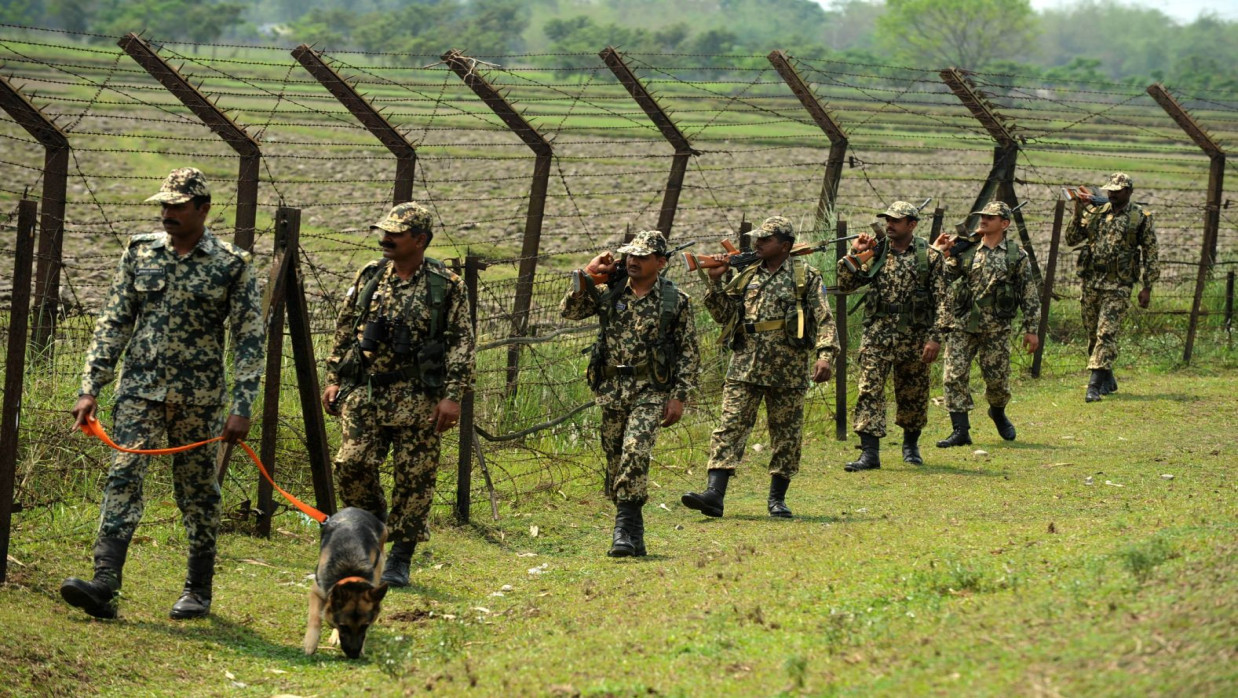
In the highly charged and fragile geopolitics of South Asia, symbolism plays a crucial role. India's reported plans to explore the use of snakes and crocodiles in border areas with Bangladesh, where fencing has not yet been completed, represent an extremely symbolic and problematic proposal that might fundamentally redefine the character of the India-Bangladesh relationship.
Even if the reptile plan remains limited to the feasibility exploration stage only, there is enough reason to worry about the implications of such a bizarre border protection policy. It reflects the increasing inclination towards hyper-securitization in India's security apparatus, which favors deterrence at any cost and sometimes even manipulates ecology and risks human security.
Beyond Security: The Politics of Deterrence
Under the Modi administration, the border management strategy has been moving toward a policy of visible, active control. From implementing large-scale fencing projects and advanced technological surveillance systems to mobilizing additional forces to guard the frontier, India's border management strategy has been focused on impermeability.
The reptile policy proposal, reportedly in accordance with the directive of the Home Minister Mr. Amit Shah, represents another extension of the border security philosophy. The use of dangerous snakes and crocodiles in border areas is tantamount to the weaponization of ecology and demonstrates India's readiness to exploit the borderland nature for deterring potential infiltrators.
However, such measures have serious repercussions for the character of India-Bangladesh border policy as the framing of the region as a zone of threats and danger is likely to increase. Moreover, it might adversely affect those who live on the border between the two neighboring countries.
Rhetoric and Resentment: Political Discourse and the Deepening Trust Deficit
Alongside border policies, an important dimension of the Bangladesh-India relationship in recent years has been the highly polarized rhetoric emanating from India's political establishment. Both Home Minister Mr. Amit Shah and West Bengal BJP opposition leader Suvendu Adhikari have engaged in a rhetoric of demographic threat to India posed by illegal immigration. Their statements are usually framed in a way that makes Bangladesh seem the primary source of such infiltration.
While such aggressive, polarized rhetoric serves India's domestic political purposes and helps the BJP secure votes, it has damaging diplomatic consequences. Such statements from high-profile Indian politicians are received as derogatory remarks about the Bangladeshi nation and as insults to Bangladeshi dignity. In the era of the free flow of news, such messages spread rapidly beyond the domestic boundaries of the politician's constituency, thus contributing to حساسیت between the countries.
Over the past few years, this process of rhetoric of Bangladesh-bashing has helped to create a feeling of growing alienation in Bangladesh, where many feel that India has come to view its neighboring country from a security point of view instead of a partnership. As a result, anti-India sentiment is emerging and gaining momentum among some segments of the Bangladeshi population, undermining Bangladesh-India trade and regional connectivity cooperation.
Human Security and Ethical Concerns
It should be borne in mind that the India-Bangladesh border area is among the most densely populated parts of the planet. People in the border areas rely heavily on rivers that flow between the two countries, as well as the land itself, for survival. In that regard, introducing dangerous snakes and crocodiles into such an environment will have no discriminatory effect.
Instead of being able to deter any alleged infiltrators, Indian authorities will expose innocent civilians who already live in harsh economic conditions to an additional threat to their lives and livelihoods. Therefore, it is necessary to ask a moral question here as to whether it is morally right to introduce life-threatening elements into a place inhabited by people.
Apart from human security, another important consequence of such a policy decision can be a negative impact on the environment. Not only might the use of snakes and crocodiles cause ecological imbalance in the region, but it may also contribute to rising tension between humans and animals in Bangladesh and India.
Diplomatic Repercussions: Straining a Delicate Partnership
For Bangladesh, the issue of reptiles in the India-Bangladesh border area is likely to be considered in the context of ongoing tensions in border management between India and Bangladesh. In the past, Bangladesh has expressed "deep concern" over Indian border activities that violate bilateral understandings.
As such, India's introduction of snakes and crocodiles into the border area without prior coordination is likely to further reinforce in Bangladesh the perception of Indian policy as a unilateral one. Since India seeks Bangladesh's cooperation in trade and regional connectivity, such a perception is detrimental to future India-Bangladesh cooperation. Indeed, the Bangladesh-India relationship is built not only on official ties, but on mutual respect and goodwill between the countries.
Image Problem for India in the Region
As India continues to pursue a policy of becoming a major regional player with great influence in the Indian Ocean region, it seeks to cultivate an image as a responsible stakeholder in regional affairs. In such a context, the introduction of potentially life-threatening animals to the border area with Bangladesh will harm India's reputation in the international arena.
The use of snakes and crocodiles in border areas will make the rest of the region perceive India as a country that uses extreme measures to solve security problems. This is particularly important, as India has been working to expand its economic and political influence in South Asia and beyond through various forms of cooperation.
Parallelisms with Other Countries
Despite certain parallels with strategies adopted elsewhere, India's approach stands out for the unconventional, highly controversial means it employs.
As in the case of Israel, the main feature of India's strategy is the adoption of a highly securitized approach to border security grounded in an existential security paradigm. Therefore, India follows the Israeli example in constructing fortifications and erecting advanced surveillance technology in the border areas. However, in contrast to India's policy, Israel's approach does not include the deliberate use of dangerous animals, although both Israel and India rely heavily on technological advancement in border security.
Similar to the situation in Israel, in the United States, under the Donald Trump administration, a controversial issue was raised concerning the building of a wall between America and Mexico as a sign of sovereign authority and absolute control. Although the issue of the wall has been used as a political tool for addressing the problem of immigration and economic competition between American and Mexican communities, it was never associated with the use of dangerous animals.
Despite differences in approach, both India's and Israel's border strategies demonstrate the securitization of border management, with the policy area framed in terms of national security. In contrast to India, however, Israel has not resorted to the use of reptiles to secure the border.
Geopolitical Implications
Given the ongoing global trend of fortifying borders and making them impermeable through the implementation of advanced surveillance technologies, India's policy of using potentially dangerous animals to secure the border is likely to become a controversial one.
On the one hand, this approach to border security is consistent with the global trend of strengthening borders; on the other hand, it is unique because of its unconventional character and controversial implications.
For Bangladesh, such an innovative and unorthodox approach will confirm its long-held assumption about India's increasingly coercive approach to border management. As Bangladesh perceives the reptile proposal as a manifestation of India's policy of treating Bangladesh as a security problem, it will have serious geopolitical implications.
Constructive Approach
Addressing security problems along the Bangladesh-India border is a challenging task for both countries and requires a comprehensive strategy that involves multiple instruments. Apart from illegal border crossings and smuggling, a host of social and economic factors make this issue especially complicated.
Although some aspects of the problem do indeed require strict safety measures, using reptiles to deter potential infiltrators might have adverse implications. Therefore, a better and more constructive approach would involve multiple steps.
First, joint measures taken by India and Bangladesh to manage the border are needed. Cooperation between the two countries, coordination of on-the-ground actions, and intelligence exchange are necessary to enhance border management capabilities while establishing greater trust between Bangladesh and India. Second, it is vital to leverage modern technological advances to secure vulnerable stretches of the border. Advanced drones, satellites, sensors, and modern surveillance technologies can be used to monitor the area without posing any risk to local people.
Third, as economic conditions and poverty in borderlands have been proven to be a source of instability in many cases, investing in the development of the border areas and promoting economic cooperation would help mitigate the problem. Finally, diplomatic coordination between the two countries' approaches to addressing the issue will play an important role in ensuring the successful management of the problem.
Conclusion: A Test of Strategic Wisdom
The reptile proposal, even though it remains at the level of feasibility exploration, poses a significant test for India's strategic wisdom. Despite the apparent effectiveness of such a strategy, there are serious geopolitical, diplomatic, and environmental concerns about such a policy choice.
In the Bangladesh-India relationship, the use of dangerous snakes and crocodiles along the India-Bangladesh border is extremely controversial. Considering the history of close ties between the two countries and their shared future, India should rethink its border security policy and adopt a different approach.


0 Comments
LEAVE A COMMENT
Your email address will not be published