

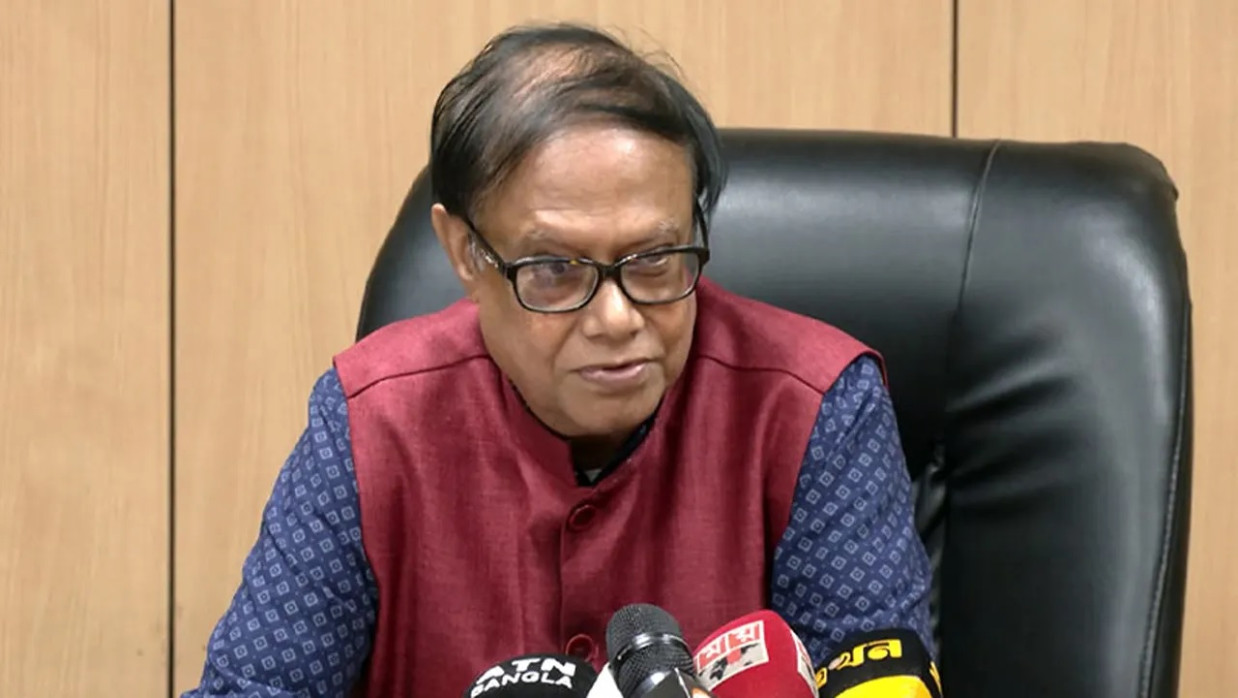
Bangladesh Bank Governor Ahsan H Mansur’s recent dismissal has sent shockwaves through Bangladesh’s political and economic circles. While economists and commentators have applauded his measures to clean up Bangladesh’s leaky banking system, ordinary bank customers have reacted with anger. After having their banking transactions blocked, many depositors saw Mansur as the person who “blocked their money”. However, the situation was far more nuanced than that.
The immediate cause of the public backlash against Governor Mansur can be traced to Bangladesh’s ailing banking sector. When he first entered office after Bangladesh’s political turmoil in 2024, Mansur faced a banking sector operating under strict reserve requirements set by Bangladesh Bank. All commercial banks are required to maintain reserves with the central bank. Traditional banks keep 17 percent of total deposits, 13 percent of securities, and 4 percent of cash reserves. Islamic banks keep reserves of 9.5 percent. The most important ratio is the Cash Reserve Ratio (CRR), currently set at 4 percent of bank deposits.
Upon assuming office, Mansur learnt that not only had these banks failed to maintain these reserves, but some had actually withdrawn money from their primary accounts, resulting in negative balances. That’s right. Insolvent banks started siphoning liquidity from the central bank. The numbers were astronomical. First Security Islami Bank had negative reserves of over Tk 10,600 crore. Islami Bank Bangladesh stood at over Tk 7,100 crore. Social Islami Bank was short by Tk 4,400 crore. National Bank’s deficit was close to Tk 3,500 crore. Union Bank, Global Islami Bank, and Bangladesh Commerce Bank were also found wanting. Altogether, these banks siphoned nearly Tk 30,000 crore illegally from Bangladesh Bank.
Now Mansur was faced with two unpleasant choices. Had Bangladesh Bank continued supporting these banks with liquidity, there would have been no depositors’ run. But that would have meant rewarding bad banking and burying the country deeper into crisis mode. Bangladesh Bank would have had to print trillions to prop up insolvent banks. This would have caused hyperinflation, currency devaluation, and a mass exodus of international investors from Bangladesh.
Instead, the governor took matters into his own hands. Bangladesh Bank discontinued the unethical liquidity support to these banks starting in August 2024. Overnight, several banks collapsed. Millions of depositors found it extremely hard to withdraw their money. The governor became the enemy in the eyes of hundreds of thousands who queued up at banks only to be turned away. Everyone was angry at the governor. Their banks had been looted for years. Some bank owners were politicians. But instead of a few crooks eating millions of depositors’ savings for breakfast, they were angry at the man who actually stood up and did something about it.
Another of Mansur’s extreme yet necessary measures was unveiling these banks’ concealed non-performing loans (NPLs). Bangladesh Bank had previously estimated the overall bad loan ratio of the country’s banking sector to be around Tk 3 trillion. Once subjected to international accounting standards and greater transparency, Bangladesh Bank revealed it to be closer to Tk 7 trillion. Critics said this was proof that Mansur single-handedly crashed Bangladesh’s banking sector. Supporters of the governor would argue that making people see the true face of the crisis was his single greatest accomplishment.
Released figures towards the end of 2025 showed Union Bank’s NPL ratio reaching 96.64 percent. First Security Islami Bank came in at 96.20 percent, and Global Islami Bank was next with 95.70 percent. Padma Bank was at 91.09 percent, ICB Islami Bank at 86.49 percent, AB Bank at 87.68 percent, and National Bank at 84.44 percent. Nearly all the money lent by these banks was defaulted.
Powerful business interests loomed behind most of the scandals. Estimates of stolen funds ran into billions of taka. At the top of numerous 'most wanted' lists was textile magnate-turned-politician Matiur Rahman Nizami’s embattled S. Alam Group, which owned three distressed banks. Some of these funds were deposited in foreign accounts, the retrieval of which posed its own set of daunting challenges.
Mansur did try a number of structural reforms, however. He put together a proposal to merge five loss-making banks, for instance. He also considered closing several of the looted leasing companies. Mansur’s rationale was simple: it made more sense to salvage what little banks you could rather than throw good money after bad by trying to keep lenders hemorrhaging money and failing to stay afloat. Economists widely praised these proposals, which saw him likened to “a surgeon who wanted to operate on Bangladesh Bank’s sick banks”.
Of course, reforms came at a price, too. Several banks’ shareholders were left high and dry after trading in their banks’ stocks was suspended on the exchange. Tk 2,206 crore worth of shares owned by retail investors were scrapped during the reforms. Mansur’s reforms infuriated investors.
In addition to bank cleanups, there were notable upticks in foreign exchange reserves. Pressure on the taka subsided, remittance flows grew, and the central bank reached a staff-level agreement with the IMF. BB had also taken tentative steps towards revamping prudential regulation and oversight.
Unsurprisingly, Mansur did not enjoy the full support of the ruling clique. Bangladeshi politics left him with almost no room to maneuver. The interim government lacked the teeth or the will to jail thousands of bank directors and major loan defaulters. It could not seize their properties either. Until that happened, Mansur would be damned if he tried restructuring banks, and damned if he didn’t.
He was no saint either. Mansur talked too much and gave too many interviews, many critics argued. Bank governors typically speak on behalf of their institutions. Mansur didn’t refrain from commenting on contentious issues.
In the end, Ahsan H. Mansur became a paradoxical figure in Bangladesh’s economic history. To depositors struggling to access their money, he appeared to be the villain. To economists and reform advocates, he was the technocrat willing to confront a deeply corrupted system.
Someone had to do the difficult work of exposing the truth about Bangladesh’s banking crisis. Mansur chose to do it, knowing that doing the right thing rarely makes one popular. History may judge him more kindly than the angry voices of the moment.


0 Comments
LEAVE A COMMENT
Your email address will not be published