

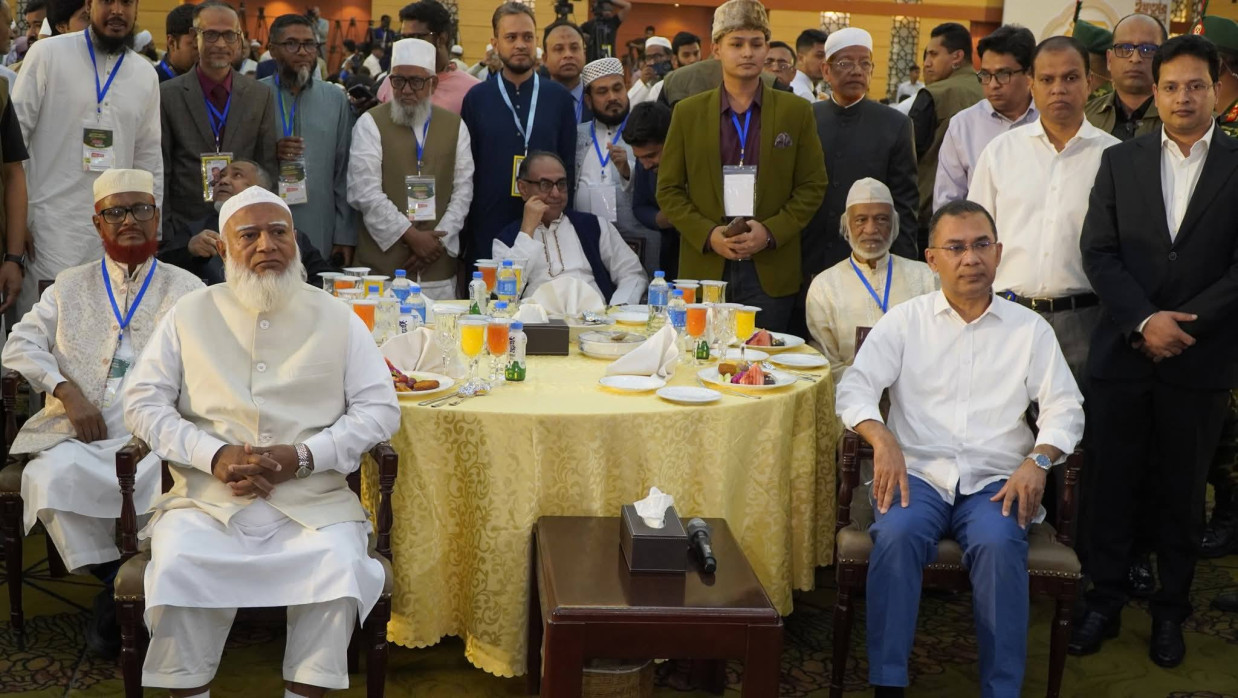
The outcome of Bangladesh’s parliamentary election is decisive. The Bangladesh Nationalist Party (BNP) has returned to power after two decades, securing a two-thirds majority with 212 seats for its alliance. The Jamaat-e-Islami–National Citizen Party (NCP) coalition won 77 seats, positioning itself as the largest opposition bloc in parliament since 1996.
Following 17 months of interim rule under Muhammad Yunus after the collapse of Sheikh Hasina’s 15-year regime, this election represents the first clear move in Bangladesh’s post-authoritarian transition. Hasina’s Awami League (AL), which had governed through highly centralized and coercive control since 2009, was barred from contesting the election over its role in the 2024 crackdown, with much of its senior leadership either in exile or behind bars. In this altered political landscape, the vote signals a structural reconfiguration of Bangladesh’s political order.
Why BNP Won
First, the BNP’s victory reflects its ability to mobilize legacy votes; the party carries a distinctly multi-generational political identity. Its founder, a hero of the 1971 Liberation War and army general–turned–president Ziaur Rahman, promoted a sovereignty-centered vision of statecraft and articulated a form of Bangladeshi nationalism grounded in inclusiveness—an ideological framework that continues to resonate with a significant segment of the electorate. Zia’s widow, Khaleda Zia, served two terms as prime minister and died days before the election. She had a long record of uncompromising politics and was imprisoned during Hasina’s era on politically motivated charges. As a result, the legacy of the Zia couple continues to resonate across the country. The return of the party's Chairman Tarique Rahman, the son of the Zia couple, after 17 years in exile generated new momentum within the party ranks and ultimately positioned him to become prime minister.
Second, the BNP’s organizational strength is stronger than that of its counterparts. The party has ruled the country multiple times since its inception in 1978 and has also served in opposition when its rival, the AL, was in power. Its experience in leading electoral coalitions and shaping national politics—whether from government or opposition—has given it a comparative advantage over other competitors. With the AL absent from this electoral race, the BNP became the de facto largest party with prior governing experience and deeply rooted patronage networks. Youth enthusiasm for change was genuine, but it proved insufficient to overcome the BNP’s entrenched presence and its capacity to negotiate and consolidate support across different segments of the electorate.
Second, the BNP’s organizational strength is stronger than that of its counterparts. The party has ruled the country multiple times since its inception and has also served in opposition when its rival, the AL, was in power. Its experience in leading electoral coalitions and shaping national politics—whether from government or opposition—has given it a comparative advantage over other competitors. With the AL absent from this electoral race, the BNP became the de facto largest party with prior governing experience and deeply rooted patronage networks. These networks help electoral candidates to local brokers, business actors, and informal dispute-resolution mechanisms that many voters rely on for access to jobs, protection, and state resources. In a first-past-the-post (FPTP) system, such dense micro-level networks matter more than aggregate vote swings, because elections are decided constituency by constituency, often by narrow margins. Even where frustration over BNP’s poor governance record marked by corruption scandals and repression pushed segments of BNP’s base toward Jamaat-NCP alliance, the party’s majority of the candidates retained name recognition that helped it to get a landslide victory. Hence, youth enthusiasm for change after a Gen Z-led uprising was genuine, but it proved insufficient to overcome the BNP’s embedded organizational networks and its ability to consolidate fragmented support into winning pluralities under FPTP calculus.
Jamaat Surged
If BNP’s victory reflects the return of the old guard, the scale of the Jamaat’s rise in the opposition signals a paradigm shift in Bangladesh’s politics. Jamaat has spent most of Bangladesh’s political history on the margins. Its stance against independence in 1971 left a lasting legitimacy problem, and for years the party survived through restriction, backlash, and a politics that depended on alliances rather than standalone strength. That is why this election is a real turning point: for the first time, Jamaat is not just present in parliament—it is the main opposition.
Jamaat won 68 seats on its own and reportedly pulled around 30–35 percent of the vote in roughly 225 constituencies it contested—far above its old 5–10 percent range. Part of the story is organizational nature. Jamaat works with a disciplined cadre based network—built through institutions and their student wing Islami Chhatra Shibir’s pipeline. Unlike the BNP’s patronage-driven approach, Jamaat sells a different claim: politics through welfare and service, backed by a web of charities and social institutions that provide education, healthcare, and humanitarian support. This time, Jamaat’s alliance with the youth-based NCP added what Jamaat had historically lacked: nationwide legitimacy linked to the July uprising and broader appeal among Gen Z voters through digital mobilization, while Jamaat supplied organizational structure and grassroots resources.
This is also Jamaat’s first real chance to prove itself as a responsible opposition. It now has the platform to shape parliamentary debate, and develop narratives that go beyond moral branding. If it performs that role well—inside parliament and in public—it can signal governing competence to domestic audiences and to the international community. If it fails, this moment may still be historic, but it won’t be durable. If Jamaat wants these electoral gains to translate into long-term political consolidation, it must expand beyond its core cadre base and become meaningfully more inclusive—especially toward moderates, less ideological voters, and religious minorities. The question of women’s leadership is central as well: a party that cannot speak credibly to women as equal citizens—on rights, economic opportunity, and representation—cannot become a true mass party in Bangladesh.
NCP’s Electoral Breakthrough
The NCP enters Bangladesh’s political arena at a moment shaped by memory and disruption. The country has a long history of youth-driven political change—from the 1952 Language Movement to the mass mobilizations that unseated military rulers and reshaped the state’s direction. What makes the NCP different is not simply that it emerged from the July uprising, but that it seeks to stand on its own rather than dissolve into an older party’s shadow. For decades, youth energy in Bangladesh eventually flowed back into established political camps. NCP represents an attempt to institutionalize that energy into an independent political force. Its six parliamentary seats may seem modest, but for a newly formed party operating in a polarized environment, that foothold is significant. It signals that a segment of the electorate is willing to invest in a new platform rather than default to inherited loyalties.
At the same time, the party’s decision to align electorally with Jamaat was not without cost. The alliance created internal tensions and prompted some resignations, revealing the difficulty of balancing ideological positioning with electoral pragmatism. Yet the fact that NCP survived that turbulence and still mobilized enough support to enter parliament suggests that its base is not entirely fragile. Jamaat’s sharp rise in vote share in many of the constituencies it contested also indicates that a segment of NCP-leaning voters ultimately backed the alliance ticket, helping to widen Jamaat’s margins. That pattern signals that NCP’s appeal was not electorally irrelevant; it likely contributed to expanding the coalition’s reach in closely fought seats.
Going forward, NCP must rebuild internal cohesion, re-engage figures who distanced themselves before the election, and expand its presence across youth-oriented and civic platforms without appearing narrowly generational. If it wants durability, it cannot remain a momentary expression of protest politics; it has to develop organization, local leadership, and policy depth that extend beyond the uprising’s emotional legacy. NCP’s strategic opportunity lies in occupying the political center. Rather than positioning itself strictly as right or left, secular or religious, it can frame itself around reform, institutional accountability, and governance competence. That means articulating credible proposals on jobs, education, digital economy, corruption, and sovereignty-centered foreign policy—issues that resonate across age groups. Parliamentary visibility, independent policy messaging, and consistent grassroots engagement will determine whether NCP matures into a lasting centrist force or remains a footnote of the July moment.
Looking Ahead
The AL’s absence reshaped the electoral map, but it did not erase its voters. Turnout at 59.44 percent suggests that a portion of loyal AL supporters stayed home rather than realign. In its current form and leadership configuration, the AL has little prospect of immediate national recovery. A meaningful return would require new leadership, acknowledgment of past abuses, and acceptance of the post-July political reality. For Prime Minister Tarique Rahman, facilitating AL’s return into mainstream politics would be politically costly. Hence, allowing grassroots political participation while conditioning broader reintegration may be the workable path for now.
The BNP also confronts the classic patronage dilemma. The same local networks that delivered victory now generate expectations—access to contracts, influence, protection. If unchecked, BNP grassroots excesses, intimidation, or attacks on NCP and Jamaat supporters will quickly erode the moral capital gained after the uprising. Tarique Rahman’s leadership will be judged not only by reform promises under the July Charter but by whether he disciplines his own party machinery. Electoral legitimacy must convert into performance legitimacy: law and order, inflation management, administrative neutrality, and visible restraint at the grassroots level. Failure would not simply weaken the BNP—it would strengthen organized alternatives waiting to capitalize on public frustration.
The immediate institutional test will be the upcoming local government elections. If sub-district and city corporation polls are conducted credibly, with minimal political interference and genuine competition, the BNP administration can signal a break from past electoral manipulation. That would reinforce its reform narrative and demonstrate confidence in democratic procedures. If the process appears engineered or partisan, resentment will deepen and opposition forces will gain momentum. The BNP government’s ability to manage patronage pressures, prevent post-election violence, and deliver credible local elections will determine whether this transition consolidates or fragments further.

0 Comments
LEAVE A COMMENT
Your email address will not be published