

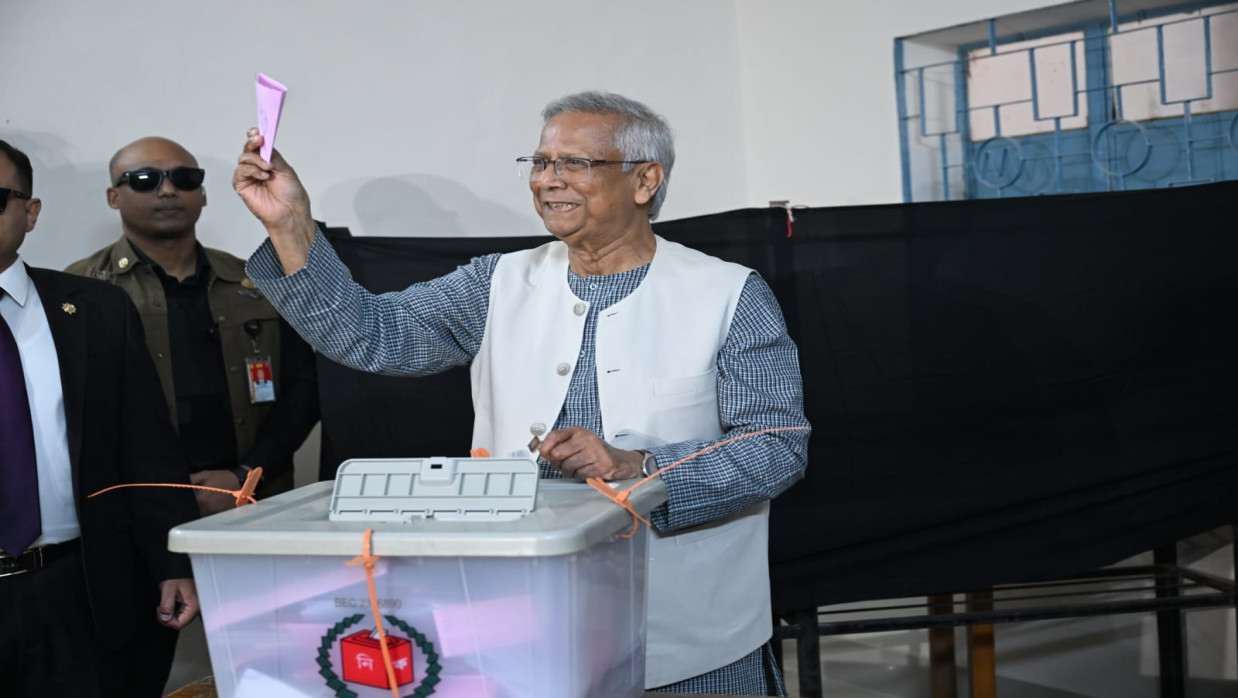
Recently, Prof. Sreeradha Datta, Professor of International Affairs at O.P. Jindal Global University, gave an uncommon and thoughtful insider view of Bangladesh’s upcoming 2026 national election in an interview hosted by Mani Shankar and Suneet Aiyar of the YouTube news channel. Having been the sole Indian national invited to serve as an international election observer, Dr. Datta shares her unique perspective. The essay quotes from and briefly summarizes the interview, available online, and does not violate copyright restrictions on verbatim reprinting.
“It was refreshing”, remarked Dr Datta, “to be able to move away from what we see in the media […] in India, especially, there has been a lot of sort of alarmist coverage. There’s also been triumphalist coverage from Bangladesh. Neither tells the full story.”
Election Day: Transparency, Technology, and Order
Dr. Datta arrived just hours before polls opened and took part in a full-day orientation session hosted by Bangladesh’s Chief Election Commission. More than 650 observers from abroad were joined by roughly 400 journalists an extraordinarily high turnout of outside observers, she felt, reflected an institutional push for transparency.
Observers could access polling stations with few restrictions, though filming voters as they cast ballots was prohibited. Technology was also leveraged to change polling operations: Voters could now search for polling stations online using their National ID (NID) cards. Bodycams and drones were deployed for additional security.
Polls were expected to be cancelled, disrupted, or worse before they opened. But Dr. Datta describes a calm Election Day in which polls opened and closed systematically, security was tight and visible, and, for those candidates who chose to take part, “free and fair.”
She tempers this conclusion with one qualification: competitive, but not inclusive.
Ghost of “election engineering” haunts again
Bangladesh has witnessed every national election shadowed by controversy and allegations of foul play. Terms may differ from election to election, ranging from “engineered” to “administrative bias” to “implicit interference,” but the sentiment underlying these charges boils down to one word: mistrust.
The latest election has been no exception.
Leaders of Bangladesh Jamaat-e-Islami (BJI) have claimed irregularities in multiple constituencies where results were decided by razor-thin margins. BJI did not accuse the Election Commission of blatantly stuffing ballots in those constituencies. Rather, they accused electoral authorities of what they termed “administrative discretion,” the minutiae decisions that accumulate over the course of an election season and can ultimately swing close races.
Marginal constituencies in Bangladesh are frequently regarded as more skeptical than larger-margin constituencies.
Delimitation controversy again!
And while allegations have been made chiefly regarding vote counting on election-day, candidates across the political spectrum have also taken issue with constituency delimitation once again.
Article 119(4) of Bangladesh’s Constitution and clause 9 of Chapter II of the Representation of the People Order grant delimitation powers exclusively to the Bangladesh Election Commission (BEC). The Commission can delimit constituencies based on what it considers a reasonable population size and administrative convenience.
This power is not without politics.
Delimitation critics argue that the Commission drew constituency boundaries that could disproportionately affect constituencies where ratios of urban/rural voters or other demographic divides play pivotal roles in determining an election’s outcome. While semantics come into play here after all, “gerrymandering” has a very specific connotation in law, such accusations do fit the political rhetoric generated in Bangladesh by two major political parties who share mutual disdain for each other.
BEC claims that they drew constituency boundaries solely on the basis of census data and with reasonable technicality.
Opposition politicians have long expressed dissatisfaction with delimitation procedures, claiming inadequate timeframes for consultation and review.
Engineering trust, again
The problem may stem from trust.
Bangladesh has seen elections held under a caretaker government, party-specific governments, and hybrid caretaker bodies over the past two decades. Accusations have been thrown every which way during every single election, but the integrity of the Election Commission itself is well-established under the Constitution.
The problem here is that administrative decisions are often viewed through partisan lenses. Marginal wins invoke further scrutiny. Results with narrow margins leave room for speculation. Operational “technicalities” can be construed as engineered rather than administered.
So why does this happen every time?
Because there is already enough distrust in our institutions.
This year’s election is not unique. It is not the first and hopefully not the last. What makes this year’s allegations predictable is that they have happened before, and they will continue to happen until institutional trust is built.
Democratic processes are built on trust when voters believe that election results are legitimate, and both the victors and the losers can accept the outcome. But when that trust is low, which victory is legitimate? That question will remain unanswered until there’s enough trust in our electoral process.
A Free but Non-Inclusive Contest
There was no Awami League this time around, Bangladesh’s largest ever party. Analyst Dr. Datta pointed out that elections were contested between two alliances: ten parties led by the Bangladesh Nationalist Party (BNP) and eleven parties led by Jamaat-e-Islami (Jamaat).
“This is the first reasonably fought election since 2008…but not fought by all actors.” Without the Awami League’s access to polling stations and the votes they would typically draw, Bangladesh lacked something this time around.
Dr. Datta was keen to avoid viewing the election through the lens of Bangladesh’s past. Although the alliance led by the BNP campaigned on rhetoric about 1971, voters did not see the election as about Bangladesh’s independence. Dr Datta said that issues such as jobs, development, and corruption were significant themes across party manifestos.
Youth and Women: The Decisive Electorate
Another takeaway from Dr. Datta was on demographics. Close to 40 per cent of Bangladesh’s eligible-to-vote population is between 18 and 38 years old. “They wanted accountable government more than ideological fights or Bangladesh’s relationship with India”, she said.
Speaking on expectations of anti-India rhetoric spilling over into the election narrative, as it has sometimes done in India, Dr. Datta clarified that although there were questions about domestic issues such as employment and corruption, India itself wasn’t a major issue for voters.
This brings us to another important demographic. Female voters make up close to 51 per cent of the population. “Yes, women in Bangladesh do face systemic problems such as gender-based violence and party-rigidity in implementation, but they did vote in large numbers too. Civil society and NGOs have actively worked towards educating women on political issues,” she highlighted.
Finally, it was also heartening to see minorities and people with disabilities present at polling booths.
Minority Insecurity and Media Amplification
A sensitive issue Dr. Datta tackled was the safety of Hindus. She stated that while there have been cases of violence and intimidation, Bangladesh has been made out to be something it’s not by some external media. There have been some incidents instigated by local political parties that were more about land grabs or money rather than sectarian violence, she added. “Voters did not necessarily vote for someone who they saw as their ‘protector’ from outside forces,” she said. “They wanted to vote for their own country, their own nationalism, and wanted that safety factor to be established within Bangladesh itself.”
Jamaat-e-Islami’s Evolution
Bangladesh Jamaat-e-Islami is among the most organized political forces in the country. Datta noted the difference between generations of Jamaat leaders. Compared to older leaders, the younger generation presents itself with a softer rhetoric. They talk about good governance and anti-corruption. They claim to practice financial transparency and accountancy, including zakat audit.
Ideologically, Jamaat fails to reach out to women due to its conservative social values. In addition, its past support of Pakistan and role during the 1971 war make it susceptible to negative perceptions.
It seems unlikely that Jamaat would be considered an extremist bloc these days. The party is positioning itself for acceptability.
Foreign Policy: Balancing, Not Pivoting
“The concerns of a rapid revival of ties with Pakistan under a BNP- or Jamaat-led government have been ‘exaggerated’, says Dr Datta.” Quoting BNP chief Tarique Rahman and others, Shayanaj Choudhury writes, “Bangladesh's foreign policy will not change. India will remain our biggest neighbor and most important partner, while our ties with Pakistan will be balanced and not biased.”
Given its geography, with India on one side and the Bay of Bengal on the other, Bangladesh will also have China as a “significant investor”. So there has to be give-and-take on all fronts. “All that this election means is recalibration in the act of balancing acts.”
India will do well to read this as “relationships cannot be taken for granted”.
Between Transition and Realignment
In Dr. Datta’s words, Bangladesh faces democratic regression rather than democratic breakdown. There are elements of continuity with the past election and elements of rupture. The institutions are likely stronger. Voters may care more about issues such as good governance than they did in past elections. Demographics will also play a large role in shaping the next election.
However, what remains to be seen is how Bangladesh will navigate its democracy without the Awami League being at the table. Another election will need to be held, and ideally, all players will come to the table.
Democratically or not, Bangladesh will also look to play both sides of India and China. New Delhi should give Bangladesh space to work out its own issues rather than see Bangladesh through the lens of its own insecurities.
That’s a perfect summary of what Dr. Datta had to say about Bangladesh during our interview on YouTube. She does not see it as a crisis or as a sign of defeat. She predicts a strong election with new players and India watching closely.
Ghost of “election engineering” haunts again
Bangladesh has witnessed every national election shadowed by controversy and allegations of foul play. Terms may differ from election to election, ranging from “engineered” to “administrative bias” to “implicit interference,” but the sentiment underlying these charges boils down to one word: mistrust.
The latest election has been no exception.
Leaders of Bangladesh Jamaat-e-Islami (BJI) have claimed irregularities in multiple constituencies where results were decided by razor-thin margins. BJI did not accuse the Election Commission of blatantly stuffing ballots in those constituencies. Rather, they accused electoral authorities of what they termed “administrative discretion” – the minutiae decisions that come together over the course of an election season and can ultimately swing close races.
Marginal constituencies in Bangladesh are frequently regarded as more skeptical than larger-margin constituencies.
Delimitation controversy again!
And while allegations have been made chiefly regarding vote counting on election-day, candidates across the political spectrum have also taken issue with constituency delimitation once again.
Article 119(4) of Bangladesh’s Constitution, and clause 9 of Chapter II of the Representation of the People Order, give delimitation powers exclusively to the Bangladesh Election Commission (BEC). The Commission can delimit constituencies based on what it considers a reasonable population size and administrative convenience.
This power is not without politics.
Delimitation critics argue that the Commission drew constituency boundaries that could disproportionately affect constituencies where ratios of urban/rural voters or other demographic divides play pivotal roles in determining an election’s outcome. While semantics come into play here – after all, “gerrymandering” has a very specific connotation in law – such accusations do fit the political rhetoric generated in Bangladesh by two major political parties who share mutual disdain for each other.
BEC claims that they drew constituency boundaries solely on the basis of census data and with reasonable technicality.
Opposition politicians have long expressed dissatisfaction with delimitation procedures, claiming inadequate timeframes for consultation and review.
Engineering trust, again
The problem may stem from trust.
Bangladesh has seen elections held under a caretaker government, party-specific governments, and hybrid caretaker bodies over the past two decades. Accusations have been thrown every which way during every single election, but the integrity of the Election Commission itself is well-established under the Constitution.
The problem here is that administrative decisions are often viewed through partisan lenses. Marginal wins invoke further scrutiny. Results with narrow margins leave room for speculation. Operational “technicalities” can be construed as engineered rather than administered.
So why does this happen every time?
Because there is already enough distrust in our institutions.
This year’s election is not unique. It is not the first and hopefully not the last. What makes this year’s allegations predictable is that they have happened before, and they will continue to happen until institutional trust is built.
Democratic processes are built on trust when voters believe election results are legitimate, and both victors and losers can accept the outcome. But when that trust is low, which victory is legitimate? That question will remain unanswered until there’s enough trust in our electoral process.


0 Comments
LEAVE A COMMENT
Your email address will not be published