

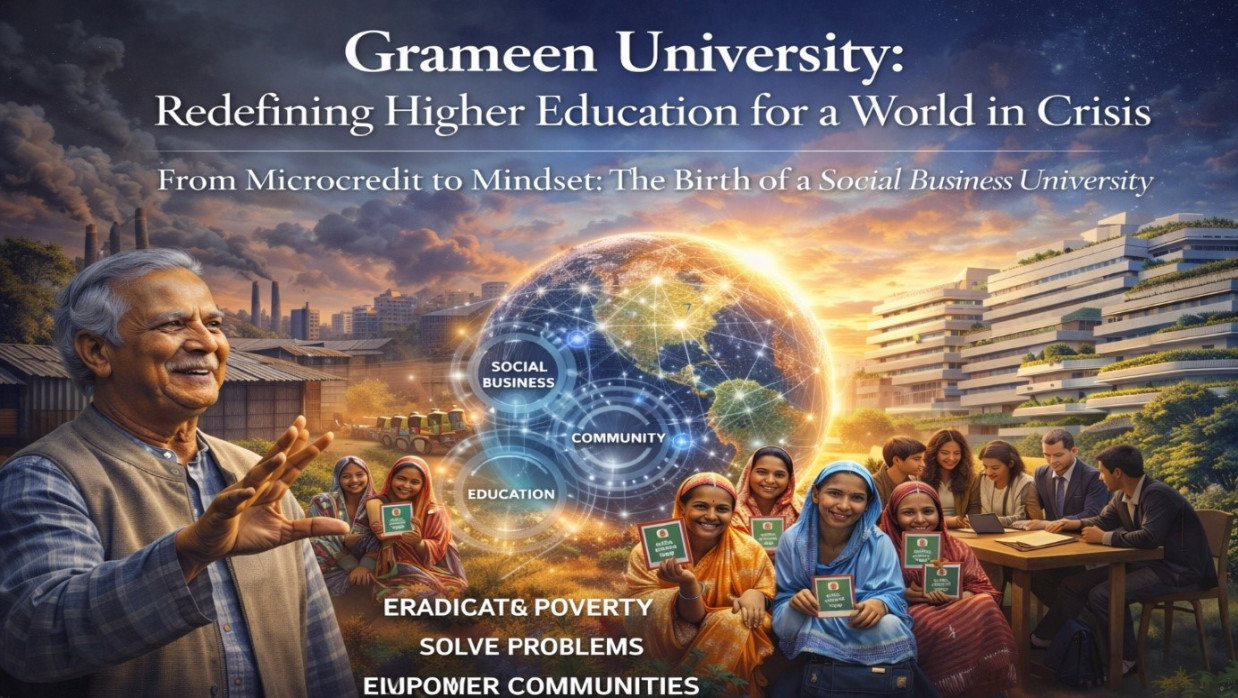
A New Paradigm in Higher Education
The concept of Grameen University comes at a time when higher education worldwide is facing serious scrutiny and re-evaluation. The rising cost of higher education, increased inequalities in access to higher education, and graduate unemployment are forcing educators and policymakers to rethink and re-evaluate the fundamental role and purpose of higher education. Inspired by the legacy and tradition of Grameen Bank and the moral and economic thinking of Muhammad Yunus, Grameen University does not represent incremental change but fundamental transformation and revolution.
Traditionally, higher education has been primarily a knowledge-producing entity, a credentialing institution for the elite, and a research institution with a strong nexus with either national or corporate interests. Although this model has led to tremendous scientific and technological progress, it has also led to increased social stratification. However, Grameen University breaks this historical pattern and repositions education as a tool for poverty reduction and social upliftment. Thus, it does not reject excellence but redefines it.
- Education Anchored in Social Business Philosophy
At the core of Grameen University lies the philosophy of social business, which rethinks and reconfigures capitalism as a tool for social upliftment and problem-solving without any personal profit motive. Conventional business schools and their academic programs are designed to train managers to increase shareholder value, build competitive advantage, and become market leaders. Case studies are often based on corporate growth strategies, mergers and acquisitions, and profit maximization.
Grameen University would likely have a curriculum focused on identifying underlying social problems and developing financially viable business ventures to address them. Instead of teaching students how to build a multinational apparel company, for instance, the university could teach them to create a solar energy cooperative for rural villages or a food-based business to address malnutrition.

Students could also be required to participate in a capstone experience to create a social business and implement it in a rural setting. The measure of academic success would not be a business plan presentation, but rather the impact on the community. Profit would be a means to sustainability, not an end in itself. This educational paradigm shift is revolutionary, as it aligns with humanity's needs rather than capital's interests.
- From Ivory Tower to Village-Centered Knowledge
Conventional universities are ivory towers where knowledge production occurs within their walls and eventually trickles down to the community. The community becomes the subject of academic study. Grameen University’s model, on the other hand, would likely have a curriculum wherein the university and the community are not separate entities.
For instance, a public health program could have students and professors embedded within a rural community to co-create affordable health initiatives for mothers. Or an agricultural innovation program wherein students and professors are embedded within a rural community to co-create initiatives to improve crop yields using climate-resilient agricultural practices.
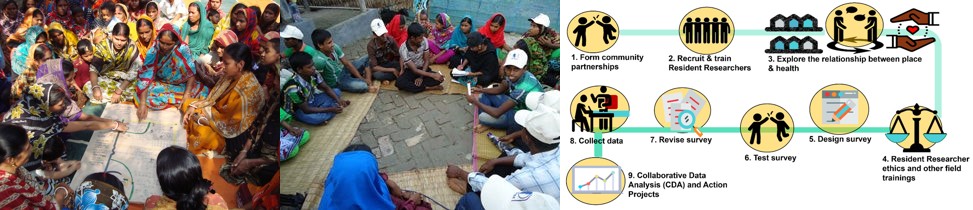
This participatory approach to research ensures that it is rooted in reality. It also bridges the epistemic divide between the research elite and the rest of society. When the community is involved in the production of knowledge, higher education is democratized. The village is no longer just another research site; it is transformed into a classroom.
- Redefining the Purpose of Higher Education
Universities such as Harvard and Oxford are globally renowned institutions that have been at the forefront of academic excellence for centuries. The research produced by these institutions is considered highly significant to global policy-making. Academic institutions are deeply entrenched in the elite's access structures.
What if Grameen University defined academic excellence differently? What if it measured its academic excellence based on the number of successful social enterprises it spawned, the level of poverty reduction it achieved, or the number of first-generation students it empowered?
For instance, if a student at Grameen University establishes a women’s cooperative employing 200 rural women, it would be a metric of academic excellence. Similarly, if research produced by the university shapes the country’s poverty-reduction strategy or climate change policy, it is a metric of academic excellence.
- Institutional Design Beyond Profit Motives
Universities operate either as corporate entities or philanthropic entities. Grameen University’s institutional design is based on a social business model with no dividend distribution. Any surplus generated by the university would be reinvested.
What if Grameen University set up a university incubator for student-run social enterprises focused on sustainable agriculture? What if the social enterprises run by students generate profits? The profits can be reinvested to establish additional rural entrepreneurship programs or to fund new research centers focused on renewable energy.

The campus could demonstrate sustainability through solar energy, water recycling, and sustainable architecture. The tuition model could be structured to ensure affordability, with income-sharing models linked to Grameen Bank's microcredit networks. This would transform the university from a business model to a social ecosystem.
- A Global Laboratory for Ethical Capitalism
The 21st century is marked by growing inequality and environmental degradation. Economic growth is no longer linked to human development. Grameen University could be an experiment in ethical capitalism, showing that economic sustainability and social justice are compatible.
For example, a climate change innovation project could be created in which students develop models for carbon-neutral housing solutions for flood-prone areas of Bangladesh. This could be replicated for flood-prone areas of Africa or Southeast Asia. Or, a fintech project could be created to develop digital financial solutions for the unbanked population of South Asia.
The university could attract scholars from around the world who seek a new model of capitalism that combines financial sustainability with moral obligation. It could be a platform for policymakers, entrepreneurs, and scholars to explore new models of economic development.
- Bridging Microfinance and Higher Education
Grameen Bank was revolutionary in proving that the poor are creditworthy. Grameen University could revolutionize higher education by extending this model of social proof to intellectual capital. Marginalized students would not only gain education but also gain opportunities for enterprise development.
For example, a student developing a model for rural dairy cooperatives could gain access to microfinance networks for startup capital. Faculty could conduct impact studies to improve the model and make it more scalable. The community would benefit from employment generation, while research would inform new models for curriculum development.

This circular system, in which education, finance, research, and community development complement one another, does not exist in any other form in traditional higher education. Such an integrated system of knowledge and living is holistic.
- A Postcolonial Shift in Knowledge Hierarchy
South Asian countries, including Bangladesh, had long followed the knowledge hierarchy of Western countries in their academic curricula. The emergence of Grameen University, therefore, signifies academic independence. The University of Social Business has successfully demonstrated that academic innovation can originate in the Global South and then be exported to other parts of the world.
Just as microcredit was exported from Bangladesh to other parts of the world, including Africa and Latin America, the Social Business University concept may similarly take root in these regions. The University of Social Business, therefore, signifies academic independence, reversing the knowledge hierarchy between the West and the rest.
- Consistency in the Bangladesh Reform Agenda
In an era of reforms in governance and recasting the economy, Grameen University signifies imagination in institution-building. The University of Social Business seeks to align education with development, promoting transparency, accountability, and ethical leadership in governance.
If successfully implemented, it can set an example for reforms in higher education across South Asia, showing how it can be made more relevant to regional development.
Conclusion: Educating the Conscience of the World
Grameen University shall be revolutionary, not in spite of its lack of grandeur and technology. Grameen University shall be revolutionary, not despite its lack of rankings and prestige. Grameen University shall be revolutionary because of its moral architecture. Grameen University shall be revolutionary because of its unprecedented and bold attempt to redefine what it means to be a successful higher education institution. It shall redefine what it means to be successful as a higher learning institution, not based on endowment and academic citations. Rather, it shall redefine what it means to be successful as a higher learning institution based on its impact on society.
At its very essence, the University of Social Business believes that education is not merely about uplifting society. Rather, it believes that education is about uplifting society in a way that re-establishes the dignity of all people and re-imagines how people interact with each other and with their economies. Community shall not merely be central to learning at Grameen University. Rather, the community shall redefine what it means to be educated. To be educated at Grameen University shall not merely mean that a person is knowledgeable. Rather, it shall mean that a person is both knowledgeable and compassionate. To be educated at Grameen University shall not merely mean that a person is both knowledgeable and compassionate. Rather, it shall mean that a person is knowledgeable, compassionate, and collaborative.
If Grameen University is implemented in good faith, with integrity, transparency, and academic excellence, it has the potential to change the course of the world’s educational map. It would challenge all the world’s universities to rethink their social contract with humanity. Instead of graduating job seekers, it would graduate job creators. Instead of graduating executives in the art of profit maximization, it would graduate the architects of equitable growth. Instead of graduating individuals who would further entrench the existing social hierarchy, it would graduate individuals who would empower those who have been denied opportunities in the past.
In that sense, Grameen University has the potential to become one of the most important exports of Bangladesh, just as the concept of microcredit has become an important export of the country in the world of finance, so too has the concept of social business education the potential to become an important export of the country in the world of academia. It would become a shining example of how higher education, in the hands of people of conscience, can become a catalyst for change in the world. As Dr. Muhammad Yunus has reminded the world many times in the past:
“We were not born to work for money; we were born to create a world without poverty. Social business is the path to that world and education must be its foundation.”
If Grameen University becomes a reality, it would not merely educate minds. It would educate the world's conscience.

0 Comments
LEAVE A COMMENT
Your email address will not be published