

Bangladesh Now at the Center of a Strategic Tug-of-War
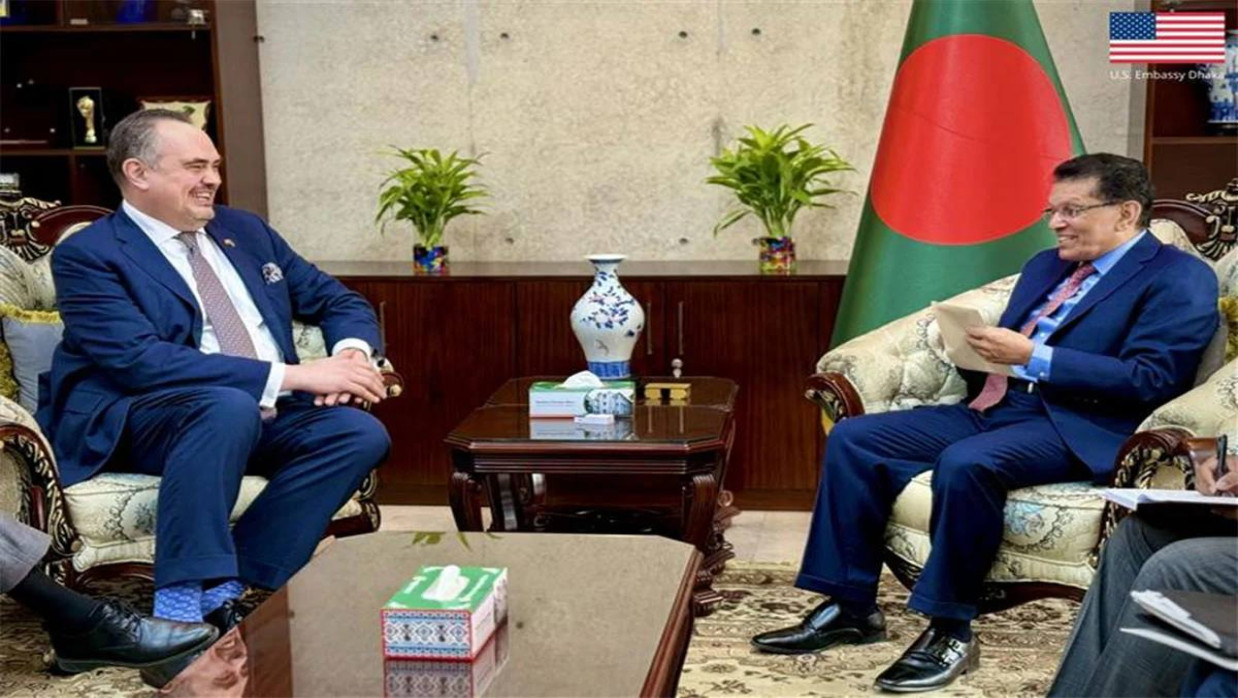
Foreign Minister Khalilur Rahman was offered diplomatic invitations from both India and China earlier today. Bangladesh has once again found itself at the center of geopolitical attention in South Asia, this time following last week’s landslide victory of the Bangladesh Nationalist Party (BNP) in the country’s general election. The foreign minister met with the Indian High Commissioner to Bangladesh, Pranay Verma, and the Chinese Ambassador to Bangladesh, Yao Wen, (Feb. 20), who separately extended invitations to him on behalf of their respective foreign ministers in Dhaka. With Prime Minister Tarique Rahman taking the helm on February 17, it seems that both regional giants are keen to recalibrate ties with Bangladesh.
Dhaka has historically been treated as a country of geostrategic importance by South Asian and Southeast Asian powers alike due to its location connecting the two regions. In recent years, Bangladesh has become a focal point of great-power competition between India and China. To an extent, Bangladesh's Foreign Minister Khalilur Rahman will have to maintain a triangular diplomatic balance among New Delhi, Beijing, and Washington, DC, going forward.
Beijing Moves Fast to Consolidate Influence
The Chinese embassy in Dhaka was quicker on the draw. Ambassador Yao Wen invited Foreign Minister Khalilur Rahman to China “at an early date,” according to a press release by the Chinese embassy. “China firmly supports the ‘Bangladesh First’ policy of the Prime Minister Sheikh Hasina,” Ambassador Yao said. “China is ready to work with Bangladesh to continuously consolidate traditional friendship between the two countries and propel the Bangladesh-China comprehensive strategic cooperative partnership to new heights.”
India Extends an Invite Promptly
Indian High Commissioner to Bangladesh Pranay Verma was also present in Dhaka to invite Bangladesh Foreign Minister Khalilur Rahman to India. Verma, on behalf of India’s External Affairs Minister S. Jaishankar, said, “Please convey the greetings of External Affairs Minister @DrSJaishankar to Prime Minister Tarique Rahman and invite him to visit India at the earliest convenience.”
Bangladesh shares close bilateral ties with India, with multifaceted connectivity between the two countries running through Chattogram and Mongla seaports in Bangladesh's south. Border security, insurgencies, and terrorism are also a top priority in Dhaka-New Delhi relations.
India has already started diplomatic outreach to Bangladesh’s new premier, the Tarique Rahman administration. But given the abruptness of last week’s election result, New Delhi will be watching Dhaka closely and hoping it can influence Bangladesh’s new government sooner rather than later.
For China, Bangladesh represents a vital node in the Belt and Road Initiative (BRI). Infrastructure investments, such as bridges, power plants, economic zones, and port development, have already cemented a substantial Chinese footprint in the country.
Beijing’s approach is less overtly security-focused and more infrastructure-centric, yet the strategic implications are unmistakable. The Bay of Bengal offers China maritime access routes critical to its long-term energy and trade security calculations.
Dhaka’s request for enhanced Chinese engagement to facilitate early Rohingya repatriation adds a humanitarian and regional dimension. China maintains leverage over Myanmar’s authorities leverage that Bangladesh hopes can be used constructively.
The message from Beijing was clear: China stands ready to work closely with the new leadership, offering economic partnership without overt political conditions.
Washington Re-enters the Equation
Adding another layer to the evolving matrix, US President Donald Trump congratulated Prime Minister Tarique Rahman on his “historic election” victory. In his letter, Trump expressed hope that Dhaka would complete routine defense agreements, granting Bangladesh’s military access to advanced American equipment.
The United States’ interest in Bangladesh has grown steadily over the past decade. Positioned along vital Indo-Pacific sea lanes, Bangladesh is increasingly relevant to Washington’s broader regional strategy.
Unlike India and China, whose interests are geographically immediate, Washington’s engagement is part of a larger Indo-Pacific architecture. Defense cooperation, maritime security, and trade expansion form the pillars of this engagement.
For Dhaka, American defense equipment offers a degree of diversification. It reduces overreliance on any single supplier and enhances strategic autonomy. But such moves also carry diplomatic sensitivities, particularly with Beijing.
The Strategic Geometry of Dhaka
Bangladesh now finds itself at the intersection of three major powers:
India is seeking stability and strategic reassurance in its immediate neighborhood.
China is consolidating economic and infrastructure influence.
United States, expanding defense and trade engagement under Indo-Pacific priorities.
The speed and symbolism of the diplomatic outreach suggest that Bangladesh’s post-election transition has triggered recalibration across capitals. No power wants to be left behind.
Yet Dhaka’s strength lies precisely in this competition.
Bangladesh’s economic trajectory, robust garment exports, expanding remittance inflows, and a growing manufacturing base give it leverage. Its geographic position astride key maritime routes further enhances that leverage. Its role in regional humanitarian crises, particularly the Rohingya issue, adds moral and diplomatic weight.
Multi-Vector Diplomacy or Strategic Tilt?
The core question is whether Bangladesh will pursue a strict multi-vector balancing strategy or drift toward deeper alignment with a single power.
Historically, Dhaka has attempted to strike a pragmatic balance, accepting Chinese infrastructure investment while maintaining close security ties with India and expanding defense engagement with the United States.
BNP’s new template starts with a more polarized environment. India-China competition is more pronounced. The US-China rivalry is more rigidified. Regional alignments are becoming more cemented.
PM Tarique Rahman’s “Bangladesh First” mantra promises that Bangladesh’s national interest will come first over bloc politics. How they translate that promise into action during rising rivalries will be interesting to watch.
Particularly, the sequencing of their visits will be noteworthy. Which country do they visit first? What deals do they strike? How is defense cooperation framed? All these will tell a story.
The Bay of Bengal as a Strategic Frontier
Beyond bilateral diplomacy lies the larger theatre: the Bay of Bengal. Maritime security, port development, undersea cables, and energy corridors are transforming the region into a frontline of 21st-century geopolitics.
Bangladesh’s ports, particularly Chattogram and the emerging deep-sea initiatives, are no longer merely commercial hubs. They are potential strategic assets in a broader Indo-Pacific competition.
India seeks assured connectivity. China seeks maritime access. The United States seeks secure sea lanes and interoperable partners.
Bangladesh must ensure that infrastructure development does not evolve into strategic dependency.
A Defining Foreign Policy Moment
For Foreign Minister Khalilur Rahman and Prime Minister Tarique Rahman, the coming weeks may define Bangladesh’s diplomatic posture for years.
A misstep could entangle Dhaka in a great-power rivalry. A skilful balancing act, however, could elevate Bangladesh’s status as a pivotal regional actor respected by all, dominated by none.
Bangladesh’s advantage lies in its restraint. It does not need to choose sides. It needs to choose interests.
In a region where power competition is intensifying, Bangladesh’s most valuable asset may be its ability to remain indispensable to all three India, China, and the United States while subordinating itself to none.
The tug-of-war has begun. The question is whether Dhaka can turn it into a triangle of opportunity rather than a contest of pressure.
The answer will shape South Asia’s strategic future.


0 Comments
LEAVE A COMMENT
Your email address will not be published