

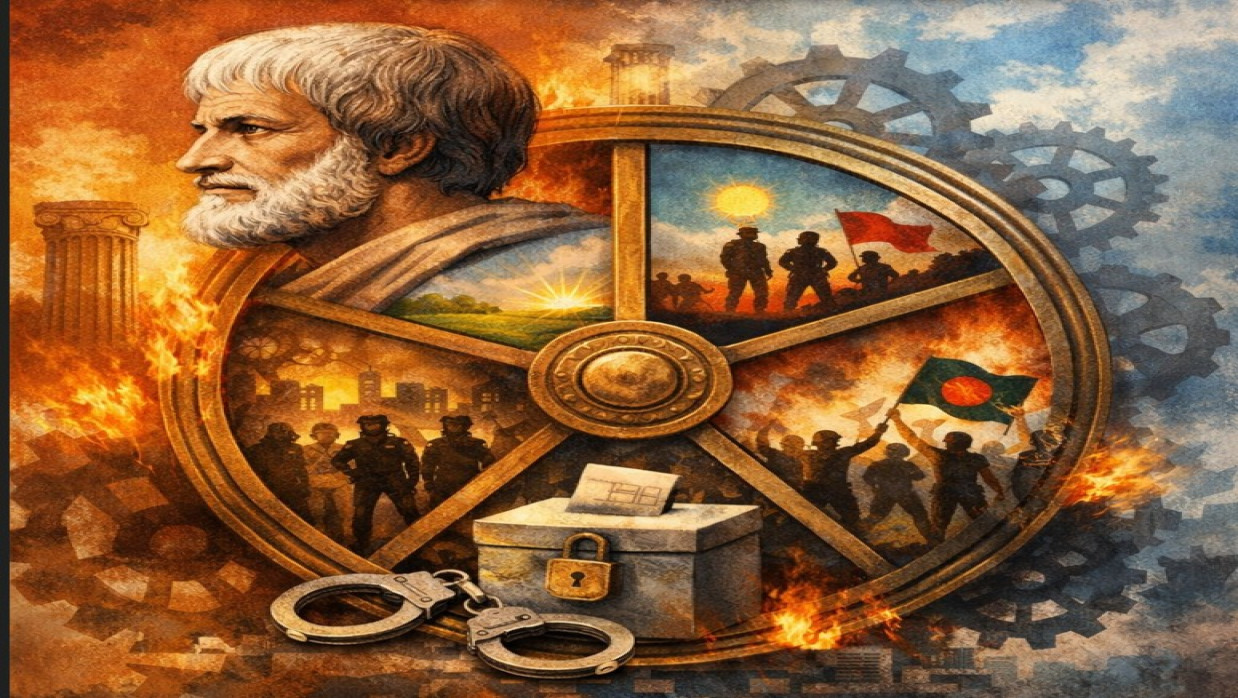
Politics does not always move in straight lines. Instead, it goes ahead, stops, falls back, and starts all over again often under new names but with old motivations. Over two millennia ago, Aristotle named this phenomenon when he wrote about political cycles systems of governance that spring up with virtue, crumble with the accumulation of power, and are rebooted in crises of return.
The political history of Bangladesh since its independence in 1971 closely resembles Aristotle’s political cycle. From idealism through authoritarianism, military rule, and democracy, and finally, an anomaly of virtue in an interim government, Bangladesh’s political past is more of rhythm than of randomness. When viewed in light of Aristotle’s political cycle, Bangladesh’s past is not really about politics; it is really about morality, morality in terms of power, virtue, and memory.
The Aristotelian Model: Why Political Cycles Happen
Aristotle’s Politics outlined six forms of government—monarchy, aristocracy, and policy being “correct” when exercised for the common good, while tyranny, oligarchy, and democracy were “incorrect” when exercised for the ruler’s own benefit. What’s most relevant here is that Aristotle also argued that all forms of government decay gradually and not suddenly. The decay begins when virtue turns to self-preservation, when laws are subverted for the ruler’s benefit, and when the people lose faith in peaceful revolutions.
Cycles, for Aristotle, were not fate. They were consequences of human behavior. Political systems repeat because societies forget the conditions that sustain balance.
1971: Founding Idealism and the Promise of Polity
Bangladesh was founded in 1971 on unprecedented moral clarity and sacrifice. The struggle for independence was a paradigm of Aristotelian civic virtue – collective purpose, justice, and self-rule. The early ideals of democracy, secularism, social justice, nationalism – all echoed Aristotle's polity – rule of the many under law for the common good.
But Aristotle also cautioned that the new regimes that follow revolutions are inherently vulnerable. In the face of scarcity, trauma, or institutional weakness, even well-meaning leaders may be tempted to centralize power. Bangladesh's early history of famine, economic collapse, and institutional disarray tested the mettle of democracy and tempted authority towards the executive.
Centralization and Collapse: From Moral Authority to Rupture
As power centralizes in the executive's hands in the mid-1970s, constitutional equilibrium is upset. One-party rule is not tyranny. Rather, it is a response to disorder – precisely the route that Aristotle's monarchic polity takes towards oligarchy. The assassination of Bangabandhu Sheikh Mujibur Rahman in 1975 was not just a tragedy. It was the collapse of a polity that had lost institutional restraint. The Aristotelian cycle of polity had reached crisis.
Military Rule as Oligarchy: Ziaur Rahman and Ershad
What ensues is not an anomaly. Rather, it is the next step in the Aristotelian cycle – oligarchy – rule of the few who claim guardianship of the state.
Under Ziaur Rahman, the military government’s legitimacy was established through political opening, nationalism, and development. This would be termed an oligarchy with a polity style of government because of the use of elections with no full competition and participation with no full dispersion of power. Peace returned under Ziaur Rahman’s leadership, but it was a procedural peace and not a moral one. Ziaur Rahman was assassinated in 1981, and this proved Aristotle’s assertion that a system of government based on personality is always unstable.
This oligarchic form was institutionalized by Hussain Muhammad Ershad. Elections were rigged; the opposition was controlled; and symbolic concessions, such as constitutional changes, were used to build support without giving up power. Aristotle had predicted the end of this form of government. Oligarchies end when they are excluded form alliances. This was evident in the 1990 mass uprising, which proved Aristotle's theory correct. Fear gave way to collective action.
1990 and the Return of Hope: Re-entering Polity
The ouster of Hussain Muhammad Ershad was a deliberate attempt to restart the cycle. Democracy returned in the form of parliamentary democracy; elections became competitive, and civil society revived. For a brief while, Bangladesh seemed to approximate Aristotle's ideal form of balanced government in which power alternates hands in an eternal cycle of contest and competition, with the people's trust in government restored. Aristotle had warned that democracy without limits has its own dangers. When competition turns into hatred and institutions become instruments of factionalism, democracy becomes self-consuming.
Prolonged Rule and Democratic Exhaustion
Sheikh Hasina's Era – Aristotelian Degeneration from Polity to Tyranny
An effective demonstration of the Aristotelian degenerative rule of democracy turning into tyranny is evident in Sheikh Hasina's 15-year regime. From the framing of politics as being cyclical, according to Aristotle, Sheikh Hasina’s regime signifies a critical point of inflection in Bangladesh politics, marking a point when a properly democratic regime began to atrophy from within its core. Aristotle was unequivocal in his assertion that duration without accountability corrupts even democratically created government because duration gives power the illusion of legitimacy and control the illusion of consent.
From Performance Legitimacy to Power Entrenchment
Sheikh Hasina's rule began with electoral legitimacy and developmental success. Large-scale infrastructure development projects, macroeconomic growth, the extension of the social safety net, and the predictability of the administration created a form of legitimacy in Aristotle's sense – the consent of the people based on the government's performance. Aristotle recognized in his work Politics that material stability can temporarily reconcile people to authoritarian rule in societies exhausted by disorder.
Aristotle also cautioned that success is often the most perilous time in a ruler’s tenure. When developmental delivery replaces accountability, rulers begin to see opposition, rather than as a constitutional necessity, as a hindrance to efficiency. Over time, there has been a systemic consolidation of executive powers in Bangladesh as the role of Parliament as a deliberative chamber was undermined, judicial independence was sacrificed, and constitutional bodies were made subservient to the whims of the party in power.
The Architecture of Fear: State Power as an Instrument of Silence
Aristotle had described tyranny not in terms of the most obvious kinds of despotic rule. There was also a more subtle form, in which rulers perpetuated their rule by removing all alternatives rather than dealing with them. This new character of Sheikh Hasina’s rule. The police, the Rapid Action Force, intelligence agencies, and other state offices seemed to be used as tools of political discipline.
Aristotle’s model of tyranny was that these regimes survived through a selective use of fear: sufficient to deter opposition, but not so obvious as to spark rebellion. The practice of enforced disappearance (goom), torture in custody, extrajudicial killings, and arbitrary detention created this kind of atmosphere. Leaders of opposition parties, activists, writers, and even ordinary citizens came to realize that political participation posed a risk to personal safety. The result was not simply repression but self-censorship, a far more efficient Aristotelian model of tyranny.
Elections Without Correction: Democracy Emptied of Meaning
In the context of Aristotle, it is important to note that elections are not sacred rituals; they are meant to serve as corrective measures. In other words, when there is a lack of possibility of genuine alternation through electoral processes, democracy is reduced to a state of degeneration. In the context of successive electoral processes, it is pertinent to note that electoral contests in Bangladesh increasingly reflected procedural characteristics rather than competitive contests foreclosed in their outcomes. In other words, whereas Aristotle would not have regarded such a situation as a democracy, he would have regarded it as a situation of majoritarian domination, where a numerical advantage is used to justify a permanent exclusion of rivals.
The degeneration of electoral processes was further compounded by a narrowing of media freedom, criminalization of dissent under digital security laws, and a systematic weakening of opposition parties through arrests, cases, and organizational suffocation. In other words, whereas the many were meant to be ruling according to Aristotle, they were being managed.
External Dependence and Sovereignty
Interestingly, Aristotle was particularly preoccupied with the role of elements outside the country in relation to internal governance. On the one hand, regimes that relied on external elements to buttress internal governance had a high likelihood of losing moral legitimacy. Claims that the administration was coordinating closely with the local Indian intelligence agency, RAW, as was common in political discourse, intensified the feeling of bolstering authority domestically with outside help. In all essences, it goes beyond the issue of security or political cooperation for there to be a quintessential Aristotelian crisis of sorts where citizens feel that those in authority are made secure by elements beyond their control.
Soft Tyranny, Hard Consequences
Cumulatively, these elements added up to a soft tyranny indeed, a politics of the discourse of development, legalism, suppression, and fear management rather than coercion. To the degree that such a regime was secure, it was secured by the weakening of opposition forces rather than because of the pursuit of consent. Aristotle would have looked right through it. Politics that is secure in such a way is one where stability is entirely illusory insofar as dignity is denied.
The loss of civic dignity meaning the right to speak out, organize, compete, and dissent without living in terror was the long-term effect of such prolonged governance. And that loss of dignity was the only event that Aristotle would have seen as a harbinger of change.
Aristotelian Judgment
Aristotle would not have viewed Sheikh Hasina’s rule as a caricature. He would have viewed her regime's abilities as a plus. However, his view would have been a structural rather than a humanistic one. Aristotle would have viewed that all forms of government are impossible when power becomes untouchable. The use of machinery to gag opposition voices, the institutionalization of enforced disappearances and torture, the erosion of institutional autonomy, the reliance on fear instead of persuasion—Aristotle would have viewed this as the closure of the cycle in the life of a republic, from democracy to tyranny.
In Aristotle’s judgment, a phase in the life of a republic does not end because it becomes immoral; it ends because it becomes unsustainable. When law becomes a tool of those in power rather than a constraint upon them, when elections become instruments of permanence rather than instruments of choice, and when fear becomes a substitute for persuasion, then the cycle of history becomes inevitable in its movement towards a rupture.
July and the Return of Political Agency
An Aristotelian Moment of Rupture and Reawakening
Hunger may enfeeble men, wrote Aristotle with prophetic insight, but humiliation, the feeling of not being seen, not being heard, and not being treated as a being of worth, ultimately leads men to revolutions. And if the July Revolution, by all accounts an authentic July 36 revolution,” can be said to fit Aristotle's dictum with uncanny aptness, this is because its primary animus was political, its essence in repellence.
This rupture was not caused by an economic crisis, external threat, or conspiracy. Instead, it was a result of a long list of civic harms, such as elections being treated as foregone conclusions, institutions becoming mere extensions of the executive will, dissent being criminalized rather than being subject to debate, and a generation growing up with development but without voice. Aristotle would term this state of affairs a point at which avenues for correction have been blocked, a point of no return where attempts at change from within are deemed impossible.
But this time, Aristotle recorded that fear disappears. What actually sustains the reality of dominance is not the presence of fear but the Generally Accepted Perception that the struggle is fruitless and unlawful. July marked the beginning of the end of this perception. Students, professionals, workers, and simply ordinary citizens, previously divided by social class, age, and political beliefs, suddenly discovered that they had something in common – the denial of any political power whatsoever. In Aristotle's words, the many found themselves again.
What is also interesting is that Aristotle did not view such a state as anarchy and moral failure, but rather as a form of cyclical correction, a self-correcting mechanism of the system as a response to a ruling elite’s forgetting their limits and their purpose as rulers. The destruction of the moral foundation of prolonged dominance was thus swift, not because the state was weak, but because its legitimacy had been quietly exhausted. Once the will to obey is no longer sustained by any form of consent, the will to obey can only be sustained by habit, and habits can suddenly break.
July, therefore, was not an instance of a protest movement or episodic civil unrest. It was an Aristotelian assertion of agency, a reclamation of dignity by citizens who had come to realize that waiting around for their patience to be rewarded was a lost cause. It was also a reaffirmation of one of the most important Aristotelian insights into politics: that stability secured through a loss of agency is inherently unstable, and that the return of agency among the ruled will always be preceded by the return of restraint among the rulers.
Whether or not this leads to rebirth or repetition, Aristotle cautioned, is a matter of what follows. Revolt corrects the imbalance, creates virtue, but does not by itself engender virtue. And yet, July remains a profound reminder that all regimes are ultimately incomplete, that even the most entrenched are always vulnerable to the cumulative effect of denied dignity.
The Interim Government as Ethical Stewardship
Dr. Muhammad Yunus and an Aristotelian Pause in the Cycle of Politics in Bangladesh
In Aristotle's model of politics, the most critical, most volatile, and most hopeful moments are those immediately following a rupture. This is a time of danger, Aristotle understood, precisely because a power vacuum creates an opportunity for opportunism, as well as a time of hope, precisely because the habits of domination are suspended. The Interim Government under Dr. Yunus is an Aristotelian moment, a rare pause in the cycle of politics where power is exercised not to dominate, but to restore equilibrium.
Aristotelian Legitimacy: Rule Without Possession
A temporary rule, according to Aristotle, may be legitimate if and only if it is self-limiting, law-bound, and restorative. By such an account, the Yunus-led interim rule had constituted a style of governance that Bangladesh had not seen in its entire 54 years of independence. None of this had anything to do with electoral machinery, coercive potential, or political affiliation, while legitimacy was instead all about moral authority, an attribute that, in the words of Aristotle, had represented the highest political virtue in the absence of recovery.
Accordingly, in no time, the interim administration set out to enact policies long discussed but never seriously attempted: opening space for the people, which meant tolerance of dissent; rebuilding diplomatic trust; addressing entrenched corruption; and focusing governance on the common good rather than the continued existence of political parties. This is the kind of thing that Aristotle would not consider revolutionary but rather corrective, trying to rebalance a system that has become too lopsided in favor of domination.
Achievements Long Deferred: Why This Moment Matters
What this interlude has made clear is not so much what has been attempted as what has been revealed. Many of the achievements made or significantly initiated during this brief time have long been promised by successive governments since 1971. However, they have never been implemented. Aristotle would attribute this to the fact that the bureaucratic structures created to maintain power, rather than serve the common good, have failed to provide the institutional will to implement reform.
What the interim government has revealed is that progress is possible on key issues of accountability, administrative neutrality, and civic confidence. However, they also revealed how resistant the old bureaucratic structures are to reform. Decades of politicization have created an administrative culture that values obedience upwards rather than serving the common good. Even after Sheikh Hasina's exit, much of this system remains in place.
Virtue Constrained by Structure
One of Aristotle's principles is that virtue without institution is not strong, and although a handful of supermen can open many doors, they cannot keep them open at any given time. Dr. Yunus's leadership style, replete with restraint, dialogue, and virtue, created unprecedented momentum; however, this has now been repeatedly halted by a bureaucracy that fosters fear, loyalty, and complacency.
This is, in fact, quintessentially Aristotelian. As he put it, political health is not ensured by good rulers, but by good political design, i.e., by designing political systems that will outlast virtue. Thus, the greatest achievement of the interim government may not have been what it achieved, but in revealing to Bangladeshis a truth they may have forgotten: that Bangladesh's problem has never been a lack of ideas or intentions, but of political systems that punish reform and reward compliance.
Cooling the Polity, Reclaiming the Common Good
A second Aristotelian virtue displayed by the Yunus-led government was that of moderation. Instead of seeking vengeance or ideological victory, it sought to cool the polity, lower political temperatures, and restore to Bangladeshis the language of the common good. Indeed, Aristotle believed that the survival of polity depends on this very ability: to rule in such a way that neither the defeated are humiliated nor the victorious sanctified.
In this sense, then, the interim government was also a moral reset. It reminded Bangladeshis that their state was capable of action without menace, that power could speak softly, and that governance need not always be accompanied by fear.
Aristotle's Final Test: From Stewardship to Structure
Aristotle, of course, would say that good stewardship is merely the beginning, that the ultimate test of good governance is not how much you have achieved in how short a time, but whether you have succeeded in reorienting the political imagination, in making Bangladeshis believe that to be moderate, to be neutral, to be independent of passions, is not to be weak, but to be strong.
Aristotle would certainly praise and caution. Praise, because Yunus Interludes had shown Bangladesh that there was an opportunity that provided a respite from the cycle of domination and resistance. Caution, because respite alone was not sufficient, and respite had to be institutionalized. Otherwise, the cycle of domination and resistance would continue, only with new faces, of course, and with new instincts, of course.
An Aristotelian Verdict
The interim government, viewed through an Aristotelian prism, represents an ethical intervention in Bangladesh’s political history, one that did more in theory than most governments did in practice, yet one that was also constrained by structures and systems that it did not create. It proved what had long been doubted: governance by trust, and not fear, was possible.
The question, of course, remains what becomes of all this, and what becomes of Bangladesh. Aristotle’s last lesson was both stern and optimistic: cycles of history slow down when individuals and societies opt for institutions over individuals, and for restraint over domination. Yunus and his team had put before Bangladesh such an opportunity for the first time in 54 years.
From Cycle to Choice: An Aristotelian Verdict on Bangladesh’s Political Journey
If one steps back and looks at Bangladesh’s political journey since 1971, one realizes that what has actually been at work is one long, uninterrupted moral story: power acquired, power consolidated, power contested, and power re-acquired. Viewed through an Aristotelian prism, what one sees as Bangladesh’s greatest challenge since 1971 has never been political instability; what one sees is political amnesia: time and again, power forgot that power had to be restrained, and that opposition was not treason, but constitutional requirement; time and again, power forgot that its legitimacy came not from inheritance or coercion, but from consent, and consent had to be constantly re-acquired.
The present, produced by rupture and supported by ethical caring, brings to Bangladesh an opportunity that is unusual in its contemporary and past politics: a pause rather than a seizure, a reflection rather than a retaliation. It would have been very familiar ground to Aristotle, and he would have understood it as a moment when the pace of history can be accelerated by repetition or decelerated by learning. Indeed, whether it marks a foundation or simply a restart of the clock will determine whether Bangladesh's history repeats itself by way of wisdom or repetition.
Aristotle's words are as stark as they are encouraging:
The cause of revolution is the desire for equality, when men think that they are equal but have not an equal share; or again the desire for inequality and superiority, when men think that they are superior and have not more than others. (Politics).
Bangladesh's history has indeed been a pendulum between the urge for equality and the urge for superiority-a citizenry whose dignity has not been recognized, rulers whose dominance is never challenged. But Aristotle never implied that history repeats itself because nations are doomed to it, just because learning and restraint are rare qualities. And though the wheel of history may never disappear, at least its pace can be retarded.
The choice of Bangladesh is not between past and future but between habit and choice.

0 Comments
LEAVE A COMMENT
Your email address will not be published