

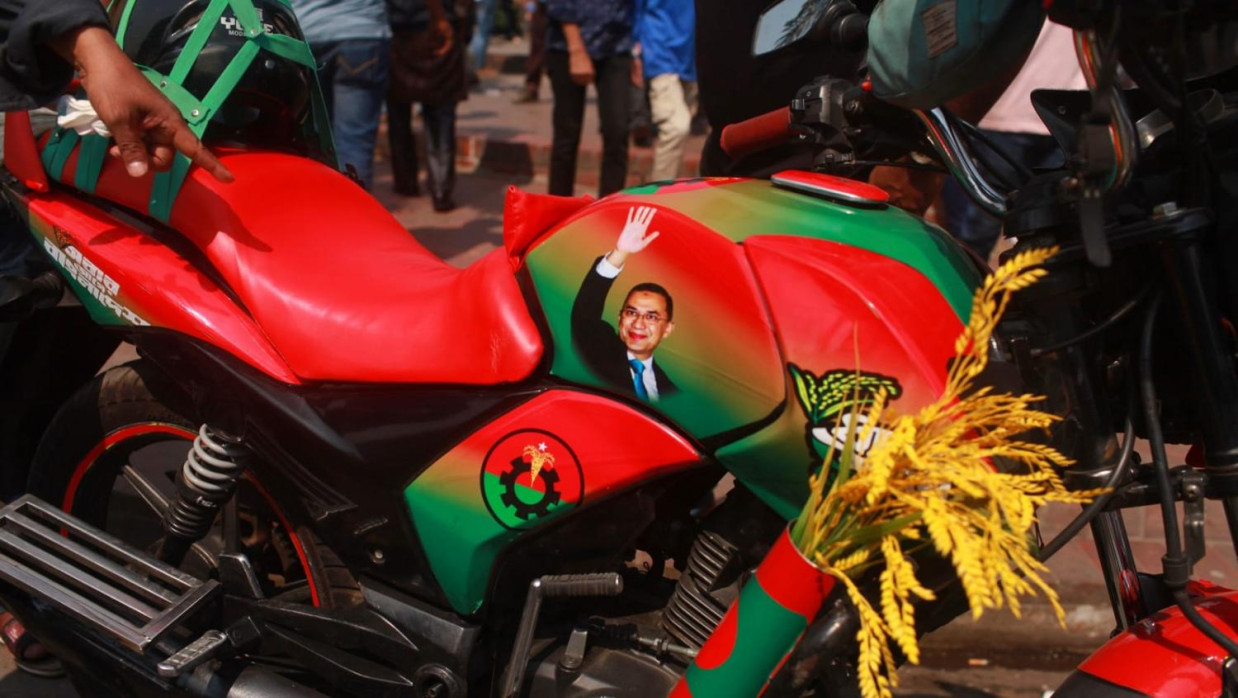
The Bangladesh Nationalist Party (BNP) has secured a decisive parliamentary majority in what is more than a reset for the country’s domestic politics after 15 years of autocratic rule. The result also signals the country’s emergence as a self‑aware, multipolar actor in South and Southeast Asia: one no longer willing to anchor its future to any single regional power.
The 12 February election was inspired by a student‑led uprising in July 2024, which left an estimated 1,400 people dead after a brutal state crackdown but eventually led to the overthrow of the Awami League government led by Prime Minister Sheikh Hasina. In the years prior, Hasina’s government had run three deeply contested elections in 2014, 2018 and 2024, marred by allegations of systematic rigging, repression, and the imprisonment of thousands of opposition activists.
After Hasina fled to exile in neighbouring India in August 2024, an interim government led by Nobel laureate Professor Muhammad Yunus spent 18 months trying to rebuild democratic institutions and restoring a measure of electoral credibility. The result is – hopefully – a government with a genuine mandate. Newly appointed Prime Minister Tarique Rahman has pledged to recalibrate Bangladesh’s international partnerships, attracting investments while avoiding over‑dependence on any single power.
This marks a clear departure from the Hasina era, during which Dhaka was widely perceived as closely aligned with New Delhi.
A post‑election Bangladesh will not seek confrontation with India, nor subordination to China. It will instead insist on respect.
Relations with India, Bangladesh’s largest neighbour, are now strained. The rupture is rooted not only in history, but in recent events. India’s decades‑long backing of Hasina – including political cover during the three disputed elections – generated deep resentment across Bangladeshi society. That resentment intensified after New Delhi granted Hasina refuge following her ouster, and has refused Dhaka’s formal request for extradition even after she was sentenced to death in absentia for crimes linked to the 2024 crackdown.
For many Bangladeshis, especially the youth activists who drove the uprising, India’s actions reinforced the belief that external support continues to shield remnants of the old regime. Anti‑India sentiment has since become a visible feature of street politics, amplified by the murder of Osman Hadi, a prominent protest leader known for his outspoken criticism of Indian influence.
This backlash has been compounded by an information war in the run‑up to the election. Bangladeshi authorities warned of a surge in foreign disinformation, including bot‑driven campaigns, AI‑generated deepfakes, and decontextualised religious messaging. According to Rumor Scanner Bangladesh, dozens of Indian media outlets, alongside the ousted Awami League, published misleading or false reports about Bangladesh in 2025 alone. Even cultural flashpoints, such as Indian Premier League cricket exclusions and World Cup venue disputes, fed popular perceptions of Indian hostility.
Yet despite this strife, analysts argue that Rahman represents New Delhi’s “safest bet” going forward. Unlike the current main opposition Jamaat-e-Islami (JI) party, whose pro‑Pakistan leanings remain anathema to India’s ruling Bharatiya Janata Party (BJP), the BNP leadership has recently struck a more pragmatic tone. Rahman has emphasised cooperation on trade, border governance and regional stability, while rejecting the notion of Bangladesh as anyone’s client state.
This pragmatism matters. India and Bangladesh share a 4,000‑kilometre border, deep economic interdependence, and unresolved challenges ranging from river water sharing to cross‑border migration. India’s role in Bangladesh’s 1971 Liberation War – when Indian military intervention decisively tilted the balance against Pakistan – remains widely acknowledged in Bangladesh. But Indian strategic circles have often treated that history as licence for influence rather than partnership, a posture that has become politically untenable in Dhaka.
Meanwhile, Bangladesh’s outreach to China has continued uninterrupted through the transition. Beijing remains Dhaka’s largest trading partner and investor, with bilateral trade exceeding US$21 billion in 2024–25 (nearly double that with India). Under both Hasina and the interim government, China has financed major infrastructure projects, including Mongla Port and a special economic zone in the port city Chattogram, while easing visa access for Bangladeshi business and medical travellers.
China offers scale and speed that no other partner can match. This does not signal ideological alignment but economic realism – and unlike India, Beijing has refrained from interfering with Bangladesh’s domestic politics.
Pakistan’s re‑engagement, by contrast, is more symbolic than substantive. With limited capacity for trade or investment, Islamabad’s strategy appears aimed at defence and cultural diplomacy – and at unsettling India’s eastern flank. While this raises legitimate Indian security concerns, Dhaka has little incentive to allow its territory to become a theatre for proxy competition.
If India seeks a sustainable relationship with post‑election Bangladesh, it may need to look east rather than west for inspiration. An ASEAN‑style approach, grounded in non‑interference, respect for sovereignty and pragmatic cooperation, offers a useful template. Such a reset would begin with a clear commitment to neutrality in Bangladesh’s domestic politics, acceptance of Dhaka’s diversified external partnerships, and tangible progress on long‑standing grievances such as the Teesta River water‑sharing agreement. These steps would do more to rebuild trust than rhetorical appeals to shared history.
Bangladesh’s 2026 election reveals a transformed political landscape: dominant parties challenged by new actors, a Gen‑Z electorate shaped by digital mobilisation, and a foreign policy no longer defined by binary alignments. A post‑election Bangladesh will not seek confrontation with India, nor subordination to China. It will instead insist on respect, and on the freedom to navigate a multipolar region on its own terms.
That, ultimately, is what this election signifies: not a pivot away from one power, but the assertion of choice.
The article appeared in the lowyinstitute
0 Comments
LEAVE A COMMENT
Your email address will not be published