

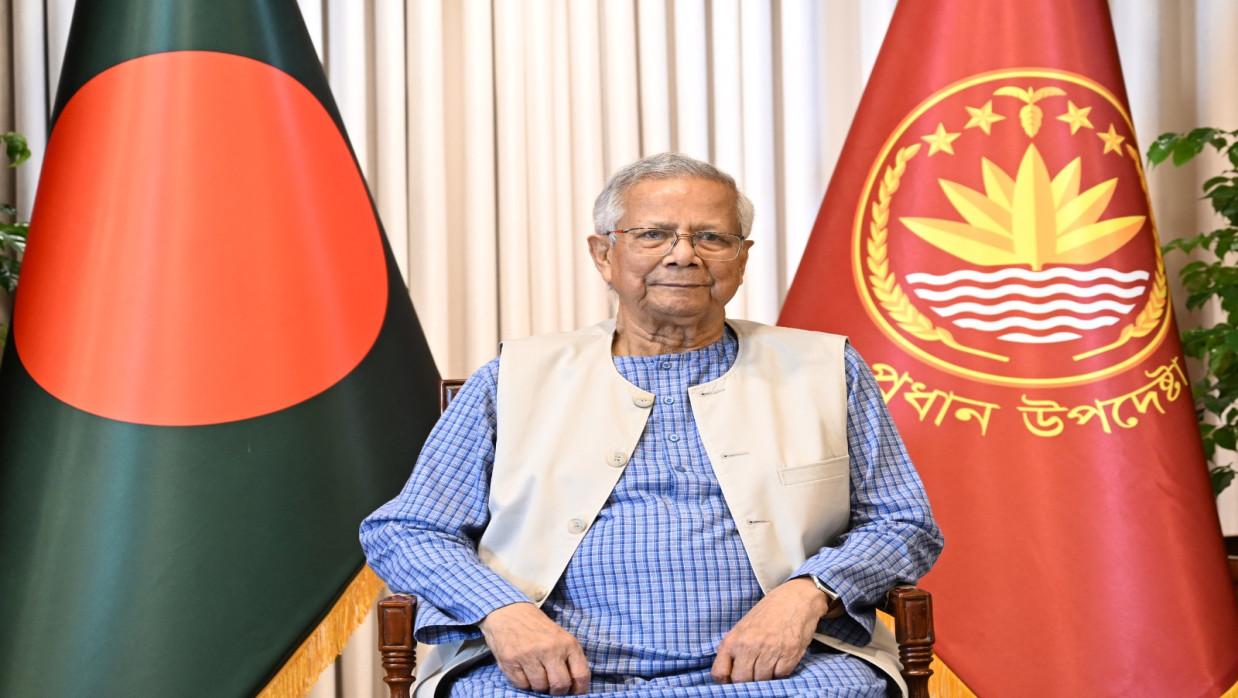
On the eve of his departure as the Chief Adviser in Bangladesh, reflection is not ceremonial; it is historic. The nation was at a crossroads. The nation was in economic trouble. The nation was politically highly polarized. The nation had low citizen confidence. The memory of July 36 loomed large over the national psyche. It was not authority that Dr. Muhammad Yunus sought at such a critical juncture; it was responsibility. It was not power that he pursued; it was stewardship.
In a televised address delivered with quiet gravitas and utmost conviction, the Chief Adviser spoke to the nation not as a man leaving office, but as a man fulfilling responsibility. His address was built around the three solemn tasks undertaken by the Interim Government to address the crisis, to strengthen the weakening institutions, to restore the independence of the judiciary so that justice is above politics, and to ensure a free, peaceful, and credible election so that the people’s sovereignty is fully restored. He reminded the people that it was not a matter of moments; it was a matter of foundation. The independence of the judiciary was a foundation of democracy. The election was not a conflict between any political party; it was a conflict between the will of the people. There was no triumphalism, no defensiveness, no regret.
The Chief Adviser reminded the people of all their achievements in the pursuit of freedom, sovereignty, and democracy. His departure was not the departure of a leader; it was a reaffirmation of faith. Faith in the people, faith in the nation, faith in the future, faith in the present, faith in the Bangladesh that went through all the turbulence, could now go forward with dignity and institutional and democratic hope.
What follows is but a brief outline of a much longer history of achievement—an abbreviated reflection on a legacy developed during barely eighteen months. Described in terms of challenges faced, steps taken, and the underlying intent behind those steps, this is but a small sampling of the work accomplished to help reinvigorate and re-anchor the democratic process in Bangladesh.
- Restoring Stability Without Authoritarianism
The Issue: In the aftermath of the July 2024 uprisings in Bangladesh, there were serious concerns about political polarization and the possibility of civil war. The people had lost trust in their institutions and were worried about the possibility of an authoritarian regime taking control of the country.
The Steps Taken: To address these issues, the Interim Government focused on restoring stability rather than consolidating power. The police were also made to work in such a way that they showed no signs of political allegiance. Dr. Yunus also announced that his mandate was temporary, reform-oriented, and time-bound from the very beginning.
Why It Matters: In the region, it is common for such Interim Governments to linger in power for long periods of time. Dr. Yunus proved that power could be exercised and then given up with great dignity.
- Building the Foundations of Reform
The Issue: There were serious governance and authoritarian issues in Bangladesh that needed correction, not merely cosmetic changes.
The Steps Taken: To address these issues, many expert commissions were set up to identify failures in governance and to suggest corrective measures that could address them in their entirety. The recommendations of the Constitutional Reform Commission, which suggested workable measures to prevent authoritarian excesses, were also accepted and considered within the acceptable limits of almost 80 percent of Bangladesh's citizens.
Why It Matters: By decentralizing wisdom rather than centralizing authority, Dr. Yunus proved that institutions are meant to evolve and that evolution is possible only when authority is not centralized.
- The July Charter Referendum
The Issue: There were also concerns that the momentum of the July uprising needed to be translated into constitutional terms to ensure there was no risk of regression in the near future.
The Steps Taken: To address this issue, the July Charter Referendum was held in Bangladesh, and the overwhelming majority of voters supported the charter, giving it a clear mandate of over 60 percent.
Why It Matters: By giving the people of Bangladesh the chance to decide their own fate and destiny, Dr. Yunus proved that democracy is about the people and that the ultimate authority rests in their hands only.
- Accountability and Justice: Revitalizing the ICT
The Issue: The culture of impunity and trauma had become ingrained in the minds of the people due to alleged enforced disappearances, the July atrocities, and political repression.
The Steps Taken: The International Crimes Tribunal (ICT) was revitalized. The legal process was reviewed to ensure due process and its independence. The cases involving the July atrocities were reopened. The sentencing and conviction of perpetrators were carried out in accordance with the law. The most historic of these was the conviction of the former Prime Minister, Sheikh Hasina.
Why It Matters: The pursuit of justice through the legal process, rather than vengeance, reasserts the principle of equality before the law. It was a move towards the rule of law, away from the culture of impunity. It was also a move towards the people, as they had long demanded it.
- Rebuilding Electoral Credibility
The Issue: The credibility of the electoral process had been eroded by the contested process and political distrust.
The Steps Taken: The Electoral Commission's autonomy was revitalized. Neutrality was emphasized. The peaceful national election of 12 February 2026 was carried out transparently with a turnout of more than 59 percent and international observation. A new majority was formed in parliament, and power was transferred seamlessly.
Why It Matters: The people reassert their sovereignty through the electoral process. His willingness to step down reasserts his image as a guardian rather than a ruler.
- Economic Stabilization Amid Crisis
The Issue: Foreign exchange reserves were depleted. Inflation was high. The level of investor confidence was tenuous.
The Steps Taken: Prudent fiscal policy replaced populist policy. The banking system was re-regulated, anomalies were corrected, and development partnerships were re-established.
Why It Matters: Preventing economic collapse amid political change ensures social stability. Invisible stability was the foundation of the visible renewal.
- Restoring Confidence in a Time of Economic Fragility
The Issue: When I took over the Chief Adviser post in Bangladesh, the country was at a point of economic vulnerability. The foreign exchange reserves were at a critically low level of less than $ 15 billion. Such a situation was extremely precarious for a country like Bangladesh, which relies heavily on foreign trade amid global inflation, currency fluctuations, and rising external debt obligations. In addition, investor confidence was undermined. The level of import cover was declining. The threat of balance-of-payments difficulties loomed large. In such an economic situation of fragility, economic stability was not a matter of choice; it was a matter of survival. However, there was a further dimension to the situation. The reserves were a matter of economic statistics. However, the situation was further complicated by the fact that the people of Bangladesh had lost trust in the economic system. Therefore, economic stability was not only a matter of economic statistics; it was a matter of restoring the moral dimension of economic management.
The Steps Taken: Over the course of 18 months, the situation was transformed by fiscal discipline, strategic engagement with the international financial community, monetary policy control, and remittance flows. The foreign exchange reserves rose from less than 15 billion dollars to over 34 billion dollars. Such a situation was not only a matter of economic statistics. The reserves were intended to restore economic confidence, manage the balance of payments, and regain international credibility.
Meanwhile, the Interim Government continued to advance institutional reforms to enhance accountability, address structural inefficiencies, and readjust the country's economic diplomacy. These developments, however, occurred amid overwhelming challenges stemming from geopolitical considerations, domestic interests, and political uncertainties.
To be a leader during this period meant being resilient and brave, confronting the dominant narratives of external forces and domestic conspiracies, and working under conditions that would have discouraged even the most experienced politicians from taking the helm. Yunus, who had never aspired to lead, took on the challenge of governance when the country needed it the most.
Why It Matters: Economic reserves are more than just figures; they are the shield and the promise of a country in times of uncertainty. The rebuilding of these reserves, therefore, sent a message to the people and to the rest of the world that the country could indeed pick itself up without compromising its sovereignty and dignity.
There, however, lies a legacy beyond the country's economic recovery. History has shown that it is not the praise and accolades one receives as a leader that define one's legacy, but the crises one helped the country get through. By holding his ground in the face of overwhelming domestic and external forces, Yunus redefined the very meaning of transitional leadership
- Confronting Corruption
The Issue: The issue was the country's entrenched corruption. The Steps Taken: The government took several steps to address the issue. Why It Matters: The government signaled zero tolerance for corruption, thus changing the institutional culture.
- Human Rights Reorientation
The Issue: There were allegations of custodial brutality and legal excesses.
The Steps Taken: The government re-examined its legal framework. The government re-engaged with international institutions.
Why It Matters: The government repositioned its image in the international community.
- Sovereignty and Strategic Autonomy
The Issue: Concerns about the asymmetrical influence of external actors in the country. The Steps Taken: The government re-articulated the idea of sovereign parity in its foreign relations. The government made public the power purchase agreements and industrial projects it found unfavorable in the past. The government sought alternative trade sources. The government’s responses in the international arena reasserted its strategic geography without conflict.
Why It Matters: The government reasserted its sovereignty by being transparent.
- Regional Power Calibration and Global Engagement
The Issue: Bangladesh’s security required broader multilateral engagement than reliance on bilateral dependencies.
The Steps Taken: Dr. Yunus proposed reviving the South Asian Association for Regional Cooperation.
Engagement with the Association of Southeast Asian Nations was also considered to integrate Bangladesh into thriving regional economies. Balanced relations were maintained with China, the USA, Turkey, Malaysia, and Pakistan.
Why It Matters: Strategic plurality is the key to avoiding dependency. Bangladesh positioned itself as the bridge between South and Southeast Asia.
- Protecting Citizens Beyond Borders
The Issue: Bangladeshi citizens who participated in the 2024 movement abroad were arrested.
The Steps Taken: Through diplomatic engagements, the citizens were reportedly released.
Why It Matters: Leadership is not limited to geographical boundaries, and it is this leadership that protects its citizens wherever they stand.
- Addressing the Criticisms: Transparency, Debate, and Democratic Maturity
The Issue: No interim administration in history traverses the course of time without being subjected to some level of scrutiny and criticism. Dr. Muhammad Yunus’ interim administration was not different. There have been criticisms from all shades of opinion from different political groups. There have been constructive criticisms and perhaps more critical ones. There have been criticisms of the pace of reforms, both too fast and not fast enough, as well as of the scope and extent of reforms in certain areas, such as the Constitutional Reform Commission, ICT processes, past bilateral agreements, and economic reforms.
There have also been criticisms about the powers vested in an interim administration headed by an internationally renowned personality such as Dr. Yunus. There have also been criticisms about judicial processes aimed at trying individuals responsible for the July atrocities. There have also been criticisms that reforms in the bureaucracy and police administration should have been pursued more vigorously and faster.
It is easy to advocate change; not so easy to implement it, especially in a culture shaped by over five decades of institutional norms. Dr. Yunus was given less than 18 months to address issues that had developed over 54 years of independence.
The Steps Taken: Rather than silencing opposition voices, the Interim Government allowed criticism to be expressed freely in the media, civil society groups, and public forums. The recommendations of reform commissions were made public. Elections were observed by both local and international observers. The ICT proceedings were in line with the rule of law, with proper consideration of due process and the principles of judicial fairness.
The reasons behind the economic reforms were made public instead of remaining opaque. Diplomatic agreements, even controversial ones, were made public rather than kept in closed rooms. Most importantly, the Interim Government made its own transience clear to the public and worked towards a peaceful transfer of power, arguably the strongest response to allegations of overreach and hidden political ambitions.
Why It Matters: In any healthy democracy, criticisms do not represent weakness; they represent strength. The very presence of criticisms in public forums was an indication of an emerging public sphere in which people could question the government without the fear of reprisal from the system itself. The public sphere of discussion was not an act of rebellion against an oppressive system; it was an act of engagement with the system itself.
A transitional government is not judged by its popularity. It is judged by how it handles opposition. The Interim Government chose to channel reforms through institutions such as the courts, reform commissions, referendums, and elections rather than relying solely on executive fiat. Transparency replaced secrecy. Dialogue replaced silence.
History can judge the pace, scope, and content of the reforms undertaken by the Interim Government. However, history is likely to note that criticisms were not suppressed in favor of reforms. Most importantly, history is likely to note that power was transferred peacefully to an elected government.
In the delicate balance of reform and restraint, urgency and patience, debate and dignity, there lies a hallmark of this transition. A reminder that maturity in democracy is not marked by the absence of criticism, but by the ability to govern in its presence.
- Why He Will Be Remembered as an Honest and Visionary Leader
He will not only be remembered as the Nobel laureate, economist, pioneer of microcredit, and social reformer that he was. He will also be remembered as the steady hand that appeared on the horizon of history when the nation was standing on the edge of uncertainty. In the midst of the turmoil that ensued on July 36, when civic life was in disarray, and institutions appeared to be on the brink of collapse, he was the one figure who could bring together a fractured land. He was not in the business of seeking power. He was in the business of accepting responsibility, reluctantly perhaps, but with conviction because the times called for statesmanship rather than personal ambition.
He chose not to succumb to the temptation of permanence. He chose not to elevate his own power above the restoration of electoral legitimacy. He chose not to view reform as an instrument of retribution. He chose to view reform as an instrument of rebirth. He never viewed governance as an end to be held on to. He always viewed it as a responsibility to be honored.
History is replete with revolutionaries who upend existing systems of governance. But history is also replete with guardians of constitutional continuity in the face of collapse. If history is to judge, the journey of democracy in Bangladesh is to be reborn in peace and dignity, then this chapter in history will be remembered as a testament to that possibility.
As he himself once noted, “The power of one person with courage is greater than the power of many who hesitate.”
In a moment when hesitation might have altered the course of the nation’s destiny, he chose the path of courage, a courage rooted in his conscience. And in so doing, he did not simply ensure a peaceful transition of power; he cemented his place in the annals of Bangladesh’s history as a man of integrity, vision, and quiet strength. The extent to which the nation lives up to its vision remains to be seen. The transformation of a system is rarely the work of a single man. However, holding a mirror up to a society, challenging it to confront its own contradictions, can be a profoundly selfless act. In the sweep of Bangladesh’s long history, his name will likely come to be remembered for far more than the accolades he has garnered from the world at large. For he has stepped forward in an hour of uncertainty. May he enjoy good health, and his actions be noted in a spirit of honor, reflection, and respect.

0 Comments
LEAVE A COMMENT
Your email address will not be published