

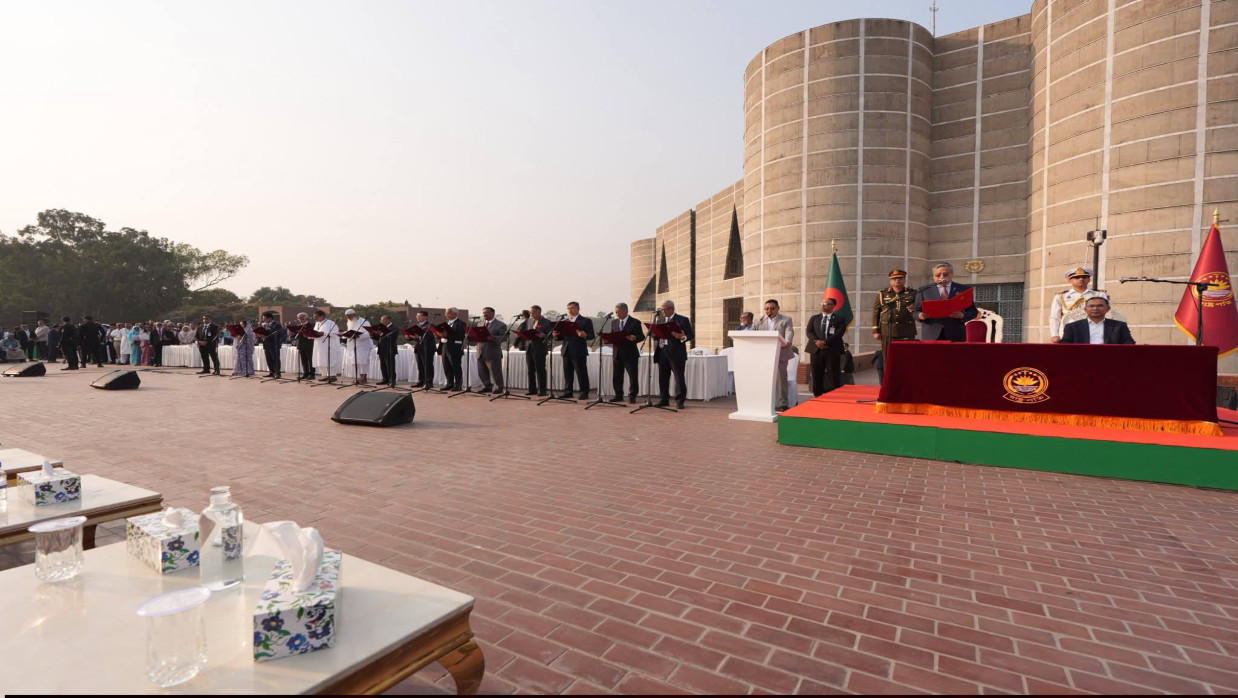
PM Tarique Rahman Sworn in New Government
Prime Minister-elect Tarique Rahman, along with his council of ministers, took the oath on 17 February 2026 to form a new government. Elected by a landslide under the leadership of the Bangladesh Nationalist Party (BNP) and its Grand Alliance partners, this newly formed government marks the end of Bangladesh’s long transition to a new cycle of government after years of political uncertainty and intense polarization.
Who’s Who: Showcasing Balance
Bangladesh’s new cabinet, consisting of approximately two dozen cabinet ministers and an equal number of state ministers, showcases a balance between new and old-guard politicians, technocrats and experts, zone-based representation, and coalition partners. The diversity of cabinet picks offers glimpses into the government's priorities going forward.
BNP veterans get key posts
Finance & Planning, Home, and Local Government ministries handed over to veteran BNP leaders. Popular veteran Amir Khasru Mahmud Chowdhury gets the Finance and Planning ministry. Salahuddin Ahmed will take the Home Ministry, and Mirza Fakhrul Islam Alamgir will hold the Local Government portfolio.
Veterans lead the charge in the new cabinet with the most critical ministries. The new government has given key portfolios to trusted veterans of the BNP, signaling continuity and stability during uncertain times. The government’s commitment to austerity measures and economic reform is evident in the appointment of Amir Khasru Mahmud Chowdhury as finance minister. Familiar to investors both at home and abroad, Chowdhury will look to restore confidence in the banking sector and rejuvenate the economy.
Salahuddin Ahmed at the helm of the Home Ministry will be another key appointment as politicians look to avoid any repeat of the violence that occurred during past regime changes. Bangladesh’s transition period has been historically rocky, and the BNP will look to Ahmed to ensure law and order is kept, allowing their term in office to start on a positive note.
Ever-popular Mirza Fakhrul Islam Alamgir becomes Local Government minister, seen as a move to legitimize his political stance by having him in the cabinet.
Representation of Technocrats and Business Community
Apart from party loyalists, there are few technocrats and businessmen in the cabinet. The inclusion of popular businessman Abdul Awal Mintoo as Environment, Climate Change, and Forest Minister signals its willingness to engage with the business community.
His presence in the cabinet would hopefully foster better sentiment among investors and might help bring more foreign direct investment to the country while addressing some structural flaws in the economy. The government seems to understand that without bread, no one would care for political legitimacy.
There might be a need for technocratic advice to fix the banking sector, which is now extremely fragile. Helping businesses bloom would ease pressures on price hikes and allow reforms to please the IMF and the World Bank.
Foreign Policy: Keeping Good Neighbors Close
Foreign policy will be one of the actions of the new government, to be watched with keen interest. Khalilur Rahman’s appointment sends a signal that Dhaka wants to balance its foreign relations somewhat after bruising some important neighbors in recent years.
Forging good relations with India will be one of Dhaka’s top foreign policy objectives going forward. Bangladesh and India enjoy historical, economic, and security linkages, though political relations in recent years have been complicated by developments in both capitals. A good-but-tough relationship with New Delhi, one based on respect for mutual interests, can be expected from the BNP-led government.
A similar balancing act will be expected from Dhaka as it navigates its ties with China and the US. Bangladesh has enjoyed robust infrastructure cooperation with Beijing, vibrant trade with Washington, and substantial engagement with the Middle East on labor markets. Managing all of these relationships without disturbing the overall balance will be a diplomatic tightrope that the Foreign Ministry will have to walk.
Sense of Inclusion
The cabinet also seeks to portray Bangladesh as an inclusive nation. Ministers from the female gender and minorities also serve in it, creating the impression that everyone has a stake in this government and that its policies are tailored to meet the aspirations of all sections of Bangladesh's society.
This indeed would influence how other countries perceive Bangladesh's democratic values and its respect for diversity.
Immediate Challenges Before the Government
Economic Pressures
The most pressing challenge confronting the new cabinet is economic. Bangladesh faces inflationary pressures, currency fluctuations, and a banking sector burdened by non-performing loans. Restoring macroeconomic stability will require coordinated action across multiple ministries and close collaboration with the private sector.
Energy pricing, subsidy rationalization, and export diversification are likely to dominate the economic agenda in the coming months. The government’s ability to address these issues effectively will determine its credibility both domestically and internationally.
Political Affairs Management
Although the party has won the elections, there will be numerous challenges politically as well. The government will have to manage expectations not only among its party members, the BNP, but also among all its allies. Alongside managing relationships with its coalition partners, managing the disgruntled opposition will also be important so Bangladesh does not return to the old politics of intolerance.
Keeping trusty institutions like the Election Commission, the judiciary, and the bureaucracy will also be imperative for the new government so they continue to operate independently and without inefficiency.
Civil-Military Balance
The positive role the armed forces played in supporting a peaceful and fair election has been recognized, and it will be important for future civil-military relations to continue the positive relations they have built on mutual trust and respect while working within the confines of the Constitution.
It is also symbolic that the Defense portfolio will be held by the Prime Minister himself.
FINALLY
This is undoubtedly a crucial moment for the cabinet. While the new government has inherited a strong mandate from the people and some level of goodwill from within the country and abroad, it will have little room for mistakes.
Time will tell whether they can prove their mettle and uphold their responsibility to bring about economic stability, strengthen democratic institutions, and reconnect with regional neighbors to maintain the momentum of Bangladesh’s political transition.
Bangladesh now has its work cut out for it. The selected cabinet shows promise. It includes familiar faces with political experience, technocrats, and even ethnic minority representation. If this cabinet delivers what people want, Bangladesh may just see a period of stability. However, if it fails, we may return to the continuous political unrest that has plagued South Asia’s oldest democracy for far too long.


0 Comments
LEAVE A COMMENT
Your email address will not be published