

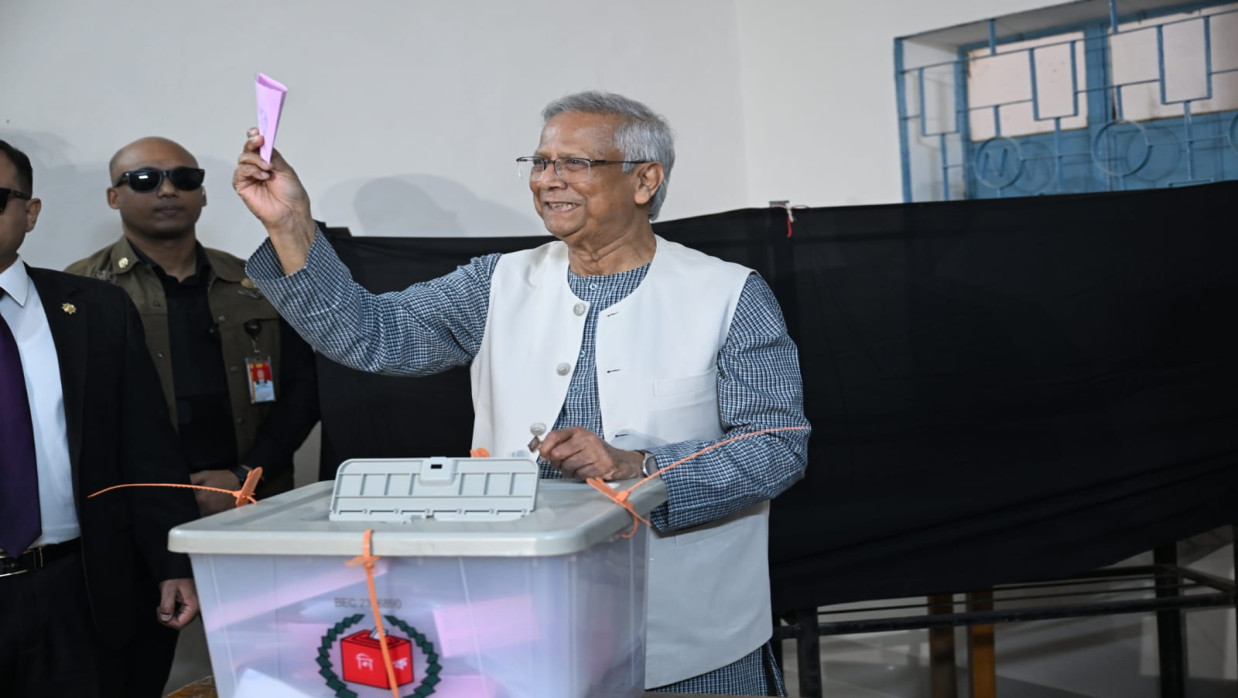
Bangladesh’s election day was a day watched live
Bangladeshis monitored the country’s 13th general election, conducted simultaneously with a national referendum, like only a society scarred by past electoral violence can. On TV tickers, Facebook lives, WhatsApp groups, and friendly-if-jittery living room debates, millions tracked live turnout numbers, periodic incident reports, and (eventually) the agonizingly slow crawl of vote counting. That “vigilant watching,” as Citizen Commons put it, helped Bangladesh see an election day not reminiscent of past disputed polls.
Three takeaways from Bangladesh’s calmer-than-recent-polls election
Counting will define Election Day’s legacy
Though no single result will make headlines like a constituency flip or surprise seat total, Bangladesh’s upcoming election may be remembered for how polling day was conducted. World media wire services and local outlets spoke to voters who reported unusually heavy security deployments, long lines in some areas, but generally calmer and freer voting than recent memory.
For Bangladesh, where polling has too often been defined by boycotts, intimidation claims, allegations of administrative malfeasance, and cycles of post-poll violence, a peaceful election day matters. It signals that competitive persuasion can occur at the ballot box with the state visibly trying to keep centers open, queues moving, and alleged intimidation in check.
The interim government led by Chief Adviser Dr. Muhammad Yunus has earned commendation for trying to hold the election on time and without devolving into violence. The interim government cast this election as a “new beginning” after contentious years in Bangladesh in 2024, and Dr. Yunus himself urged political parties to practice tolerance and restraint moving forward.
Critics could argue that we’re lowering the bar by calling any election that “didn’t fall apart” a good election. Candidate networks may still benefit from administrative support, uneven application of rules, or the right of reply to any accusations made. Will Bangladesh accept an election as legitimate if we can’t prove irregularities until after the votes are cast?
How Votes are Counted Matters
Scale is one reason why we care about counting processes.
Bangladesh held this election nationwide. Days leading up to the election saw reports that Bangladesh had around 127 million registered voters who would vote at tens of thousands of polling stations staffed by large numbers of election workers and security forces. International observers were also in attendance in significant numbers, including several hundred, according to Reuters.
The bulk of these two logistical decisions informed much of election day’s calm (and controversy):
Deployment of security forces. A large security presence upon voter arrival appears to have prevented organized attacks on polling stations or attempts to steal results while votes were still private. However, elections administered by security still pose “free and fair” questions: Who are voters frisked? Whose representatives receive escorts? Are certain types of complaints investigated right away, while others are held until the next day?
The referendum. Bangladesh held a national referendum vote at the same time as its parliamentary election, adding complexity to election day procedures and lengthening the time it took to count ballots and announce results. Reuters highlights the referendum question asked voters about amendments to major government bodies – a reminder of past debates in Bangladesh over election time neutrality promises.
Allegations of fraud & irregularities will follow a relatively calm day
As voting tabulations began, allegations of overwriting signed result sheets and counting-center irregularities surfaced in closely watched constituencies. Reporting from within Bangladesh described multiple allegations that signed result sheets were overwritten (such as in Dhaka-17) and that undue pressure was placed on the Election Commission to adjudicate irregularities before certifying results.
Similar complaints have emerged during previous elections in Bangladesh, but hit particularly poignant because they target the counting stage: the phase of voting when citizens have fulfilled their duty to vote, candidates have presented their agents to watch the count, and democracy asks voters to trust the process to deliver results free from interference.
Two points can both be true:
Malpractice can occur in any election, and allegations don’t always imply that systems were compromised end-to-end.
Patterns of consistent allegations, including around counting protocols, tabulation, and influential “miscommunication,” can discredit an election even if limited incidents of wrongdoing occur or if polling day was largely peaceful.
The Election Commission’s willingness to be transparent about delays, publish real-time, granular data from each center, and uphold credible audit systems will matter now more than at any other point in the cycle.
Was 2026 better than past elections in Bangladesh? Let’s compare
Bangladeshis have seen both better and worse elections. Comparisons to past polls are inevitable for voters who saw cleaner votes under previous interim-style arrangements but also know, given recent history, that Bangladeshi politics can disrupt even its best traditions.
Relative to recent polls, Sunday’s election felt different for three reasons:
Uncertainty about which party would ultimately form the government appeared real this cycle, with all major actors contesting in earnest.
Visible restraint was evident on election day, according to global reporting, which noted the lack of major violence and successful voting in many constituencies.
Social media video clips, local civic group updates, and citizen agitation against perceived irregularities amplified faster than official communication channels, allowing no single party to dictate the narrative.
The past, however, often claws back. Bangladesh has proven time and again that it can produce elections that are peacefully participatory in some districts but unresolved in others. Just because this election will likely be “better” than recent polls does not guarantee it will be “trustworthy” across all stakeholders.
Polls always begin with the question of international acceptance
International acceptance of Bangladesh’s election day will depend primarily on two beliefs returning to diplomats after polls close:
Did enough go right? Was voting broadly credible? Were there isolated incidents of violence, but nothing systemic?
Are violations being appropriately channeled through Bangladesh’s institutions rather than through mass protests?
Ahead of voting, a few noteworthy international signals about Bangladesh included:
The EU deployed long-term and short-term Election Observation Mission (EOM) monitors to Bangladesh’s districts, signaling sustained international attention rather than last-minute, media-seeking arrivals.
UN officials in Bangladesh explicitly highlighted women’s participation and inclusion of vulnerable groups as benchmarks of legitimacy, even if the UN itself will not be “certifying” the election.
India publicly expressed support for free, fair, inclusive, and credible elections while also clarifying that New Delhi will not send observers. This unusually frank posture will set the terms of India’s relationship with Bangladesh’s next government.
No country will unequivocally reject or endorse Bangladesh’s election results. BNP boycotted the election and didn’t nominate candidates. The Awami League was banned from participating. Expect both of them to play the victim card effectively to press foreign diplomatic missions even after most governments realize they have to deal with Bangladesh’s elected representatives.
Reuters is reporting that the Bangladesh Nationalist Party won enough seats to rule outright. International headlines featuring “Will Bangladesh’s election take place?” will soon be replaced with “How will Bangladesh’s new government function?” after voting concludes.
Here’s some unbiased congratulations, if that’s what you’re looking for.
The objective truth of Bangladesh’s election improved relative to past elections:
An international bystander could make a fair argument that Bangladesh Election Day was probably more peaceful and well-organized than previous contested elections, with more security forces on hand and a larger number of Bangladeshis voting.
Acceptance of this election’s legitimacy in Bangladesh will hinge on the transparency and timeliness of the Election Commission’s responses to allegations of rewritten ledgers, irregularities, vote-counting deadlines, and on the proactive vs. reactive publication of center-level results.
Foreign governments and international stakeholders will probably accept Bangladesh’s elected leadership, but will likely apply private and public pressure for guarantees, reform, and transparency before the next election.
A Bangladeshi election is just the first step.
The mere existence of an election day that wasn’t a national emergency is a positive sign for what Bangladesh could achieve. But Bangladeshis regaining trust in their electoral system will be determined by more than peaceful voter lines on polling day; it will be judged by whether votes can truly be cast in secret leading up to counting, if complaints are handled fairly, and if the winners consider respecting the rights of the opposition as part of their mandate.
How Bangladesh’s incoming government acts in good faith after the results are announced will decide whether 2026 is the year democracy grows stronger or just another chapter in Bangladesh’s tragic story of rising expectations followed by roadside skepticism and institutional disappointments.

0 Comments
LEAVE A COMMENT
Your email address will not be published