

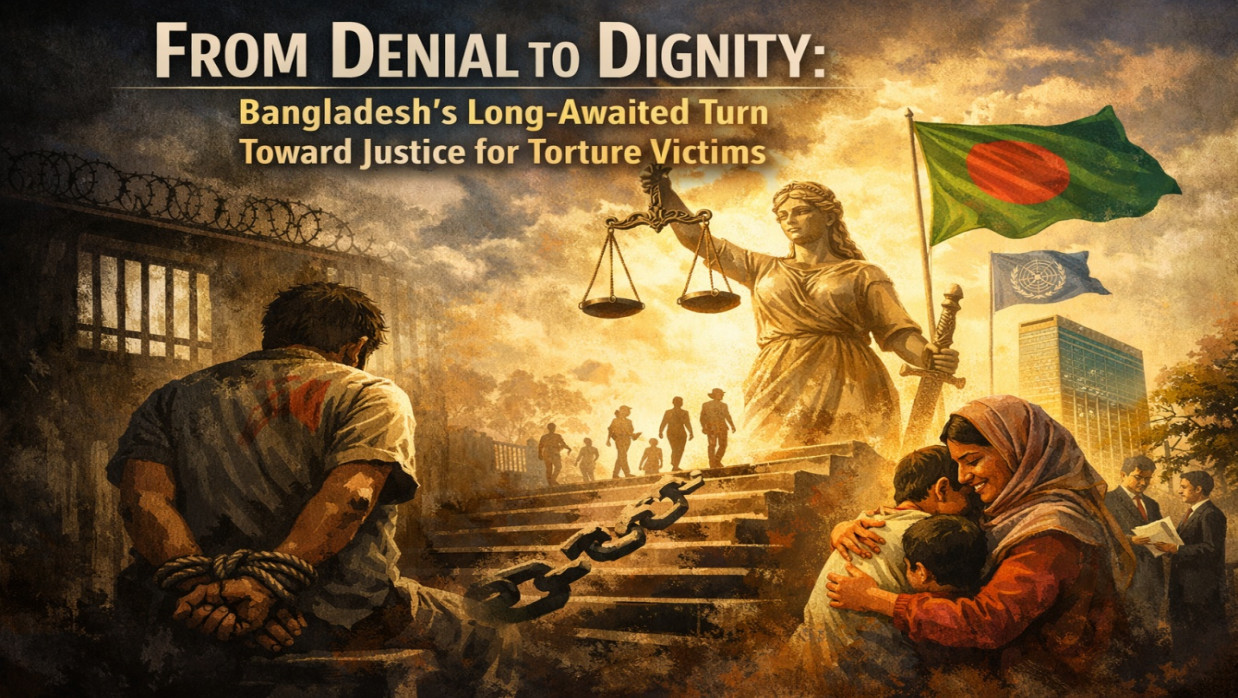
Bangladesh’s decision to withdraw its declaration under Article 14(1) of the Convention against Torture marks far more than the correction of a technical irregularity in its treaty obligations. It represents a decisive moral pivot—one that moves the country beyond years of cautious ambiguity toward a clearer, more principled embrace of human rights accountability. Taken at the United Nations under the forward-looking leadership of Dr. Muhammad Yunus, the decision reflects a dynamic rethinking of the state’s responsibilities toward victims of torture and enforced disappearance, and a renewed willingness to align law with conscience.
For a nation whose Constitution enshrines the right to life and whose international identity has long been shaped by moral leadership in global forums, this shift carries special weight. Bangladesh had lived with a quiet contradiction advocating justice and dignity abroad while maintaining ambivalence at home about full accountability for grave human rights abuses. By confronting that contradiction head-on, the state has signaled not only a change in policy, but a reassertion of values. This moment matters not simply for its legal consequences, but for what it reveals about the evolving character of the Bangladeshi state: one prepared, under Dr. Yunus’s leadership, to replace hesitation with moral clarity and to place human dignity at the center of governance.
A Reservation Whose Original Rationale Had Become Obsolete
Bangladesh ratified the Convention against Torture in 1998. This move reflected Bangladesh’s commitment to the international consensus that torture is absolutely prohibited, regardless of the circumstances. However, the decision to place a reservation to Article 14(1) of the Convention against Torture effectively exempted Bangladesh from one of the most important commitments of the Convention: the commitment to ensure that the victim of torture has the right to seek compensation and rehabilitation.
The reservations made to the treaty, including CAT, when the nation entered into the treaty, were justified as a means of ensuring that the nation was capable of meeting the treaty obligations imposed on it. However, over the years, these initial justifications for reservations to the treaty have diminished, and the emphasis of the law has shifted to a victim-centered approach in international law.
Bangladesh was suddenly grouped with only four other nations: the Bahamas, Fiji, New Zealand, Samoa, and the United States. None of these could be termed comfortable company, especially as the rest of the world began to implement reparative justice.
The Turning Point: Political Will Meets Moral Reckoning
The withdrawal of the declaration was formally decided on the 29th of December during the Advisory Council meeting, which was headed by Chief Adviser Muhammad Yunus. However, what must be understood is that this was not an arbitrary or impulsive decision. This was not a decision made under external pressure. This was a decision made based on the reality that was becoming increasingly apparent in Bangladesh. This was a decision that was made based on the reality that the human rights legitimacy of the nation of Bangladesh could not be restored while the citizens of the nation were still marginalized.
Essentially, this constituted a decision that was made based on the reality that the prohibition of the use of torture without any form of reparative justice for the victim of the torture is not really just. This was a decision made in light of the reality that the concept of justice is not simply about criminalizing an action or behavior. This was a determination made based on the reality that the concept of justice is about providing the victim of a behavior or criminal act the means to be rehabilitated.
Why Article 14(1) Is the Moral Heart of CAT
Article 14(1) has been recognized as the most “human-focused” article of the Convention Against Torture. In all the other articles, there is a focus on the different aspects of the prohibition, prevention, prosecution, and non-derogability of torture, but in Article 14(1), there is a shift in focus towards the reality of the survivors of torture. It is a recognition that justice is not just about making something illegal or prosecuting its practitioners, but about making it right for those who have been victimized.
At its very core, Article 14(1) requires states to ensure that victims of torture are given fair and adequate compensation for the harm they have suffered. Such compensation is not conceived in terms of money but as a concrete expression of guilt and responsibility. In addition, there is a focus on the medical and psychological rehabilitation of the victims. This is another important part of the provision, as it is a recognition of the fact that torture leaves deep scars and marks, which are felt for a long time after the actual act of torture has ended. It is also essential to note that this provision recognizes the need to reintegrate the victim socially and to restore their dignity. This is an affirmation that the victim has to be reintegrated into society as a full and equal citizen and that they are not relegated to the status of shame and embarrassment.
The most significant part of this provision is that its protective cover is not limited to the actual victim. In cases where torture leads to death, the right to compensation extends to dependents of the victim. This is an affirmation that the effects of torture are not felt only by the individual and that the death of the individual does not mean that the pain and suffering caused by torture come to an end. The pain and suffering are simply transferred to the spouse, children, and others who depend on the individual for support and sustenance.
With its withdrawal of the reservation in respect of Article 14(1), Bangladesh acknowledges the fundamental ethical truth that the victim of torture is not just an unfortunate and collateral consequence of the exercise of state power, but that the victim of torture is, in fact, an individual who possesses inherent and fundamental human rights which must be recognized and protected.
Enforced Disappearance and the Legacy of Silence
The implications of Bangladesh’s decision to withdraw its reservation in respect of Article 14(1) are especially important in the context of enforced disappearance, which represents a form of cruelty that denies families truth, closure, and legal redress. For years, families of enforced disappearance victims have been in legal limbo, unable to claim legal redress because the law itself did not reach far enough to recognize their right to claim redress.
With the withdrawal of the reservation, there now exists a legal window of opportunity for families of enforced disappearance victims to claim redress. There also exists, in effect, an acknowledgment of the fact that silence, denial, and legal evasion constitute injury in and of themselves. This is not about rewriting history. This is about not perpetuating injustice through legal omission.
Global Standing and the Politics of Credibility
Bangladesh has traditionally been vocal in multilateral forums across a range of issues, from development to climate change, refugee issues, and peacekeeping. Yet, the issue of human rights diplomacy is not merely about being vocal in multilateral forums; it is also about being even-handed in domestic policy.
Bangladesh’s commitment to CAT will only enhance its standing in multilateral forums and human rights mechanisms. Yet, the larger importance lies in the fact that it sends a message across the world that its commitment to international law is not selective.
In an age where the resilience of authoritarian regimes is growing globally and where the standards of human rights are being tested across the world, the clarity of purpose is crucial.
From Commitment to Implementation: The Real Test Ahead
The ultimate test of this policy is not merely the symbolism of removing the reservation and the commitment to the policy; it is the policy's implementation. The ultimate test of commitment to international law is when it is operationalized domestically. By removing the reservation to Article 14(1), Bangladesh has clearly demonstrated its commitment to a policy. Commitment to a policy is only the first step towards the ultimate goal of justice.
The first and most immediate task is to be accomplished in the legal field. There is a need to enact domestic laws and regulations that not only reflect the promise of the provisions contained in Article 14(1) but also to ensure that the right to compensation and rehabilitation is not only acknowledged but also realized. There must be clarity in the legal standards and procedures to ensure that the victim of torture and enforced disappearance is able to seek compensation and rehabilitation without any ambiguity or difficulty.
Another key issue is the creation of independent and reliable systems for assessing the claims of the victims of human rights violations. Compensation and rehabilitation should not be subject to ad hoc decision-making or the capricious intentions of those in power. They must be backed by reliable systems for assessing victims' claims of human rights violations.
Another key issue is access to comprehensive rehabilitation services. The victims of torture need comprehensive rehabilitation services to rebuild their lives. It is therefore critical to ensure that access to these comprehensive rehabilitation services is made available throughout the country, not only in the cities but also in elite institutions. This is an integral part of realizing the provisions of Article 14(1).
Lastly, the protection of the judiciary's independence is also an indispensable requirement. The judiciary must be empowered to adjudicate the claims of the victims of human rights violations without any fear of favor or any pressure from any party. Without the independence of the judiciary, the promise of the provisions of Article 14(1) may be reduced to mere rhetoric.
Without these actions, the removal of the reservation may remain an aspiration; with these actions, Bangladesh has an opportunity to move from a historic commitment to a lasting reality of justice grounded in dignity, not merely articulated.
A Victory Earned Through Persistence
This is an issue that human rights activists, lawyers, and the families of enforced disappearance victims have been advocating for almost two decades now. The position they have always maintained on this issue is: How can a country claim that it is against torture if it does not provide compensation to its own victims of torture?
This decision is a validation of their persistence, of their advocacy work that is not based on any ideology, but on suffering.
A Defining Moment
Ultimately, the decision of Bangladesh to withdraw its reservation on Article 14(1) of the Convention against Torture is not just a decision to comply with its international law obligations, but a declaration of intent on what kind of country Bangladesh now aspires to be, a country that recognizes that power must be answered with pain, that authority must be answered with accountability, a country that recognizes that its very legitimacy is not just based on its sovereignty and its ability to maintain law and order, but on its ability to confront pain inflicted in its name and work towards healing with dignity and compassion.
This is a recognition that human rights are not merely lofty ideals articulated at the negotiating table of diplomats, but are grounded in the lives of people whose lives have been shaped by pain, suffering, and waiting.
The credit for this moment belongs to the leadership that made it possible. Under the leadership of Muhammad Yunus, Bangladesh has demonstrated that moral leadership is not simply possible, but necessary. This is a choice made from a vision of leadership that sees accountability not as a threat, but as a catalyst for rebirth, and justice not as a barrier, but as a measure of national integrity.
The challenge is now clear and formidable: to ensure that this pledge is fulfilled for those who have waited longest for it, those whose voices have been silenced by fear, loss, or neglect. If fulfilled in good faith, this pledge can be the beginning of a new level of reckoning, a reckoning in which the country begins to heal not by forgetting, but by honoring those it once failed.
As Dr. Yunus has told the world, “Human rights are about dignity, not charity.” In embracing this notion, Bangladesh has taken a step towards a future in which justice is not simply articulated but practiced.

0 Comments
LEAVE A COMMENT
Your email address will not be published