

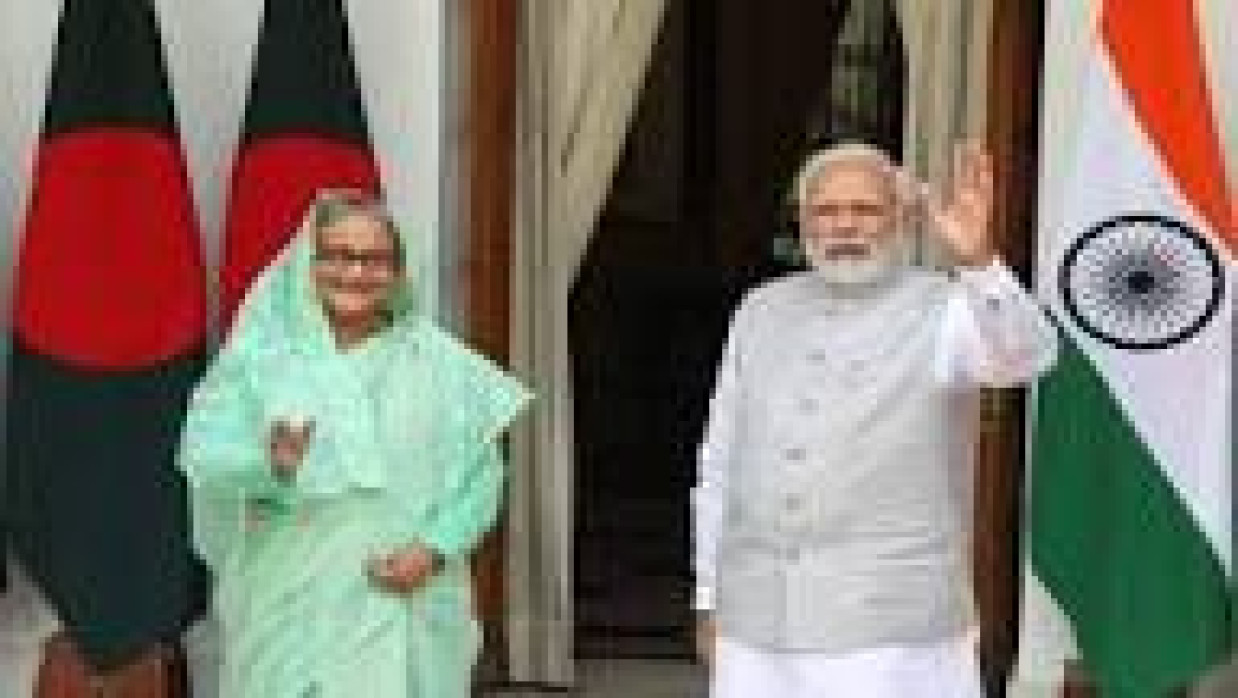
Bangladesh is all set to hold its first democratic election after the dramatic implosion of 15 years or more of Awami League rule. Yet another political reality seems to have emerged on the other side of Bangladesh, in Kolkata and Delhi, where the political fugitives of the erstwhile ruling party face grave criminal charges and speak of their political comeback with striking confidence. This is no ordinary political reality of a dethroned ruling party planning a political comeback after exile. This is a political reality that reflects strikingly on the impact of political ambiguity and power politics, which cast long shadows over Bangladesh's democratic struggle and its efforts to reclaim political power and legitimacy from an increasingly disillusioned citizenry.
From Sudden Flight to Prolonged Exile
The sudden flight of Sheikh Hasina from Bangladesh after the July uprising was perhaps one of the most dramatic political events in Bangladesh's recent political history. As people began to gather around her residence protesting against her government, she was flown out of Bangladesh into India, leaving behind a nation in shock and mourning. The findings of events that transpired during her final days in Bangladesh, as revealed by the United Nations, suggest that Bangladesh had never witnessed such unprecedented violence and bloodshed as during the final days of her rule. An estimated 1,400 people died as a result of the activities of security forces.
This collapse resulted in the rapid disintegration of the Awami League's domestic power base. Thousands of party workers, enforcers, members of its student wing, and party leaders fled in fear of public ire, mob violence, and the litany of criminal charges brought against them. Over 600 party members found refuge in Kolkata alone, which has become the de facto capital of the suspended ruling party.
India as Operational Rear Base
India has not just become the sanctuary for the exiled Awami League; it has become its operational rear base. It has provided the party with organizational cohesion, messaging, and the ability to keep its cadres and members back in Bangladesh optimistic and mobilized. This has been done despite the interim government suspending the party and prohibiting it from contesting or campaigning in the February elections.
Party leaders travel frequently between Kolkata and Delhi to meet with Hasina, who is still chairing meetings, okaying party directives, and giving political instructions. This has all been done in the open under the watchful eyes of the Indian authorities, which gives credence to the belief that not just has India provided sanctuary, but also space. This ability of the Awami League to function has enabled the party to act more like a party not in introspection but in waiting in the wings, confident that history will be kind and change its course.
Defiance, Denial, and the Cult of Return
While she has been given the death sentence by a war crimes tribunal for crimes against humanity, her rhetoric has become more defiant. She says she is a victim of unconstitutional changes in government, that the legal process is fabricated, and from her safe hideout, she has exhorted her followers to undermine the election by boycotting, disrupting, and protesting it.
The student wing leaders and former ministers talk of the “upcoming struggle” and returning “as a hero.” The disconnect between their rhetoric and the ground reality in Bangladesh is astonishing, where the name of the party is synonymous with enforced disappearance, secret detention centers, election rigging, and corruption. The idea of her returning “as a hero” is based neither on political acumen, patronage politics, nor on the notion that the legitimacy of the government rests on the exercise of power rather than the will of the people.
Democracy Rhetoric and the Credibility Vacuum
The most astonishing and disconcerting part of the Awami League's exile rhetoric is their newfound interest in democracy. They now talk of free and fair elections, independent judiciary, human rights, and the free press, which is precisely what they sought to destroy during their fifteen years in office.
The Awami League's sudden adoption of democracy-sounding rhetoric strains credulity for many Bangladeshis. International human rights organizations have documented the systematic suppression of the opposition by Hasina's regime, including the arrest or enforced disappearance of opposition leaders, the use of draconian laws against journalists, the politicization of the judiciary, and the transformation of electoral processes into administrative exercises devoid of any semblance of competition. Therefore, the argument that the exclusion of the Awami League from the election process undermines democracy lacks grounding in political reality and appears to be a ploy to regain relevance without being held accountable for its actions.
The Interim Government: Promise and Paradox
The new interim government under President Muhammad Yunus has vowed to deliver a free and fair election and dismantle the machinery of the authoritarian regime. The commitment to a competitive electoral process marks a major turning point in Bangladesh's political history. However, the transition process also had its drawbacks.
Why Did India Allow Hasina to Speak and Organize? A Diplomatic Perspective
- Strategic Investment in a Proven Ally
This allows her political voice to be heard and a tried-and-trusted ally to remain an option in case the transition process in Bangladesh fails. - Leverage Over Bangladesh's Interim Government
India has leverage over the interim government in Bangladesh because it hosts Hasina and allows the Awami League to operate. The unstated assumption in India's decision to allow Hasina to speak and organize is a veiled threat to Bangladesh: Your stability and ability to contain internal strife depend on our benevolence. India can use this leverage in negotiations over water sharing, transit rights, and related issues. - Non-Interference as a Basis for Plausible Deniability
India's action is justified by its policy of non-interference. India believes that merely allowing speeches does not mean it endorses them. Therefore, India has plausible deniability. India's lack of comment on Bangladesh's protests against Hasina's speeches is a well-thought-out strategy and not an indication of its lack of interest. - Fear of Uncertainty and Rise of Political Islam
The security council of India is concerned about political uncertainty in Bangladesh and the rise of political Islam in the region. This is why; by providing political asylum to Hasina, India is attempting to hedge against political uncertainty and other outcomes it cannot manage or control. - Signaling India’s Role as a Regional Power Broker
The final reason for the Indian government’s decision to provide Sheikh Hasina with political asylum and enable her to continue her political activities is to allow a deposed leader to remain and operate from Indian soil. This is a clear sign to all parties involved in South Asian geopolitics that India is the regional power broker and that politics in South Asia cannot be considered an internal affair.
Public Backlash and the Surge of Anti-Indian Sentiment in Bangladesh
One of the most important, though least understood, consequences of the Indian government’s decision to provide Sheikh Hasina with political asylum and enable her to continue her political activities is the surge in anti-Indian sentiment in Bangladesh.
For many people in Bangladesh, the Indian government’s decision to provide political asylum to Sheikh Hasina is no longer considered a pragmatic and necessary decision for maintaining a delicate balance in regional geopolitics, nor is it considered a humanitarian gesture to provide political asylum to a former leader who is wanted for serious human rights abuses in her own country. What is now seen is a blatant attempt at political interference in another country’s affairs, especially given the fact that a former leader who is wanted for serious human rights abuses is being given political asylum in India and is able to operate on Indian media outlets, give political instructions, and even delegitimize the political process in her own country, all while her political opponents in Bangladesh are complaining to no avail.
The Indian government’s actions in this case have resulted in a paradigm shift in how people in Bangladesh view the Indian government. Anti-Indian sentiment in Bangladesh is no longer a source of frustration; rather, it has become a source of anger, resentment, and suspicion, especially because of the Indian government’s actions in this case. The Indian government’s actions in this case are now seen as facilitating the worst form of authoritarianism and impunity, especially because of the Indian government’s actions in this case. The argument being advanced on the streets of Bangladesh is simple yet effective: if the Indian government were interested in helping the people of Bangladesh, it would never facilitate political asylum for a person against whom the people of Bangladesh rose up at a great human cost.
This anger is fueled by memory. Bangladesh remembers years when Hasina’s government appeared overly solicitous towards Indian strategic interests on transit, security, and regional issues without corresponding consideration for Bangladeshi public opinion. Her visit to India now retroactively confirms, in public imagination, a suspicion long harbored: Hasina’s regime has been as much sustained from outside as it has been enforced from within.
Most importantly, however, this backlash is no longer restricted solely to party lines but has now begun to transcend ideological and generational lines, bringing together students, professionals, and even India's erstwhile support base in a sense of humiliation and anger at being so blatantly ignored. What was ostensibly a political dispute has now become a question of nationalism, thereby transforming India's strategic ambiguity into a reputational crisis. In this context, each speech delivered by Hasina from Indian soil is merely pouring oil into a fire that is already raging. However, instead of undermining the opposition to her legacy, this merely seems to solidify it further with the added bonus of deflecting anger away from the current political crisis and onto broader anti-Indian sentiment that may extend far beyond it.
Conclusion: Exile Is No Substitute for Legitimacy
The Kolkata-Delhi policy of the Awami League is, in the final analysis, based on denial rather than reckoning, on nostalgia rather than reform, and on foreign shelter rather than popular consent. The political relevance of the Awami League based on geography and patronage might sustain the party’s presence, but it cannot and will not create legitimacy where the party has forfeited it on the streets of Bangladesh over decades of repression, coercion, and institutional decay. India's permissiveness might sustain the Awami League's political presence, but it cannot restore the party's legitimacy, which was squandered on the streets of Bangladesh.
The democracy of Bangladesh’s future will not be scripted in the drawing rooms of India, in the villas of India, or in meetings held in exile, beyond the reach of accountability to the people of Bangladesh. It will be scripted in Bangladesh itself in an environment where justice is seen to be fairly administered, where polls are genuinely contested, and where the memory of a people who fought with their lives to reacquire a voice is kept alive. Until such a time as the leadership in exile engages with this reality with sufficient introspection and humility, the politics of the Awami League will remain precisely what it is today: politics of exile loud from afar, ever hollower and losing resonance at home.
"Power may survive in exile, but legitimacy does not; it can only be earned where the people live,


0 Comments
LEAVE A COMMENT
Your email address will not be published