

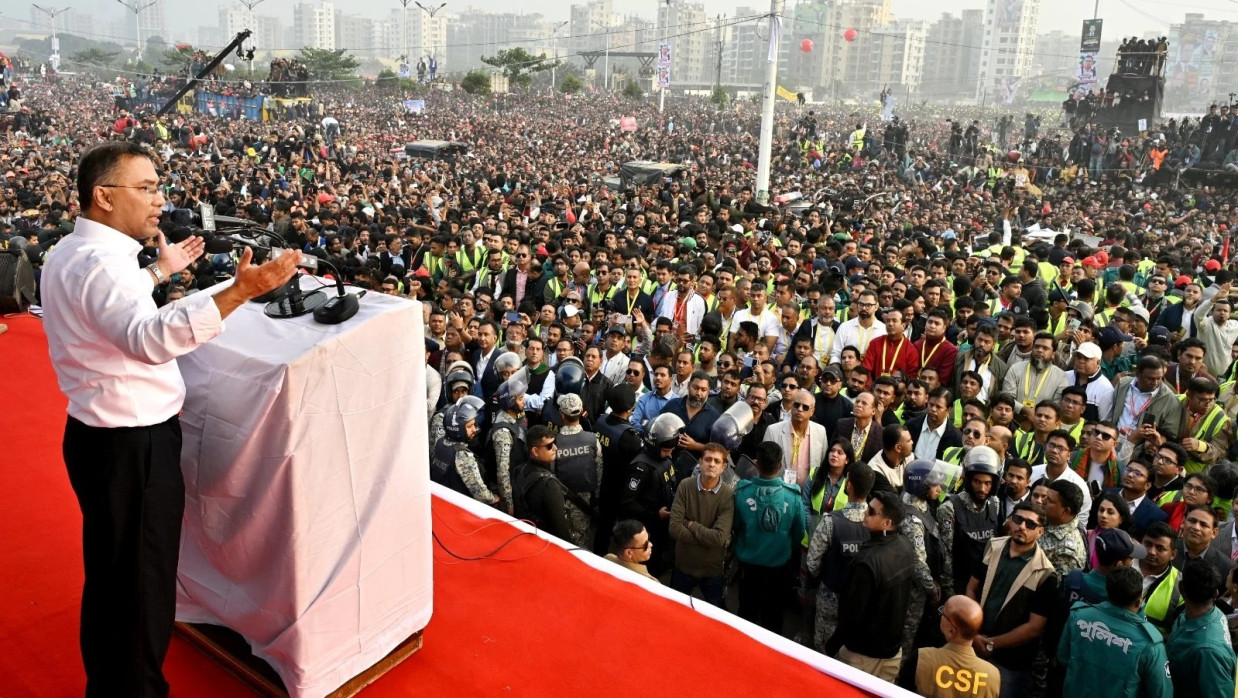
Bangladesh is heading toward parliamentary elections on February 12, yet the vote may resolve far less than it promises. While ballots will be cast and winners declared, executive power is unlikely to change hands-raising the prospect of an election that legitimizes authority without transferring it. On the surface, the process appears democratic: parties are campaigning, polling preparations are under way, and an interim government promises neutrality. Beneath that surface, however, lies a post-election design that delays power transfer and risks hollowing out democratic choice.
What makes this election different is not merely the absence of the ruling Awami League or the resurgence of political violence, but an institutional architecture that decouples electoral victory from governing authority.
Who Is Contesting and Who Is Missing?
The election will be contested across Bangladesh’s 300 constituencies, but the political field is unusually fragmented.
The Bangladesh Nationalist Party (BNP) is leading a coalition of roughly ten parties and enters the race as the largest traditional contender. Its central figure, Tarique Rahman, is widely viewed as a potential prime ministerial candidate should power genuinely transfer after the vote.
Opposing the BNP is a separate 11-party alliance led by Jamaat-e-Islami, which has aligned itself with newer political forces, including the National Citizen Party formed by student leaders who spearheaded last year’s uprising.
Outside these blocs, Islami Andolan Bangladesh and the Jatiya Party are contesting independently.
Notably absent is the Awami League (AL), whose political activities were banned in 2025 following the ouster of its leader, Sheikh Hasina. From exile in India, Hasina has continued issuing political statements, further polarizing an already volatile political environment.
The Return of Fear: Protests and Political Killings
Many Bangladeshis believed the culture of fear had ended with Hasina’s removal in August 2024. That assumption has not survived the campaign season.
Since the election schedule was announced, at least 16 political activists have been killed. Among them was Sharif Osman Hadi, a prominent youth figure of the 2024 uprising who was shot days after announcing his intention to contest a parliamentary seat. His death triggered nationwide protests, arson attacks, and renewed security anxieties.
BNP activists account for the majority of the fatalities, but Jamaat leaders and even figures linked to the banned Awami League have also been targeted. Police maintain that the killings are criminal rather than political. For campaigners on the ground, that distinction offers little comfort.
The violence is not confined to inter-party rivalry. Internal disputes especially in constituencies where rebel candidates are challenging official nominees have fueled intimidation, threats, and clashes. In several districts, violence has erupted among supporters of rival BNP candidates, underscoring how fragile party discipline has become.
An Interim Government That Does Not Intend to Exit
The elections are being overseen by an interim administration headed by Nobel laureate Muhammad Yunus. His government is not accused of orchestrating repression, but it faces mounting criticism for failing to curb violence or provide clarity on the post-election roadmap.
Under the current plan outlined in the July Charter, endorsed by several political actors newly elected members of parliament will not immediately form a government. Instead, they are expected to function as a constitutional reform council, often described as a Constituent Assembly, with a six-month mandate to overhaul foundational laws. During this period, Yunus’s administration remains firmly in place.
The legal ambiguity is significant. Bangladesh’s constitution does not clearly provide for a Constituent Assembly formed without an explicit electoral mandate. As a result, elections may produce representatives who are empowered to amend the system but not to govern within it.
The Referendum Trap and Constitutional Suspicion
Compounding these concerns is a referendum scheduled alongside the election. If passed, it would effectively suspend the 1972 constitution and delay the swearing-in of MPs until a new constitutional framework is finalized.
Critics argue that this maneuver risks bypassing Articles 7A and 7B, which criminalize unconstitutional seizures or subversions of power. The concern is not abstract. When constitutional safeguards are weakened during a “transitional” moment, temporary authority has a tendency to become permanent.
Supporters of the roadmap argue that reforms must precede elections to prevent a return to authoritarianism. Yet this logic raises an uncomfortable question: why could those reforms not be pursued by an elected parliament, as is standard practice in democracies worldwide?
Jamaat’s Strategic Patience, BNP’s Strategic Risk
The proposed delay suits some actors more than others.
Jamaat-e-Islami has openly supported extended reforms and constitutional restructuring. For a party long constrained by Bangladesh’s secular-liberation framework, prolonged transition offers an opportunity to reshape the state without securing a decisive electoral mandate.
The BNP, by contrast, appears caught between momentum and miscalculation. While it is well positioned to win seats, its acceptance of the July Charter risks legitimizing a structure that could neutralize its own victory. In effect, the BNP may win the election only to discover that it cannot rule.
The India-Pakistan-US Triangle
The domestic uncertainty is sharpened by regional and global geopolitics.
India’s role has drawn particular scrutiny. Indian media platforms have amplified Sheikh Hasina’s political messaging from Delhi, reinforcing perceptions that New Delhi is not a neutral observer but an invested stakeholder. For many Bangladeshis, this recalls a longstanding pattern in which Indian strategic preferences are conflated with democratic legitimacy.
The United States, which strongly supported the post-Hasina transition, has adopted an increasingly pragmatic posture. Stability and continuity appear to outweigh concerns over delayed civilian authority, reflecting a broader Indo-Pacific logic in which predictability is often prioritized over democratic process. Quiet Western accommodation of Islamist actors-once treated with caution has reinforced perceptions that Washington’s commitment is to order, not outcomes.
Pakistan, by contrast, has maintained a notably restrained stance. Islamabad has emphasized sovereign choice, constitutional continuity, and non-interference-an approach that contrasts sharply with Delhi’s visibility and Washington’s quiet accommodation. In a region accustomed to interventionist impulses, Pakistan’s restraint has subtly altered the diplomatic optics.
Elections Without Authority
Bangladesh is not facing the absence of elections. It is confronting the erosion of what elections are meant to accomplish.
Even if polling day is peaceful, even if turnout is high, and even if results are accepted, the real test lies afterward. Without a timely transfer of executive authority, ballots risk becoming symbolic gestures rather than instruments of accountability.
February 12 may change the composition of parliament. It may not change who governs. And that distinction between representation and power defines the real stakes of Bangladesh’s most consequential election in more than a decade.


0 Comments
LEAVE A COMMENT
Your email address will not be published