

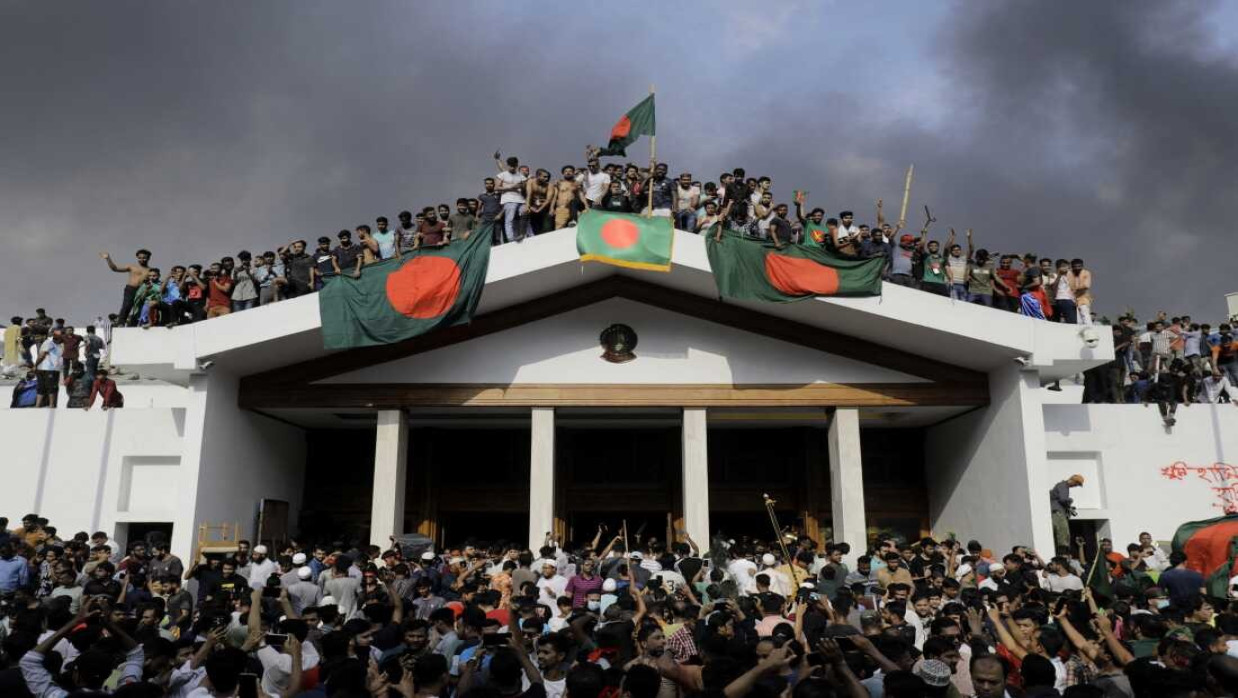
On February 12, Bangladesh is at the crossroads of a choice of historic profundity – one which goes beyond the normal ceremonial exercise of a general election and speaks to the very heart and soul of the republic. As the people get ready to exercise their franchise to select their elected representatives, they are simultaneously being asked to make a choice of far greater moment through the referendum – whether the people shall at last harness the moral authority of the July 36 Revolution to establish irreversible foundations of democracy in the land, or whether they shall let the spirits of authoritarianism steal back into the state unobserved.
This referendum is neither a symbol nor a legal formality concocted and imposed by the elite. It is the ultimate embodiment of a people’s uprising, which came about because of frustration, courage, and sacrifices, and which defied the rule of fear and the drift towards authoritarianism. The referendum is the people’s assertion that power must again come from the people, and not the other way around. Ultimately, it is the people’s effort to return the citizen to the pinnacle of sovereignty over the republic.
Crucially, this reform agenda has been the product of the thoughtful and principled efforts of Dr. Muhammad Yunus and his reform-minded team of experts, who have embarked on this momentous change with a refreshing sense of moral purpose and foresight. With their collective knowledge and experience in the fields of moral leadership, social justice, and institution-building over the years, the Yunus team has been mindful of the hard-earned collective knowledge of the nation’s past 54 years of existence: democracy will not thrive on elections if the institutions of democracy remain susceptible to abuse.
The country's history is marked by alternating cycles of elections and authoritarian consolidation. Regimes changed, elections were held, parliaments functioned, and constitutions were invoked. But in fact, with each cycle, power was consolidated, opposition shrank, and state institutions were weakened and politicized. This cycle made people in the country increasingly disillusioned and made democracy even more precarious. This is where the referendum comes in, intended to end this cycle by ensuring democracy is entrenched in a way that is very difficult to reverse, even when one party is very dominant in elections.
In this regard, February 12 is more than just election day; it is a constitutional milestone. To cast your vote on the referendum is to keep the spirit of July and to ensure that fascist and autocratic rule, disguised as it may be, never returns to our country and to put Bangladesh on the right path to becoming a true democratic state, one that is ruled by law and the will of our people.
Why the Referendum Matters: From Momentary Uprising to Permanent Reform
History shows that revolutions have failed not because the will of the people wavers, but because the state's structure remains untouched. In Bangladesh, history shows that mass movements have consistently led to political change, while the underlying power structure has remained unchanged.
The referendum specifically targets this weakness. The referendum aims to turn the emotional and moral power of the July uprising into constitutional and legal requirements. Voting for “Yes” is an affirmation of the proposition that democracy is intended, rather than wished for. This is because elections cannot guarantee freedom if the bodies mentioned are politicized or made subservient to the authorities' will. In this respect, the referendum becomes a safety mechanism. It instills institutional memory in circumstances that have hitherto seen short political memory, ensuring that the mistakes of the past are not simply repackaged and normalized.
Commemorating the July 36 Revolution: Sacrifice to Statecraft
The July 36 Revolution was not a spontaneous outburst of passion without a purpose; it was a collective expression of defiance against fear, impunity, and exclusion. It was the result of the obstruction of democratic avenues, the nullification of votes, the repression of the opposition, and the denial of accountability. It cost the highest price. Its sacrifice calls for more than mere commemoration; it demands consequences.
The most immediate way to pay that tribute would be to cast a Yes vote. This ensures that the bloodshed and pain are not merely a prelude to another elite settlement but are instead the foundation upon which a new political order has been established. The referendum turns grief into governance by institutionalizing safeguards against the abuse of state power and against violations of civil liberties and political pluralism.
Neglecting and dismissing the opportunity would mean the revolution becomes a tragedy rather than a turning point. A Yes vote means the nation wants the continuation of the reforms rather than the usual, comfortable, but destructive ways in politics.
The Yunus Reform Framework: Ethics, Institutions, and Democratic Depth
The content of this referendum embodies a reform vision that has been Dr. Muhammad Yunus’s guiding principle all along: one that puts ethics, integrity, and humanity above all else in governance. Dr. Yunus’s leadership during this interim reform period has also taken into account that one important lesson that has been learned from Bangladesh’s 54 years of history: that democracy falls apart when institutions become instruments of power rather than instruments of principle.
The reform agenda developed by Dr. Yunus and his team is centered on state rebuilding through an inner revival. It requires independence, transparency, and accountability as non-negotiable conditions for any democratic state. The agenda is not centered on leadership and politics, but rather on developing institutions that will be stronger than any negative factor.
This is a non-partisan approach. It is intended to benefit future generations, whoever comes to power in the next government. By voting Yes, citizens express support for a democratic ideal that is ethical by design and guaranteed by law.
The Consequences of a "No" Vote: Reopening the Way for Authoritarian Return
An anemic “No” vote on the referendum would mean more than simply the absence of change. It would represent an interruption between the sacrifices of the July 36 Revolution and the constitutional future of the state. An anemic “No” vote would mean the architecture of power remains much the same, allowing the same weaknesses in the country’s power architecture to persist and contributing to the repression, electoral manipulation, and executive power the country continues to face. In essence, the vote would mean the lessons of the past remain unlearned.
A No vote would embolden those sectors that prosper in a state of indeterminacy and institutional weakness. Without the referendum’s guarantees, politicized administrations, compliant oversight institutions, and a weakened system of checks and balances would once again become the norm. This would most likely lead not to a cataclysmic downfall, but to a gradual unraveling, a gradual destruction of democracy, a stifling of dissent, and a consolidation of power that would, in fact, be illegal and illegitimate. In that case, the July uprising would be remembered not as a moment of transformation, but as an interlude.
The Core Reform Principles Underlying the Referendum
At its essence, the referendum aims to address the wrongs that have existed in Bangladesh's governance structure. First, the changes seek to depoliticize state agencies, ensuring that the civil service, the police, and regulatory agencies are non-political entities that act as impartial protectors of the general interest rather than as instruments of political will. Secondly, the changes enhance accountability, allowing independent agencies to probe corruption, misuse of power, and electoral irregularities without fear of retribution. Thirdly, the changes enhance civil liberties, making freedom of speech, assembly, and dissent more than just pre-election campaign promises. Lastly, the changes seek to curb the state’s over-reliance on the executive.
Each of these factors, working together, helps build a democratic system in which no person or political entity can monopolize power.
Preventing the Re-emergence of Fascism and Autocracy
Authoritarianism never returns by tanks and coups, but it returns by the manipulation of the law and the fatigue of the citizenry. It thrives in places where the citizenry is reminded that stability is more important than liberty and efficiency is more desirable than accountability. Bangladesh has experienced this before.
The referendum is clearly meant to break this cycle. By enshrining protections and fortifying institutions, it increases the political and legal price of illiberal regression. A Yes vote is a collective signal that the time when citizens can be governed through fear, silence, and coercion masquerading as order is over. Thus, the referendum is neither reactive; rather, it is preventative, ensuring that all the factors that led to the July uprising are removed.
Memory vs. Amnesia: The Moral Choice Facing the Nation
Each country reaches a point in its existence when it must choose to remember or to forget. Remembering is hard work requiring accountability, change, and self-control. Forgetting is easy, leading to the return of old ways of doing things, now dressed up in new ideologies.
Bangladesh faces just such a dilemma on February 12. To vote "Yes" is an act of collective memory. It is an acknowledgment of suffering, an acknowledgment of failure, and a commitment to the future. To vote "No," or to vote apathy, is to invite the possibility of historical amnesia.
Why Anti-Reformers Are Against the Referendum
The very fact that the referendum is intended to consolidate reform is why it is opposed by entrenched groups, both local and foreign. On the local front, there are forces left over from the previous ruling elite, some of which are affiliated with the banned Awami League (AL), who have every reason to oppose the referendum's success. This is because the reform agenda opposes the networks of influence and impunity that developed under the previous system of governance.
In this respect, a "No" vote maintains room for maneuver. This is because it leaves room for a possible return to power via rebuilt alliances, managed elections, or exhaustion of the population. This is contrasted with reform, which would be very difficult to reverse once entrenched in the constitution. This is as opposed to a lack of reform, which would allow authoritarian measures to be reframed and reinstated.
Apart from the local players, there are also powerful regional players who may have their own motivations for resisting the emergence of a stronger, transformed, and more autonomous state in Bangladesh. A truly democratic state, which functions according to the rule of law and enjoys the people’s mandate, would be less vulnerable to external pressures and influence.
For such actors, “the referendum marks a shift in strategy, since it decreases leverage, reduces the power of backchannel diplomacy, and increases transparency. A weakened or failed referendum sustains a Bangladesh that can more readily be shaped by compliant elites and fragile institutions. For such actors, “opposition to the referendum is not ideological, but interest defined.
The Strategic Cost of Rejection
A No vote, thus, will come with its own implications and consequences, not only in the politics of the country but in the broader global arena. It will send signals to people, reformers, and the international community about the state's capacity to consolidate its democratic ideals in the face of crises.
Most importantly, failing to hold a referendum may mean failing to live up to the moral challenge of July, to honor the fact that the people rose up not to replace a government, but to replace governance itself. The forces that operated through fear, silence, and the concentration of power would be best placed to regroup and reorganize without constitutional change.
Why "Yes" is the Firewall Against Regression
By contrast, a Yes vote shuts the door to regression. It translates the revolution’s charter into a contract, making it much harder for the return of authoritarianism, whether homegrown or foreign assisted, to exploit procedural weaknesses. It asserts that the course of Bangladesh’s destiny will be determined by its people, not by the interests vested in the shadows by the imperatives of opacity, weakness, and vulnerability.
In this regard, one can see that the vote on the referendum is not merely a question of reform, but rather one of irreversibility. The vote for the Yes option ensures that what happened in July cannot be reversed in secret and that Bangladesh will have a sovereign and democratic republic that can resist both authoritarian regression and foreign interference.
Conclusion: Choosing the Republic of Bangladesh Deserves
The referendum is no distraction from electoral politics; it is the foundation on which legitimate electoral politics must be based. Without such foundational reforms, electoral politics can devolve into periodic rituals – procedurally proper but deeply empty. But with reforms on the referendum's side, electoral politics can resume its authentic role in genuine self-government and popular sovereignty.
A Yes vote on February 12 marks the end of an epoch that began last July. This is a move that will take the people’s struggle from the streets of Dhaka to the pages of the constitution, from protests to policies, from sacrifice to safeguards, and from hopes to a constitutional mandate that will never be reversed or annulled.
It is a statement of intent that says, once and for all, that Bangladesh shall never again barter away its future for a moment of peace or a sense of stability that is merely a euphemism for a return to tyranny and oppression.
As Dr. Muhammad Yunus has said on multiple occasions during this moment of reform, “A democracy will not survive on the basis of elections alone; it needs to be safeguarded each day by institutions working for the people, not for power.” This idea encapsulates the essence of the referendum. It represents the untiring efforts of Dr. Yunus’s reform team of constitutional lawyers, civil society activists, and governance practitioners, all of whom have been working to make the next chapter of the Bangladeshi experience different, not just at the leadership level but also at the structural level.
Credit must also be given, although briefly and clearly, to the political parties and democratic forces that have decided to rise above short-term thinking and lend their support to the referendum agenda. Such support indicates a welcome consensus that the defense of democracy is more significant than any short-term gain or loss in power, and that the lessons of relapses into authoritarianism must at last be treated seriously. By voting Yes, citizens vote not only for reform. They vote for memory to remember those who gave their lives in July. They vote for responsibility—to accept that a democracy must be constructed and defended, not simply claimed. And most importantly, they vote for a republic worthy of its people—one that is ruled by the law, safeguarded by institutions, and grounded in the steadfast will of the Bangladeshi people.

0 Comments
LEAVE A COMMENT
Your email address will not be published