

Why This Moment Matters
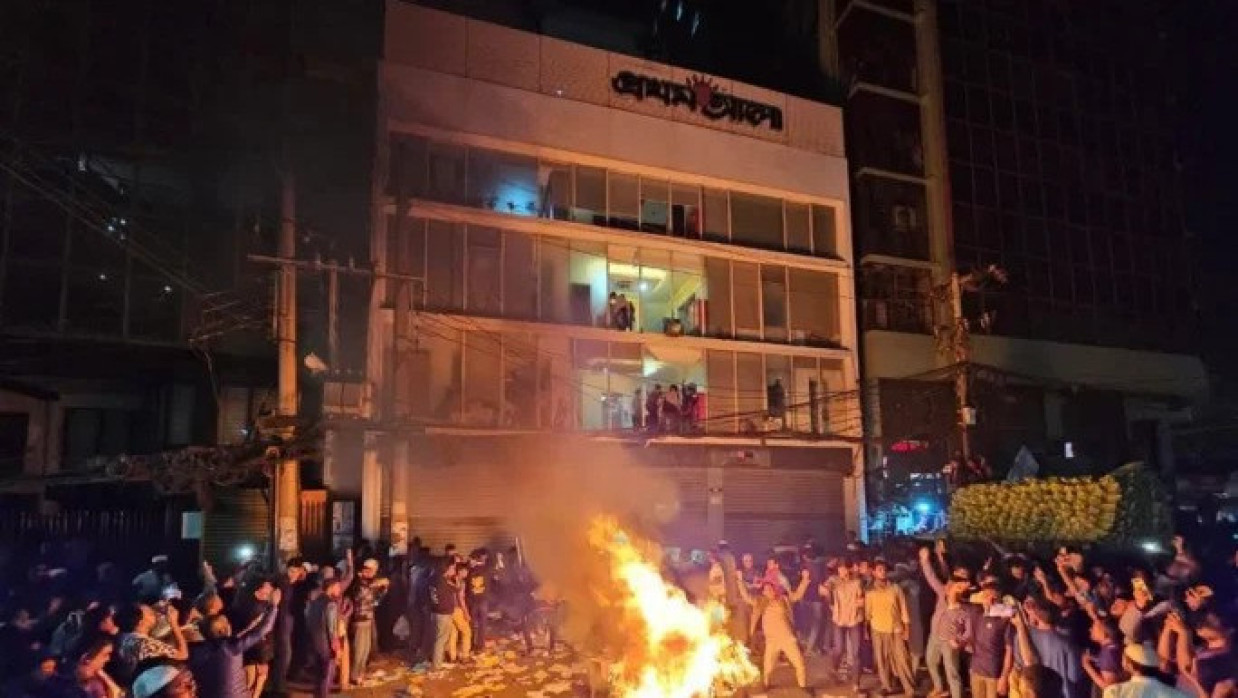
Moments of crisis are more than a test of institutions; they lay bare institutions. They reveal, beyond the scripted commitments, the underlying moral structure. Specifically, in the case of the media, these instances expose a harsh reality: whether the news enterprise serves the public conscience or the interests of power, prestige, and political comfort. This December 18 evening in 2025 will remain a moment of reckoning in the history of the media in Bangladesh. But what proved more significant than the violence that took place on this evening of unregulated attacks on the offices of “The Daily Star’ and “Prothom Alo” was the aftermath in which the narrative of the incidents shaped and constructed.
This essay starts with a very brave entry by Shahidul Alam, a media institutional builder, photojournalist, intellectual, storyteller, writer, and educationist, who presented a scathing critique of how the most popular Indian dailies framed their reporting of the event by omitting essential information. This writer remembers this eventful night differently. However, this particular narrative presents much more than that; it presents an indictment of something much deeper than just that one particular failure.
The aim of this article is to critically assess, from a hegemonic perspective, post-attack media performance in “The Daily Star and” “Prothom Alo”, as a way to prove that guided omission, story filtering, or news-paper self-preservation are not exceptions but a normative strategy that has created a culture of silence that has a detrimental effect, not only on the credibility of “The Daily Star” and “Prothom Alo”, but also on the role that journalism plays as a democratizing voice that has the power to hold those who are in power accountable.
The Night of Fire and the Arrival of Truth
Shahidul Alam remembers that ‘that night, he received two pieces of urgent information.’ The first one stated that “Nurul Kabir, the editor of ‘New Age’ newspaper, he President of ‘Editors’ Council, has been publicly humiliated, beaten up, while he visited the newspaper office yesterday.” The second piece of information that the Shahidul received stated that “‘Zaima Islam’, a researcher at the World bank, feared that her life could be at stake, as posted on Facebook.”
Alam arrived at the scene to find something that would soon disappear from mainstream coverage: six members from the National Citizens Party had gathered to show solidarity. Kabir, unwilling to resort to symbols of privilege, decided to exit the way he had entered, not through some hastily arranged “safe route” but in the same space that had witnessed violence.
The media personnel, with help from security personnel, were evacuated. Only when the final journalist had been evacuated did Kabir and other personnel return, again passing through the hostile crowd. A sizable NCP group, together with three party leaders, awaited them outside.
All of this is important information. Not for glorification, but as a whole, it is the story of collective risk, collective unity, and collective bravery.
The Politics of Omission: When Silence Is Not Neutral
What happened after the Attack is, in fact, the real heart of Shahidul Alam’s argument, and this one in turn. Both The Daily Star and Prothom Alo did cover the Violence. But in covering the issue, they missed the decisive point. This was that other people, and particularly leaders of the NCP, were in danger, that they had entered an angry crowd, and that they refused to leave until all the journalists were safely out. This was far from being an afterthought. It was, in fact, the very point of this incident.
Such an omission cannot in any way be attributed to oversight or editorial cutting. As Alam forcefully argued, this was sheer truth distortion. At this level, it becomes not really an issue concerning factuality, but more that of hegemonic storytelling, where not merely what, but who, gets to have its virtuosity validated through moral recognition.
From an ideal perspective, this fits with Antonio Gramsci’s concept of hegemony in relation to meaning and visibility. Where the presence of non-elite actors in protecting journalists has been made to disappear through acts of courage and solidarity, this has ensured that the philosophical status of a minutely maintained moral order has been upheld—one in which legitimacy, responsibility, and morality are monopolized. Such an acknowledgment would disturb this order in which only some actors are deemed the saviors of democracy.
This kind of omission is also characteristic of what agenda-setting theory calls “second-level agenda control,” in which the omission is not about what happened, but about what mattered. There was coverage of the event, but not the full ethical context. By doing so, the two newspapers shifted the public’s gaze from “collective courage” to a clean institutional focus, thereby safeguarding their reputational capital.
Counterintuitively, this tactic is somehow self-defeating. Although this approach may allow for momentary control over the story, it comes at the expense of journalistic credibility. The value of news journalism lies not within its prestige or tradition but instead within its comprehensiveness, veracity, and morality. Eventually, readers will come to realize that important facts were withheld, but this time not for journalistic necessity but for news convenience. Silence speaks louder than headlines.
Thus, it was not just that one night that was distorted by this omission, but so was the ethical high ground that these papers, or should I say “newspapers,” have enjoyed. By failing to honor those who put their lives in danger to help journalists, it seems that these organizations have inadvertently projected themselves to reflect an authoritarian mentality which they have always professed to resist: to determine what action should or should not matter, what sacrifices should or should not be recognized, what truths should or should not be disrespected. In journalism, objectivity does not reside in silence. Where truth is selectively concealed, silence becomes a political act one that debilitates journalism, diminishes the public domain, and hastens the slow decay of democratic integrity.
Hegemony in Practice: Manufacturing Moral Hierarchies
To grasp the strategic silence that permeated this moment in history, it is necessary to recall the crucial ideas of the hegemonic school of thought developed by Gramsci. Gramsci recognized the impossibility of modern power maintaining or relying solely on force. Its actual strength derives instead from the power of meaning: deciding what voices are considered authentic or what actors gain visibility on the cultural horizon depends on the hegemonic will. Gramscian hegemony functions best when force becomes common sense.
In this case, omission can be viewed as a function of moral gatekeeping. In omitting the role of NCP’s physical presence, as enacted by its leaders and activists, who literally put themselves on the line to safeguard journalists, it ensures that the moral order, as intended, remains intact. In such a moral order, mainstream media organizations again take up their role as the only moral keepers of democracy, bravery, and responsibility, to the effect that grassroots groups, no matter what acts of bravery they partook in, are denied moral acknowledgment.
This dynamic is also directly related to what Louis Althusser has defined as the role of ideological state apparatuses. These apparatuses are more involved in the reproduction of ideology through the dissemination of selective truths as norms, as well as in the consensual disappearance from reality of certain truths. The media relies on power rather than questioning power.
Crucially, this hegemonic storytelling also has real-world effects. This selective reporting has merely fueled the fire in many of Bangladesh’s younger generation, already alienated by institutions, further angering them against The Daily Star and Prothom Alo. Young readers, aware of social counter-narratives and eyewitness accounts, soon realized that this selective reporting pointed not merely to caution, as would be expected in institutions, but to a deliberate covering up of truths to maintain hegemonic storytelling.
It is ironic that the process that was expected to save journalistic authority has hastened its collapse instead. Agenda-setting and framing become mechanisms of repression and, thus, lose all credibility as journalism. The anger against these publications did not just develop in a vacuum; it was shaped by the framing of all agendas. That which was left unsaid was more audible than that which was published.
In this way, the function of hegemonic control actually proved self-defeating. The failure to recognize those who represented solidarity and bravery on the part of the media did more to misrepresent reality but also contributed to alienating a generation of people who felt they did not have to be fed the truth as presented to others. Ultimately, this has created an ever-expanding gap between the prestigious press and the democratized public that they are expected to represent.
As Gramsci cautioned and as is the nature of hegemony, it is not and can never be a fixed condition. Once the instruments of hegemony become transparent, consent is undermined. When consent is undermined, moral and journalistic authority, in the absence of legacy, is unsustainable.
Journalism to Self-Preservation--Writing professionally
Shahidul Alam pushes the argument further, stating that the leadership of these publications failed to support the journalists among whom their ranks were numbered: “For those who work inside these institutions, this fact is as clear as daylight.”
In truth, good journalism involves little, if any, heroism, but merely honesty. Reporting news as news. Reporting events unfiltered. Not selecting facts that serve as comfort to institutions. However, what was produced instead is truth laced with a construct that favors reputation over truth.
Habermas was specifically warning against this: the corruption of the public sphere by communication that is strategic rather than truth-telling. If news sources prioritize survival over transparency, they stop being democratic institutions.
Why It Matters to Democracy in Bangladesh
It is not just about the threat posed that night or by those newspapers. It is about what happens when truth becomes filtered, when solidarity becomes erased, when courage is selectively acknowledged. It becomes an act of normalization when journalism becomes an apparatus for authoritarian control. The citizen is formed not only in terms of what to think but in terms of whom to recognize.
The future of democracy in Bangladesh has much more to do with moral integrity in its narrative politics than with electoral politics itself or its institutions. A culture of media hiding the truth from public consumption, even if it means protecting itself, cannot hold its rulers accountable. It embodies the same principles of exclusion and silence that sustain authoritarian regimes.
Conclusion: Reclaiming Journalism’s Moral Core
Fire can level buildings. Silence can destroy trust.
Alam’s example confronts us with a difficult but necessary truth: The measure of journalism is not how loudly it shouts about press freedom, but how accurately it tells the entire truth, even when that truth is complicated and messy.
To the print media in Bangladesh, this is a harsh but optimistic message. Democracy can be reformed if the press can regain its boldness. This transformation shall not begin with banners, but with the simple, revolutionary gesture of telling the truth.
Otherwise, there will be no public sphere. Without a public sphere, there will be no democracy.
Because without courageous journalistic endeavors, truth has no habitat.


0 Comments
LEAVE A COMMENT
Your email address will not be published