

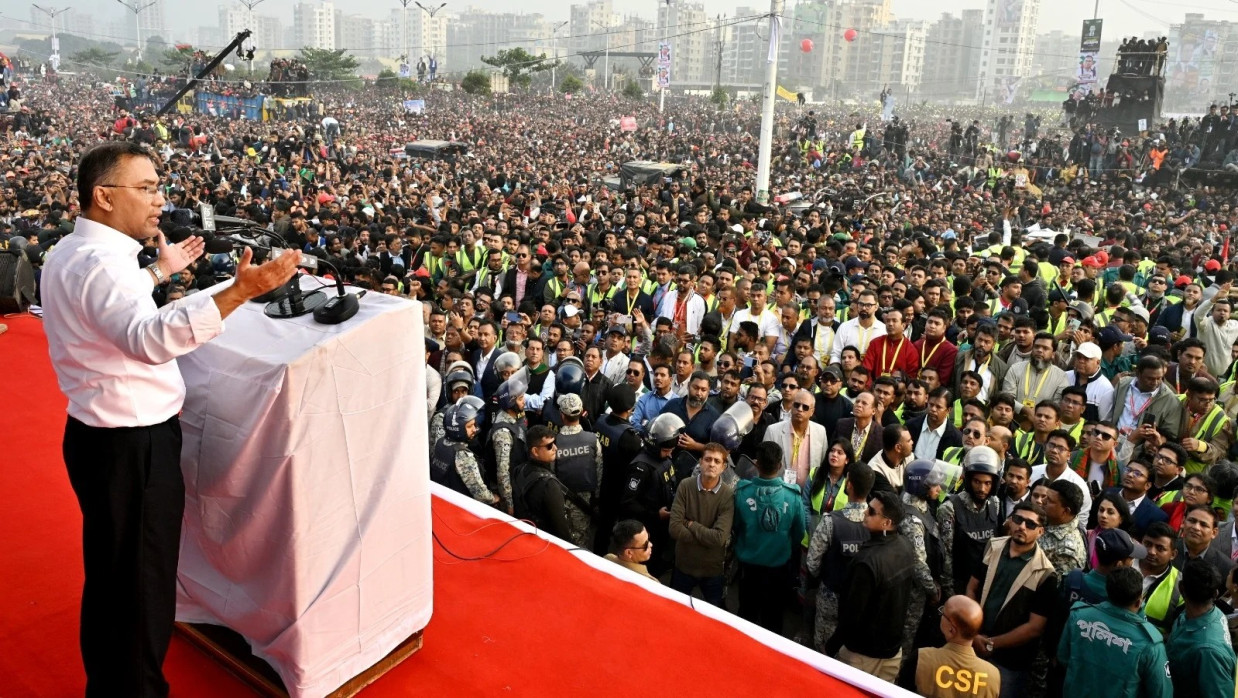
This piece provides a thoroughly inspiring, deeply reflective discussion of the historical return home of Tarique Rahman after seventeen long years in exile a moment that has touched the innermost levels of the emotional-political awakening of Bangladesh's national consciousness. It is much more than a return to homeland politics; it is, rather, the shaping of a pivotal page within the democratic unfolding of the country, centered within the ideological renovation introduced with the Interim Government formed under the inspired leadership of Professor Muhammad Yunus in a more general revival initiated in the wake of democratic fatigue triggered in Bangladesh and throughout South Asia as a whole.
Right from the beginning, it is also significant that there is an emphasis on a magnanimous and statesman-like deed. Upon arriving at Hazrat Shahjalal International Airport in Dhaka, Tarique Rahman made a point of personally calling the Chief Adviser to thank him in advance for the security measures that facilitated his return. This was no mere courtesy call; it was an important way to show appreciation and an acknowledgement of the Interim Government’s honesty, sobriety, and sense of civic dignity during a moment of heightened emotional interest. During that moment, under the sagely, unbiased leadership of Dr. Yunus, there was a dignified, very unifying return.
This dialogue of gratitude and duty between the leader and the state symbolized the finest ideals of transition into politics. Tarique’s homecoming, its meaning for the democratization of Bangladesh, a nation impatient for a new dawn, will be explored against the rich ideological framework of moving from a zone of fear to a zone of reconciliation, from a zone of resentment towards a zone of constructiveness, from a zone of coercion towards a zone of peace.
A Homecoming Made Possible by an Interim Government
History can be made through subtle, noble choices by caretaker governments. Tarique Rahman’s non-violent homecoming on Christmas Day was more than just his own triumph it was also a moment of testing Bangladesh’s political adulthood. The Interim Government, headed by Professor Yunus, provided security, impartiality, and freedom of civic choice during an occasion that would have otherwise easily sparked conflict. Rather than an oppressed democracy, there was restraint by the state and a letting of history unfold with serenity, legal rights, and decency.
Seventeen Years of Exile, Seventeen Minutes of Reckoning
For seventeen long years, Tarique Rahman had to live in exile, away from the soil that nurtured him. However, this distance had not diminished his connection with Bangladesh. After he came back to the country, he did not wear his privilege on his sleeve. He stepped on the soil with bare feet—touching it, feeling its scent, and hugging it with reverence. In a country where political gestures seem rehearsed, this gesture of humility was very human.
His trip from the airport to his reception site, which would have taken only ten minutes, took three hours, not because of congestion but because of the number of people. Thousands were lined up on the way, reaching out to touch, to see, to know that this was, in fact, real.
His speech took only seventeen minutes, but the ensuing silence lasted much longer.
A Nation Watching—360 Million Eyes
In a nation of 180 million, it was said that 360 million eyes were fixed on Tarique Rahman that day. From smartphones held high in Dhaka’s crowds to glowing television screens in remote villages, from tea stalls to drawing rooms, Bangladesh watched together—united in stillness. Never in recent memory had a single political moment commanded such collective attention.
For the span of his address, the country entered an almost sacred silence. Streets quieted, voices stilled, and the usual chaos paused. It was not the silence of fear that had defined years past, but the silence of anticipation, reflection, and shared emotion.
That stillness itself was political. It marked the reawakening of a public’s right to listen freely, to bear witness without intimidation, and to rediscover itself as a people capable of collective attention and collective hope. This silence was not emptiness; it was presence. It was the sound of a nation, long denied civic peace, hearing itself once more.
From Personal Sacrifice to Collective Peace
It is the gesture that speaks the most about the quality of leadership and not words. Coming back home, rather than tending first to his ailing mother, who would have been only natural had Tarique Rahman been motivated by his filial duties and devotion, Tarique decided to go first to the people and pay homage to the love and faith that had sustained him for so long while he was away. This action carried a very rich message.
There was no bitterness, no sense of revenge in his words. The man who had suffered so bitterly, who had been oppressed under the rule of the caretaker government of Fakhruddin and Mainuddin, called for peace, for forgiveness. That was anything but weak. It took courage. There was a purpose behind his act, an act of statesmanship. He spoke of peace across party lines and across religious and ethnic divides, appealing to Almighty God as the source of morality in politics. In a region where lines are often drawn by divisions and resentment, the preaching of forgiveness and patience by the newly sworn-in member of the club was evidence of a different style of leadership.
Echoes Across Time: From Washington to Purbachal
From August 28, 1963, to December 25, 2025—fifty-eight years apart, worlds away, yet united by moral resonance. When Martin Luther King Jr. stood before 240,000 people at the Lincoln Memorial, his words “I have a dream” reshaped the moral landscape of America through faith in dignity and nonviolence.
On that December day in Purbachal, near Dhaka, Tarique Rahman rekindled that spirit—not by echoing King, but by adapting his legacy to Bangladesh’s wounds and hopes. “I have a plan,” he declared—a plan born not of revenge but of peace, not of division but of shared dignity.
Where King dreamed of equality, Tarique envisioned reconciliation. Where Washington once heard a call to conscience, Dhaka heard a call to rebuild trust, restore rights, and reclaim democratic space.
From Lincoln to Purbachal, the moral echo was clear: true leadership speaks the language of its people, meets the needs of its time, and dares to believe that even the most divided societies can rise again through courage and compassion.
A Vision for a Safe Bangladesh - After the Shadow of 'Fear'
“Within an ocean of people,” Tarique Rahman stood alone and preached his vision of a “safe Bangladesh,” which was “disarmingly simple and profoundly transformative.”
“We will ensure,” his voice continued, “that our children and grandchildren will not have to live the way we have lived,” A darkness that had existed for so many years, a darkness of repression, of fear, of creeping authoritarianism that many believed had been spreading under the leadership of Sheikh Hasina, was given the potential for illumination by his speech. There was a quiet strength in his words that spoke not only to politics but to the collective pain of a nation.
He spoke not as a political leader but as a voice for the people to a nation troubled by disappearances, intimidation, and uncertainty. When he talked of a Bangladesh in which a person man, woman, or child could go out of his or her home without fear of not being able to get back home safely, his words gave form to the collective desire.
In order to ground this vision in the soil of history, Tarique Rahman refers to those milestones of Bangladesh's moral history, when in 1971 independence was attained through relentless sacrifice, when in 1975 resistance blossomed against oppression, when in 1990 democracy was retrieved once again by the people, and when in 2024 all Classes and all Generations stood by each other to uphold sovereignty and freedom.
Through these defining instances, he wove the narrative of Bangladesh’s democratic history not as a collection of disparate struggles but as a singular, unended endeavor a living covenant between generations. It was clear what he was trying to convey it has never been bestowed upon Bangladesh; it has only been extracted from fear with the tools of courage, sacrifice, and unity.
Emerging from years of repression, when Tarique Rahman asked for safety, it was more than just an appeal for stability and order. It was an appeal for redemption—redemption of a nation that would be healed by its own dignity and its own mercy. It was an appeal to finish what had been started by previous generations, still unfinished freedom must be defended by its own strength of its own character.
Memory, Mourning, and Moral Accountability
In what is surely one of the most moving moments in the speech, Tarique Rahman turned from hope to memory. With no trace of accusation or resentment, he honored the memory of the thousands who had disappeared or been murdered during the dark days of political oppression.
He spoke softly of fear that had lingered in Bangladesh for over a decade and of the bravery with which, in 2024, that fear was overcome. His words paid tribute not only to those who had struggled, but also to others who merely had to live: mothers waiting, families searching.
He made special obeisance to the youth who gave their lives in defense of their freedom, recognizing in particular a martyr in Osman Hadi, a young activist of "the 2024 movement." He asked forgiveness for his soul and eternal peace. This was not turning politics into tragedy; it was something even more elevated than that an occasion of national mournfulness, a moment of national reckoning, and recognition of the holy price of freedom.
Implications for Bangladesh’s Political Future
The return of Tarique Rahman is clearly much more than personal rehabilitation. It is an indication of a moral and political shift a change in values, tone, and expectations that characterizes Bangladesh's politics.
Firstly, his homecoming rewrites the politics of exiles. For many years, exiles have been used as a means of political exile, a way to silence opposition. In his homecoming with grace, patience, and restraint, Tarique Rahman turned this on its head. This act made it apparent that exiles do not always result in forgetfulness, but that a political reunion can be achieved without a loss of direction in ideals. This applies in a region where many leaders in countries such as Pakistan and Sri Lanka, through exile, manage to increase divisions between people, but in a way that Bangladesh shows a glimmer of democratic growth.
Secondly, his statements and actions have put the idea of peace, restraint, and self-discipline back into opposition politics. In a world where protest in South Asia is increasingly characterized by street aggression, populism, and confrontation, it is a major change to witness Tarique Rahman's emphasis on staying peaceful even under provocation. His brand of politics shows that greater strength, not street aggression, is needed to bring about change. Such politics reduces internal tensions and, at the same time, helps strengthen Bangladesh's image as a responsible democracy in the international community.
Third, he brought about moral vocabulary that had been absent from public discourse for far too long. By using the language of rights, dignity, security, and shared responsibilities, Tarique Rahman brought ethics back into politics, a language grounded not in cynicism but in conscience. In a society corrupted to the point of exhaustion by transactional politics, it is through this restatement of moral vocabulary that people are encouraged to recognize themselves as voters on a journey of moral discovery.
As a high-ranking official of the Bangladesh Nationalist Party (BNP), he made the promise, “I have a plan for the people of my country,” more of a moral contract than a politician’s promise. It held promises of development founded upon dignity, progress charted through peace, and leadership based upon service rather than retaliation. His return could thus mark a turning point toward a more inclusive, ethical, and compassionate Bangladesh.
South Asia in Comparative Perspective
Nevertheless, the resonance of this moment does not remain within Bangladesh. Across South Asia, a region beset by the decline of democracy, the growth of authoritarian politics, and deepening rifts, Tarique Rahman’s homecoming provides a glimmer of hope.
Even as Sri Lanka protests and the elections in Pakistan spark controversy, and amid India's majoritarian concerns and Nepal's tentative coalitions, the region is seeking examples of how a peaceful transition is possible. Bangladesh's experience, with the interim government's preference for liberty over tyranny, shows that stability and liberty can coexist and that trust-based reconciliation is preferable to repression.
It is a moment when many democratic systems are failing under the pressure of populism and polarization. It is relevant because the Bangladeshi experience of a quiet transformation underlines the simple truth that democracy does not thrive through domination but through moral restraint.
The Unspoken Frontier: Sovereignty, July 36, and the Question of Foreign Hegemony
In the emotional and moral weight of his words, there was one silence that stood out it had its own meaning. Tarique Rahman did not raise the question of sovereignty and foreign intervention. Many would have found it significant. The spirit of the July 36 movement had been established on defiance of external domination and on the assertion of national pride. In a nation where people from all political persuasions share one thing in common: concern about living under the shadow of Indian hegemony, such an admission could have lent credence to his words. In today's context, with the Chief Adviser, Muhammad Yunus, redefining Bangladesh's foreign policy on the principles of balance, independence, and self-respect, Tarique Rahman's silence had both strategic and symbolic overtones. Had he directly related peace inside to respect outside, maybe more people could have listened to his words. For one thing, there is no truth that liberates like the truth that freedom and sovereignty represent two sides of the same coin. A state cannot be internally secure and at the same time internationally dependent. Protecting the democratic future of Bangladesh is consequently to safeguard its integrity in both its internal and international contexts.
The Luther King of Bengal
Fifty-eight years ago, Martin Luther King Jr. spoke of his dream of a nation living up to its creed of equality before a divided America. It was a Thursday afternoon at the reception stage at Three Hundred Feet when the people of Bangladesh witnessed the return of a leader from exile, with a promise not only to dream, but to act, plan, and reconstruct. They did not merely see Tarique Rahman. “They saw themselves in his journey home. After all those years of silence, of fear, and of waiting, they finally saw themselves, but in that instant, Bangladesh forgot not its past. It began to conceive of its own future.


0 Comments
LEAVE A COMMENT
Your email address will not be published