

When a country is bleeding, it listens more intently. When a young voice of revolution is stilled, history leans forward.
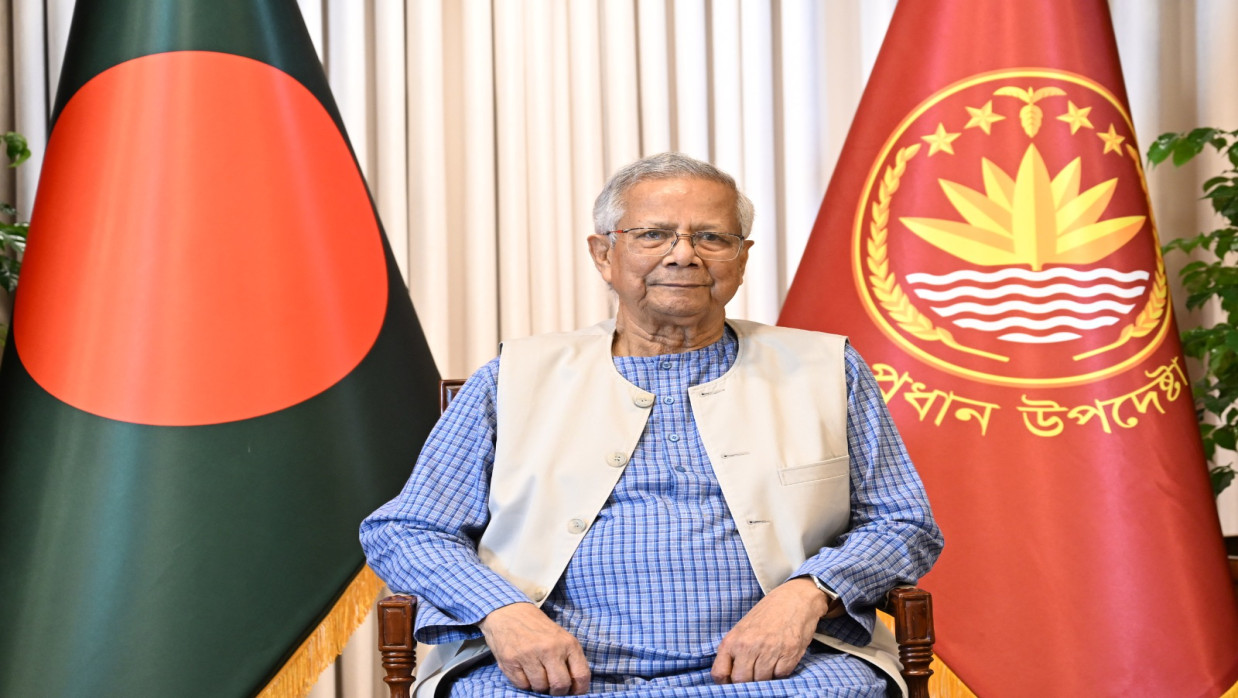
There are times when leadership is challenged, not by celebration, but by tragedy, as when the tone of leadership must embody sorrow without descending into anarchy, must speak of justice without resorting to revenge, and must reach a hurting nation without hurting a hurting people deeper, as they are already scarred. Dr. Muhammad Yunus’s speech to the nation, following the demise of Sharif Osman Hadi, was one such speech. It was more than a speech of condolences; it was a carefully crafted exercise in statesmanship at a very dangerous political juncture for both Bangladesh and South Asia at large.
In a political environment where the rhetoric in the region appears to inflame the passions and the fractured societies, Dr. Yunus could have chosen the path of passion and politics, but he preferred the path of law and ethics. His speech must be examined not only for its content but also for its intention – the grammar of power in South Asian politics.
A Human-Centred State: Compassion as Governance
Right from the start of the speech, Yunus articulated the tragedy not as a figure or an event relating to security, but as a human tragedy. In referring to Sharif Osman Hadi not only as a political figure but also as “a fearless frontline fighter” and “a unique symbol of resistance,” he brought back the dignity that had been violently stripped away from his life.
However, more notably, the fact that the state would provide care and protection, by assuming responsibility for Hadi’s wife and only child, is no mere symbolic form of charity—it is a form of governance grounded in a very clear moral imperative. Indeed, within this region, it is all too common that the families of martyr activists are left behind, ignored, and marginalized.
This is social contract politics at its most humane reflecting Dr. Yunus's lifelong creed that organizations exist to serve people, not oppress them.
Rule of Law Without Rhetorical Fury
Nor, perhaps most noticeably, did the speech resort to the rhetoric of using grief as a weapon. While staunch in its condemnation of the slaughter as “brutal” and vowing “maximum punishment” to its perpetrators, Dr. Yunus did not resort to language that explicitly targeted the Bangladesh populace.
In urging citizens to exercise "patience and restraint" and to give law enforcement agencies time to investigate professionally, he went against the script of the region, where mobilizing public rage or an illegal response to an incident has been the norm to gain short-term political leverage.
This is no weakness. This is constitutional courage.
It is a time when South Asia finds itself on the back foot regarding democratic degradation, judicial autonomy under threat, and the acceptance of political violence. But Dr. Yunus has again reiterated a very precious view: a mere emotionally guided system will not keep the voting booth democratic.
Democratic Transition as a Collective Moral Project
Through the placement of Hadi's death in the larger context of the “final stage of the country's democratic transition,” Dr. Yunus was able to raise the private sorrow to the level of a national moral issue. “Democracy is not a theoretical concept,” he said. “Democracy is what we live through when we choose the ballot over the bullet.”
His recognition of Hadi’s unfulfilled wish to run in elections and help construct a "new Bangladesh" was especially moving. This showed what political violence aims at destroying—that is, the possibility of peaceful engagement.
Indeed, by assigning “the responsibility of fulfilling that dream on the shoulders of the entire nation,” Dr. Yunus transformed a narrative of martyrdom into a narrative of mandate. The implication was clear: that political assassination is answered, not by resignation or retaliation, but by greater political participation.
A South Asian Signal: Leadership Beyond Borders
Dr. Yunus’ public appreciation for the Government of Singapore, and his acknowledgement of the direct role played by Foreign Minister Vivian Balakrishnan, went beyond mere diplomacy. This is because Dr. Yunus' actions represented a model for a different style of engagement with the world, one that is based on professionalism, gratitude, and the principles of human solidarity rather than geopolitics.
For South Asia, where nationalism expresses itself through diplomatic aggressiveness, it carries significance. It implies that Bangladesh, under interim administration, is looking for cooperation, ethical diplomacy, and international trust.
Also significant was Dr. Yunus’s clear statement that he believed democratic progress would not be swayed by fascist terror. In a region where majoritarian authoritarianism and political intimidation are increasing, this message rang true not just in Bangladesh but throughout South Asia.
Practices Based on the Yunus Doctrine
From this speech emerged something that went far beyond a reaction to a national tragedy. It was the articulation of a philosophy for governance of a Yunus Doctrine on leadership that can be defined as follows.
In substance, it holds that the dignity of humanity must take precedence over politics. In this sense, it should be noted that it was not the voice of a tactician that was heard at this forum, but rather that of a guardian of the nation's moral conscience. By placing the loss of Sharif Osman Hadi not in the realm of politics but in that of humanity, it has underscored that the legitimacy of the state resides in its respect for life.
This doctrine also requires an unswerving allegiance to the rule of law, rather than the rule of the mob. In a place where sorrow is frequently used as a weapon, and public anger is rallied in the service of short-term political objectives, it was significant not only that Dr. Yunus eschewed inflammatory language, but that he reaffirmed the preeminent importance of due process.
The address also represented a deep commitment to democratic patience rather than revolutionary impatience. Dr. Yunus recognized the imperatives of the democratic dream while also warning against the dangers of imprudent steps that could jeopardize the very process of the transition itself. This address encouraged democratic values as a process, not a wave or a momentary sentiment, and called for patience, foresight, and institutional trust.
Finally, "The Yunus Doctrine" gives more prominence to moral authority over force. The greatness of a state, according to the address, does "not lie in force, in terror, or in repression," but "rather on credibility, on moral clarity, and on public trust." In this respect, Dr. Yunus showed, through his non-threatening, yet uncompromising, words against fascist terror, that moral integrity is a more effective antidote to fear than either force or authority.
Collectively, this tradition constitutes a resolute defiance of the hegemonic model of leadership that pervades South Asia and nourishes itself on polarization and the creation of a climate of fear. It represents a vision for the future grounded in moderation and the upliftment of society rather than its domination.
Conclusion: Mourning, Morality, and a Ritual of Renewal
Whereas in bestowing the award on Sharif Osman Hadi, President Dr. Muhammad Yunus has done the extraordinary – he has honored the concept of a nation grieving without losing its soul.
His address reminded Bangladesh—and the South Asian subcontinent—that democracy is maintained not only through elections but through moral leadership during a period of grief. Such restraint is not surrender. Such justice doesn’t have to shout to prove its strength. And the best memorial to a dead revolutionary would not be chaos but a society which refuses to become what its enemies want.
“This is not a difficult task for us, as we are on a mission to improve the lives of all Bangladeshis,” Dr. Yunus asserted. Indeed, in a region eager for leadership with values, Dr. Yunus’ utterances were far beyond. Indeed, this may well stand as one of the speech’s most enduring and consequential legacies.

0 Comments
LEAVE A COMMENT
Your email address will not be published