

Bangladesh After Hasina: Revolution, Reckoning & the Road to 2026
CaptionIndia’s strategic community rarely speaks with a single voice. But on a handful of issues, the consensus can be overwhelming. One of these is democratic change in a neighboring state.
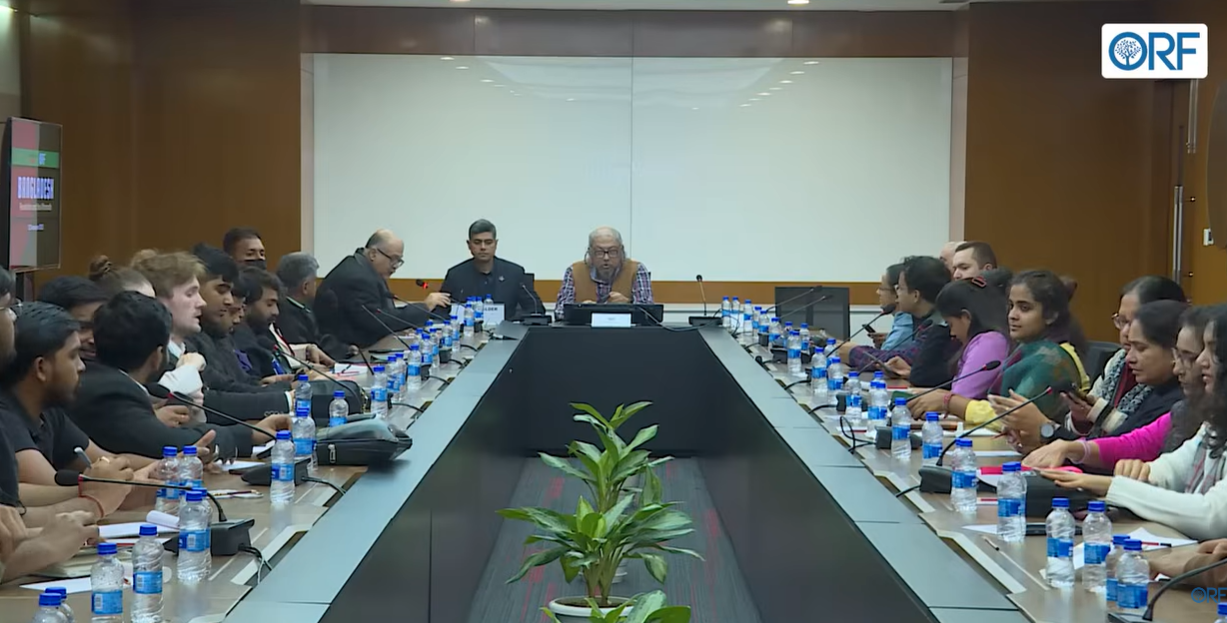
In its 14 December 2025 Discussion Point panel, Bangladesh After Hasina: Revolution, Reckoning & the Road to 2026, the Observer Research Foundation (ORF) provided a partial window into how this consensus thinks, speaks, and operates. The ORF discussion took the form of a free-flowing conversation, but, in the end, amounted to the predictable airing of something familiar. The plain fact is that when a popular movement challenges a South Asian state’s elected leader, the only lens through which strategic concerns can process such developments is a set of received ideas about order, continuity, and stability.
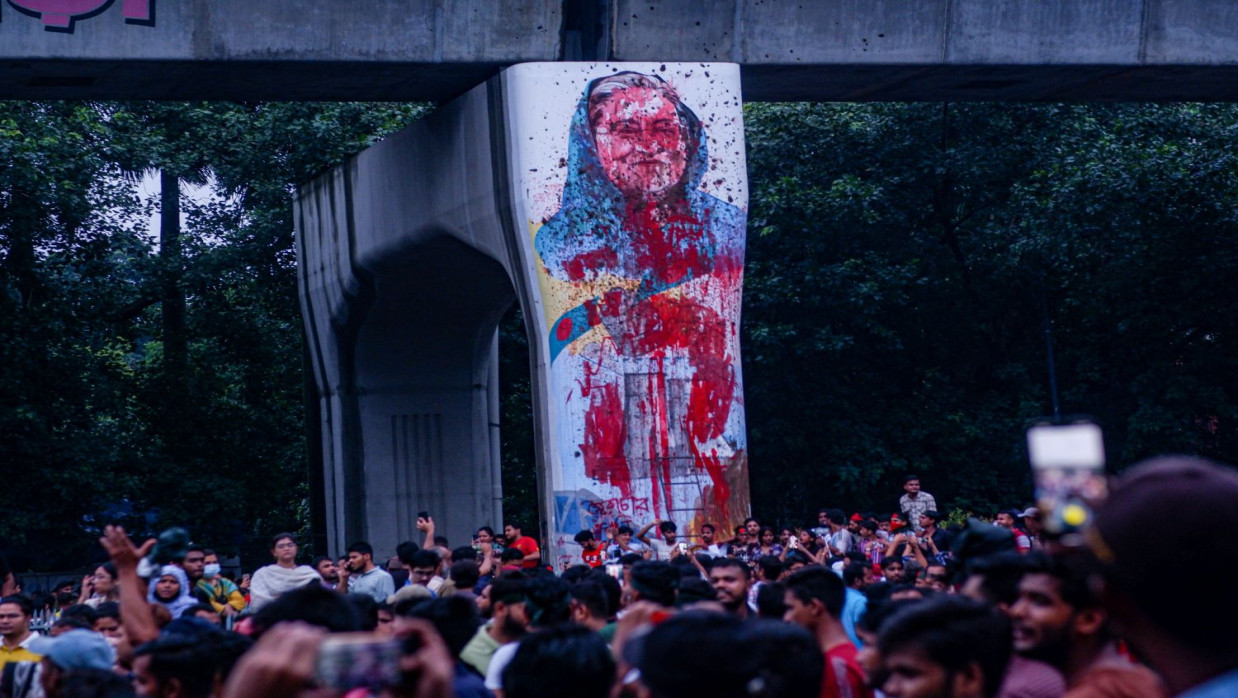
The demise of Sheikh Hasina Wajed’s three-decade-plus government in the middle of 2024 was not in doubt for any of the panelists. But a popular uprising for regime change in Dhaka is a revolution if anyone wants it to be. So long as its legitimacy is in question, it will be presented as spontaneous, anarchic, a governance vacuum, or an incomplete transfer of power. These labels for popular political action privilege continuity of elites and the maintenance of existing, long-standing arrangements over the expressed will of the people. Where Bangladeshi people have the agency to define their own future, it is not wielded lightly or capriciously, but often against formidable odds.
Questions about the nature of regime change in Bangladesh in mid-2024 are not so much about semantics as about discomfort with unpredictable, organic, and at times ungovernable processes of people-driven change.
Revolution or Regime Breakdown?
If there was one defining theme of the ORF roundtable, it was whether the July–August 2024 Bangladeshi change was a revolution. Most speakers would have none of it. A revolution, they said, has a clear direction, leadership, ideology, and a roadmap for institutional transition. It must have a vanguard party and a transformational leader. Such revolutions may have happened in political science textbooks, but they never quite play out that way in real life when it comes to overthrowing well-entrenched authoritarianism.
The problem with that analysis is that it was all true, but not applicable to Bangladesh before 2024. Bangladesh had not seen a free and fair election in over a decade and a half. Opposition politics had been criminalized. The media was muzzled, and civil society was intimidated. A growing number of institutions were not just politicized; they were subverted. Loyalists flocked in, meritocrats walked out, and institutions, from the bureaucracy to the judiciary, were atrophied under executive pressure.
In such a context, you don’t get political change through regime-to-regime change but through the cumulative rage of long-thwarted citizens.
Leaderless mass mobilization was a feature, not a bug. Had Hasina’s pre-election plans for regime change been overtly visible, a leadership would have been identified and terminated long before the groundswell of public anger reached a critical mass. The ORF discussion on Bangladesh discounted Bangladeshis’ revolt against the Hasina system by judging it by textbook standards for revolutionary change, and in the process, forgot to acknowledge the context and the courage.
The Myth of the “Governance Vacuum”
At several points, the panelists warned about the post-Hasina “vacuum”. But that assumes some form of governance existed beforehand. Bangladesh’s public bureaucracy, its judiciary, and its security services had been hollowed out and effectively weaponized, becoming less an arm of the state than a tool of regime protection. The vacuum, such as it was, was revealed by the fall of Hasina, not caused by it. Transitional fragility is not a sign of revolutionary recklessness but the price of extricating a personalized political system from every nook and cranny of the state. In institutional reconstruction, trust-building, and public management, a foundation laid in weeks and months is not a foundation at all.
India’s Strategic Lens: Predictability Above All
Speakers such as Kanchan Gupta and Sushant Sareen were prominent in stating that what the state of Assam, Tripura, Meghalaya, Sylhet, and the Northeast of India want more than any ideological valence for a new Bangladeshi government is predictability. Territorial control, border management, suppression of internal disorder, the prevention of ungoverned space, all of these factors speak to a certain statist logic. From this lens, whether a government in Dhaka is proto-Hindutva or secular-socialist, Bangladeshi or Burmese, is less critical than their control of territory, law and order, and deterrence.
That is a perfectly logical position to take. But its political range is equally limited by a particular narrative that frames Bangladesh as a strategic buffer rather than a democratic polity. In that context, the governance vacuum revealed after Sheikh Hasina’s fall and the difficulties of transitioning to a new dispensation were as much a result of India’s own overinvestment in the Hasina system itself as of Bangladesh’s own missteps. Diplomatically and bureaucratically, over long years of cross-border cooperation, there was the reality of India behind the Hasina government. By the time of her overthrow, a strand of India’s approach to Dhaka had become so invested in Hasina as an indispensable partner that even the simulacrum of that relationship was deeply destabilizing.
When stability is prioritized over legitimacy, it is the beginning of stagnation. The Hasina era provided some predictability to the extent it existed, but only by accelerating a reversal of democratization that ultimately produced more instability.
The Calculus of the Hasina Era
In assessing the impact of the Sheikh Hasina era, former High Commissioner Veena Sikri’s point on counter-terrorism cooperation, the suppression of various insurgencies, and bilateral connectivity was well taken. These are real achievements and should be appreciated. But they do not erase the long-term costs of vote rigging, electoral disenfranchisement, politicized law enforcement, intelligence-state networks, or the broader normalization of repression against a range of minorities.
The sedimentation of authoritarian stability is not value-neutral. The long list of unresolved socio-economic, identity, and political grievances that predated the Bangladesh revolt and were not addressed during the Hasina era will only find expression in more episodic and destabilizing forms. The ORF panel saw such grievances not as the source of instability but as an irritant to security and order.
Minorities and Instrumental Narratives
One of the most troubling subtexts of the entire ORF panel was the instrumentalization of minorities and minority insecurity to a regional power’s political anxieties. Minority security, particularly of Hindus, is a real and legitimate concern. But in the roundtable, it risked being conflated with a fear of regime change or communal retaliation, both of which can be allayed not so much through a posture of regime loyalty or external pressure as the reassertion of the rule of law and an end to the legal and de facto discriminatory conditions fostered by an authoritarian system that utilized institutions of equal citizenship for the opposite purpose.
In that context, Deep Halder, author of two recent books, Being Hindu in Bangladesh and Inshallah Bangladesh: A Chronicle of Upheaval with an Unfinished Argument, presents the reader with essentially a single-axis story. Claiming to be the “untold story” of the condition of Hindu minorities in Bangladesh, his investigation relegates the narrative of minority marginalization, discrimination, and violence to one community alone without making a comparison of the status of the minorities in India. By focusing the lens so sharply, the intervention ends up misreading a much larger and complex story about multiple and intersecting religious, ethnic, and linguistic minorities across South Asia, their conditions of marginalization, and the varying degrees and forms in which each experiences vulnerability and precarity.
Islamism and the Fear of Chaos
One of the more predictable claims was by Sushant Sareen that Islamist forces in Bangladesh would only return if the central state were weak or fractured. The fear of Islamist revival in the region is not without foundation. But its presentation by several panelists at ORF came without a similar historical context.
Islamist mobilization in Bangladesh, often with an insurgent, violent component, has usually not grown in democratic interregnum as much as under partial repression, state violence, and illiberal bargains struck during periods of authoritarian quiescence.
The 2024 uprising has already revealed itself to be a pluralist, youth-driven, internally diverse movement with few unifying appeals to religion and an agenda more animated by demands for dignity and accountability than theology.
In short, when you view the process of democratic transition primarily through the lens of security threats, you often end up marginalizing precisely those constituencies that represent the most fertile ground for long-term secular civic politics.
The Silence That Spoke Loudest
If there was one curious aspect of the ORF panel, it was the absence of any Bangladeshi voices. No constitutional experts, civil society or business leaders, no economists, and indeed no members of the student movement. For all the speakers, Bangladesh was an abstraction, an object of strategic policy, not a living, breathing polity in the making.
If Bangladesh’s trajectory to 2026 is going to be seen as a debate rather than an inevitability, Bangladeshi voices should have had a place at the table.
The Road to 2026
Two broad visions of Bangladesh’s future, by implication, contended for space at ORF. One wanted a fast normalization, a managed transition, and a strong national security footprint. The other, less spoken (in ORF and elsewhere), believes in a genuine electoral restoration, institutional neutrality, and civilian oversight. Which one you choose will determine far more of Bangladesh’s politics than reassuring its neighbors.
Bangladesh does not have to demonstrate to a region that democracy is safe for its neighborhood. It is a region that must come to terms with the fact that democracy is sometimes disorderly, messy, and must first be won. But it is ultimately more durable and stable than repression.


0 Comments
LEAVE A COMMENT
Your email address will not be published