

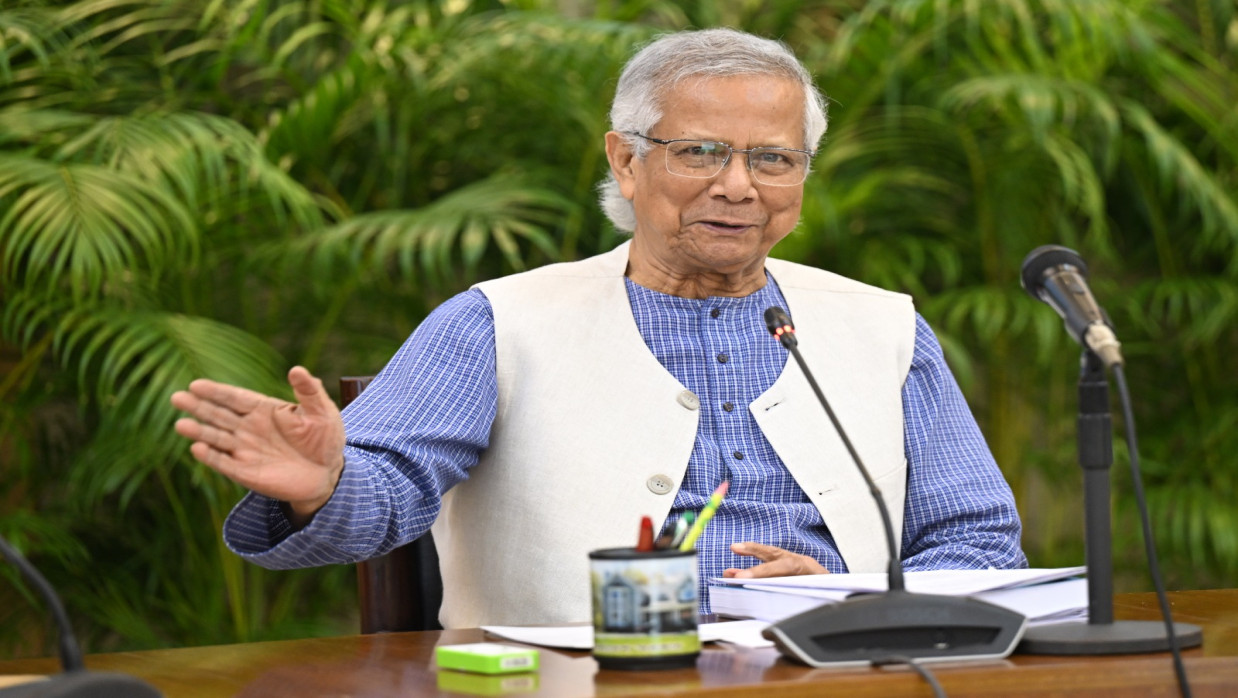
Since my last publication relating to the reform of the education sector in Bangladesh, I have received the most heartwarming response from academics, vice-chancellors, teachers, and members of our diaspora across the globe. Veteran academics informed me that this dialogue should have taken place long ago, while my younger counterparts and friends in academia advised that reform is always a long-term process and is never too late in coming, especially in a phase where the Interim Government has already demonstrated uncommon courage in forming a Police Reform Commission recently. The one thing that came through, in every message, loud and clear, is that unless an Education Commission is formed to overhaul the entire education system, and unless the curriculum is changed, Bangladesh will find it impossible to attain any form of stability in a democratic framework and a proper future for its youth.
I was urged to not only examine the solution to the problem but to boldly declare a loud and clear expression of the rapidly emerging consensus in the country that a much needed Education Reform Commission is needed in Bangladesh, and to highlight that almost everyone named one individual whose qualities of character, global reputation, and decisive visionary leadership make them the only one qualified to provide leadership to a venture of this historical importance: Nobel Laureate Dr. Muhammad Yunus, a man whose exemplary character, leadership qualities, and passion for reform have already given hope to a nation eager for a new destiny.
The press release in 2024 from the British Council and OrCHEST has aptly captured the sense of urgency in the following statement: “Bangladesh stands at a critical point in its process of nation-building. The question again arises: How do we establish an education sector worthy of our people and our vision of the future?” The answer was clear: the country requires a high-powered National Education Commission that was capable, not only of auditing the system but of overseeing a complete overhaul that might form the backbone of a new Bangladesh.
This need becomes even more urgent when one considers the rapid progress made in the last seventeen months under the interim administration of Dr. Yunus. Within the timeframe that most people believed to be much too short to really make a difference, Dr. Yunus has been working relentlessly to impart equity into public services, to rekindle a sense of morality in governance, to embolden the youth and the people in general, to revive an impartial and independent judicial system, to reform the policing and administrative structure, to consolidate the fragile economy, to mend the strained relations with the foreign countries, to withstand the pressure of an overwhelmingly powerful neighboring state, and to revive a hope that long ago went out.
Within this short period, he has tried to accomplish what no political leader in the last 54 years has ever attempted he has been doing what no political leader in the country has ever done with the honesty and determination this requires. But much of this has been unseen and unreported in the mass media in BD.
It is precisely for this purpose that the next and foremost challenge in the realm of education has to become and be the frontiers of Dr. Yunus himself. It is the lifeline of our progress and the motto of equality in our renewed framework because unless the other spheres of our policies and actions are based upon an effective and a proper functioning education system in our nation, they will fail and fall apart.The purpose and aim of this article are to mark how it has reached the time to take the initiative and the responsibility to form an Educational Reform Commission from the side of Nobel Laureate Dr. Muhammad Yunus, an effort that should and has to be the first and foremost priority in our nation.
Taking Back Educational Sovereignty from Outside Control
Reflecting upon the structural vulnerabilities that have impaired the education sector in our country, it has become impossible to overlook the more sinister fact: our education autonomy has progressively decayed over the years. For a long time, the Bangladeshi structure and process of education swayed to the will of a factor that did not always favor our interests. This was only worsened in the erstwhile regime, in whose period the trends and terms of our curriculum progressively reflected the choice of an important country adjacent to us. Though the exchange of ideas and values between two countries has multifaceted advantages, our education circles and wider societal elements widely sensed the lack of scholarly give-and-take in this process and sensed the sinister signs of a large-scale political design to mold our country’s youth to the detriment of our cultural and developmental sovereignty.
This tendency accelerated further with the advent of the education minister, Nurul Islam Nahid, whose reign changed the face of education in its entirety with amendments that diminished the fabric of learning. The damage occurred through the popularity of MCQ-based exams in every school, the relaxation in the levels of studies, and the consequent and apparently rapid rise in GPA-5 passers where the appearance of success overshadowed the reality of success because the passers were less able to say, “I scored GPA 5.”
The events escalated to a higher level when the education sector was under the leadership of Dr. Dipu Moni, and the country was experiencing one of the most alarming periods in the education sector. The outsourcing of textbook printing to another country and the need to include Durga in the image depiction of the back cover of the textbook made the entire process a question mark in terms of the control and purpose behind the teaching process of the Bangladesh population, especially the children.
However, the most damaging effect came not in the printing decisions but in the texts themselves. The students were learning trivial things, such as the barking of dogs and foxes, while the very foundations of learning were being ignored. Critical thinking, analytic thinking, creativity, questioning, and application to the 'real world gave way to rote learning and shallow activity in the classrooms across the country to the point where, in the view of some observers, it seemed less the result of benign neglect than a design to undermine basic learning and to leave the child unprepared for any serious higher education, work life, or citizenship.
The aftermath has been calamitous. A whole generation has been brought up in a way that has deprived them of the mental equipment necessary for independence and development, a loss that is both tragic and unacceptable in a country aspiring to its rightful and dignified emergence. Instead of developing capable and enterprising brains, the system has bred dependence and obedience. Many observers think the process has a purpose that it has long been intended to weaken the human capital of Bangladesh and make it ever more dependent upon foreign sources, especially a neighboring country, for human capital, industrial know-how, and technological capacity.
Thus, an approach that has the effect of damaging education offers a threat to sovereignty per se. The loss of control in countries regarding the way their children are educated implies the loss of control in their destiny in the long run. It is this subtle but pervasive presence that put the country of Bangladesh at the brink of a loss of intellectual and strategic independence. No question of cooperation existed, but the unevenness in the degree of influence and the looming threat of hegemony in the region.
One of the most damaging effects has been the undermining of critical, analytical, reflective, and applied thinking in the curriculum. Rather than nurturing autonomous thinkers who question, innovate, and produce, the system has produced learners who are conditioned to memorize, conform, and obey. This is the opposite of what a proud, independent, and visionary Bangladesh needs.
It is no less this weakness that Dr. Muhammad Yunus has the remarkable chance to rectify presently. Through the restoration of its educational sovereignty, the linking of educational reform to its own priority development area, and the implementation of a National Educational Commission to update the educational curriculum right from the primary to the university levels, he will be able to make sure that the educational system should be primarily to the advantage of the people of Bangladesh. Should Dr. Yunus accomplish in this mission, he will do much more than mend the structural flaws of the past, he will assure the independence of the intellect in the years to come. His mark will appear not only in buildings and institutions but in the minds and capability of unborn generations—an investment in a nation that stands poised to claim its destined place in the years to come.
Why Bangladesh Needs an Education Commission at This Historical Moment
Considering the existing challenges and the external influences discussed above, the education sector in Bangladesh is currently poised at a crucial junction. Though the country has made commendable strides in enrollment and parity, these should be noted in the context of stagnation in learning achievement and a growing gap between the public and private sectors. The gap that has arisen between the outputs of the learning process and the demands of the modern economy has been poignantly noted as a lack of people able to function as problem-solvers, communicators, digital workers, and innovative thinkers.
All these internal problems have been made worse by the presence of some larger global political forces. For many years, some aspects of the neighboring country's strategic intentions seemed more oriented towards an independent Bangladesh, yet in a way that fostered a subtle form of dependence. The issues of one-sided agreements, unequal trade advantages, and dominance in transit and water issues, along with influences in media, culture, and security, and, most fundamentally, education, have long been a point of concern.
The point to make in this instance is not to encourage enmity but to emphasize the need to establish robust, think-tank-independent national bodies, first and foremost a National Education Commission, to safeguard the country's intellectual independence and future. When a nation has ambitions to transform and redesign itself in social and economic terms, the destiny of its educational programs becomes a question of its survival as a nation. This is where several historical elements come into play:
- The Fast-Changing Global Economy
The global landscape is undergoing a radical transformation through artificial intelligence, automated processes, and the digital revolution. The countries that can produce creative, highly skilled human capital will emerge victorious, while those that rely on outmoded, rote-based learning processes will be left in the dust. For a country such as Bangladesh, whose economy is driven by the textile, information and communications services, food processing, logistics, and emerging industries, the need has never been more pressing to produce employees who are flexible and resourceful thinkers.
By establishing a National Educational Commission, the learning processes and procedures in the country's educational institutions can be radically transformed to ensure that students in Bangladesh are educated to face tomorrow and its potential, and not the jobs of yesterday and the present day.
- The Demographic Dividend is Narrowing
Bangladesh is poised at a historic crossroads: an opportunity or a crisis waiting to happen, with a third of its people under the age of thirty. Then, the country has the choice to equip this segment of its population with the right skills and turn them into the engine driving the country's economic prosperity. Instead, this segment has the potential of turning into a demographic disaster characterized by unemployment, discontent, and migration. The government has a possible rescue in a high-level "Education Commission.
- The Politicization of Reform
Political meddling has long permeated the processes of curriculum design and development, the employment of teachers and the administration of higher education institutions, the review and approval of textbooks, and student politics. The decay of meritocracy has thus undermined the integrity of higher education in the country. An "Education Commission" made up of respected and non-partisan experts should be able to suggest the following changes in the sector to make it less political and more accountable and professional in every aspect:
- Weakened Coordination through Fragmentation
The Bangladesh education system is plagued by a complex web of ministries, directorates, boards, and non-governmental organizations that function in silos, duplicating each other's efforts and hindering reform in the sector. The National Education Commission has the potential to offer a strategic, cohesive view of the industry's governance structure and to make recommendations on it.
- External Influence Has Diluted Critical and Analytical Capabilities
As has been emphasized earlier, there are subtle forces within the country and, more specifically, pressure from a neighboring country that have impacted the education system in a manner detrimental to critical, analytical, and applied thinking. This has meant that the government has bred a generation taught to remember, not question, and not innovate. The National Education Commission needs to focus on higher order thinking in the country and emphasize applied learning in the classrooms.
Transitional Bridge to the Mission of Dr. Yunus
Taken together, these elements make one thing clear: a changed education system will be a prerequisite for achieving a prosperous and independent Bangladesh. In terms of the qualities he has already demonstrated in making a success of his microfinance initiatives and the level of popular support he has won for his actions and his vision, there is no one better positioned to make that happen than Dr. Muhammad Yunus at this point in history.
A Vision for Long-Term National Development through Education
Having discussed the pressing structural forces that push Bangladesh to reassess its learning trajectory, the question then is: How can a strengthened Education Commission assist in making our future, and, more crucially, how will this future relate to Bangladesh's ambitions regarding its economic and democratic futures and its desire to be a global force?
This is where the example of governance presented by Dr. Muhammad Yunus becomes pertinent, and indeed crucial. Bangladesh is already experiencing, through its interim government, the results that a leadership grounded in righteous, right-minded governance and decision-making can produce in a short period of time. The same energy and momentum need to be injected into the education sector, since the destiny of the intellect and economic futures of generations to come hangs in the balance there.
At this critical point in its history, understandably, a country like Bangladesh requires more than piecemeal changes and isolated reform initiatives. It demands a visionary strategic framework in education, one that will last beyond the typical political term, binding the country to the requirements of the global present and securing a robust, proud, and independent nation through the acumen and capability of the coming generation, envisioned and spearheaded by a properly conceptualized National Commission in Education, in the reformist idealism of Professor Yunus:
- Integrating Education with National Development Goals
The vision for Bangladesh is to become an upper-middle-income country by 2031 and a developed nation within the next two decades. For this to be possible, the government requires a labor force with more than just an educational qualification it must be skill-driven, enterprising in its mindset, and technologically adept. The Commission has the task of preparing an education agenda for the next 20 to 30 years, in which the skills required in the workforce must be linked to the learning process in classrooms.
- Harnessing the Demographic Dividend
Indeed, due to the growing number of youths and the declining number of dependents, Bangladesh is currently at a demographic peak, but this will eventually pass too. The Commission should take bold steps to tap into this youthful vitality and turn this sector into a productive capacity through enhanced higher education and a learning culture.
- Fostering Global Competitiveness
Bangladesh cannot be competitive in the global marketplace solely based on its labor costs. Instead, the country needs to move towards a knowledge-based economy based upon innovation, information, and excellence in research. The Commission should promote effective accreditation processes, increased R&D expenditures, expansion of STEM programs, and robust partnerships between industry and academia to prepare students for the global environment.
- Promotion of Equity and National Cohesion
For genuine progress in the country, there must be equality in the services the Commission provides to its citizens through quality education for the following groups: rural students, minorities, people with disabilities, girls, and those from low-income families.
- Ensuring Continuity Beyond Political Cycles
For any reform to be sustainable, it has to be shielded from political instability and turbulence. Learning from best practices ranging from Finland to Singapore, the Commission should establish a framework to ensure stability and professionalism in the implementation of policies
.
Continuity: The Cornerstone of Dr. Yunus's Educational Legacy
This is an investment in more than a new committee or an institutional structure. It is an investment in the most crucial nation-building project of our generation and an institutional backbone on which the rest of Bangladesh's sectors will rely. For Dr. Muhammad Yunus—Nobel Peace Prize Laureate, and global pioneer of social business, microcredit. and devoted advocate for people with low incomes, and one of the most outstanding moral leaders of our age the forming of an Education Commission is more than a policy gesture. This is a historic opportunity to shape his most enduring and lasting domestic legacy.
Through his interim stewardship, hope has been renewed in a disillusioned country, equality has been restored to a broken system, and a disillusioned people in Bangladesh have a chance to remember what it means to be governed with integrity and ethics. This is where the most significant challenge and accomplishment face the remarkable Dr. Yunus in the education sector.
Governance reform will stabilize the current state of affairs. Economic reform will heal a damaged economy. Foreign reform will realign a country's strategic position in the international sphere. But educational reform will shape the future.
By forming a high-powered and inclusive Education Commission to analyze and totally reform the entire education sector in Bangladesh from scratch curriculum, instructional methods, assessment, governance structure Dr. Yunus will establish the intellectual and moral foundations for a new Bangladesh. Long after the interim government has served its term and the political turmoil has passed, the changes stemming from this Commission will bear witness to Dr. Yunus's faith in Bangladesh's youth's unlimited potential, in a way that will outlast the storms of the present political climate.
For a man whose life's work has changed the lives of millions of people from poverty to a life where economics and humanity coexist, the metamorphosis in the education sector in Bangladesh will be the next steppingstone in his life's mission. It will be a manifestation of his life-long qualities and attributes of honesty, integrity, and compassion, along with an unflinching faith in people. If governance has been his corrective gift to the present, education will be his transformative gift to the future. And in the story of Bangladesh, that gift will not only survive but also thrive, lighting the way for the entire nation for many years to come.
Nelson Mandela put it best in his message to the global community: "Education is the most powerful weapon you can use to change the world." If the people of Bangladesh ever find the courage to seize this vision, Dr. Muhammad Yunus teacher, reformer, patriot, and humanitarian will stand in the ranks of a long line of historical figures, to be remembered in Bangladesh, and in the world, simply for giving the greatest weapon of all to an entire people not the military, but the mind the mighty weapon of education.


0 Comments
LEAVE A COMMENT
Your email address will not be published