

A Nation at an Unfinished Crossroads
“Every revolution evaporates and leaves behind only the slime of a new bureaucracy.”
Franz Kafka
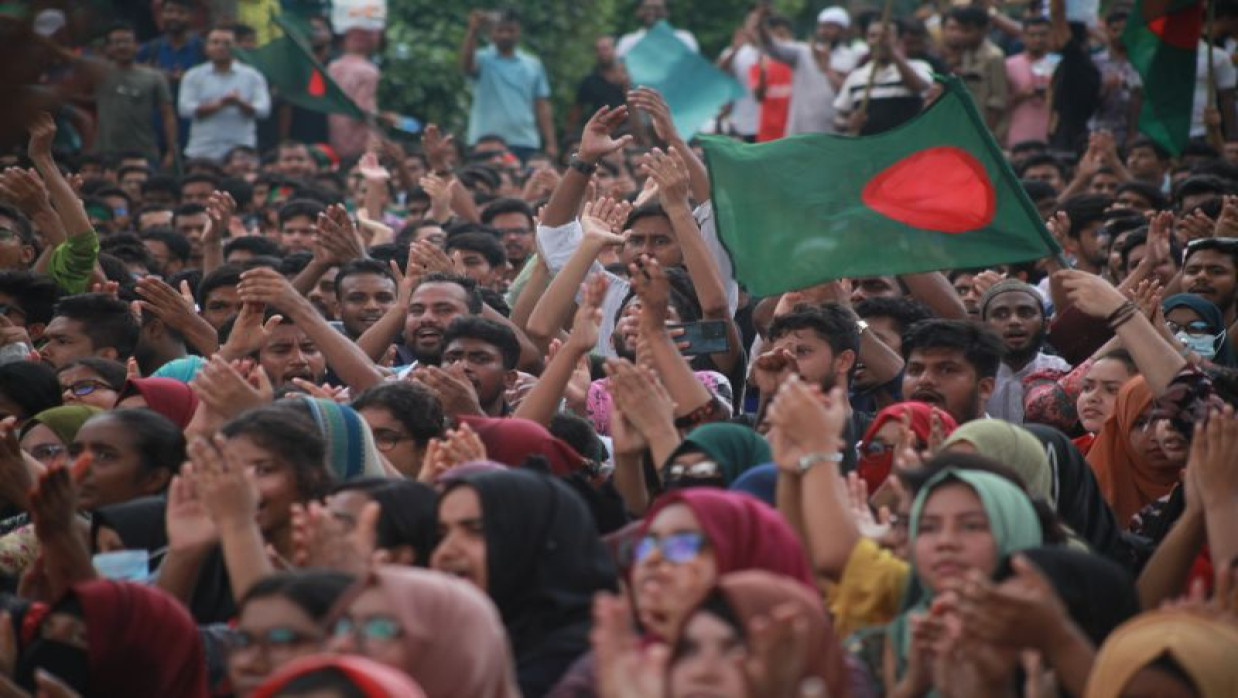
History seldom gives any nation the opportunity to experience both the ending and beginning at the same time, and this is exactly what Bangladesh is facing today. The downfall of the fascist government under Sheikh Hasina, which occurred in 2024 after presumably decades of disappearances, Orwellian surveillance, annihilation of the opposition, and the erosion of democracy, is both cathartic and volatile. The July 36 Movement is both a moral revolt and a reaction against no single ideology, but simply against the national collective weariness of all things related to politics, policing, and courts.
However, revolutions are, by definition, transitory phenomena. They are sources of strength, not architecture. The question now is what will happen if this moment of revolution is not accompanied by revolutionary change in Bangladesh’s structuring. If this moment is missed, then Bangladesh will likely enter into a cycle of oppression perhaps more deep-rooted than what preceded this moment.
This piece explores this question through the lens of historical comparisons and politics, speculating on the potential future of Bangladesh, and by extension, the future of South Asia, should it fail to establish a democratic infrastructure on the heels of tearing down a fascist state.
The Danger of Undone Revolutions
“The most common way in which people give up their power is by thinking they don’t have any.” Alice Walker
The case of unfinished revolutions provides tragic repeats in global history. These revolutions overthrow leaders but fail to address the systems which spread tyranny. The state apparatus, national security systems, and political cultures, unless intentionally redesigned, provide rich terrains for the growth of authoritarian regimes. The Bangladesh experience is no exception either.
“A revolution can kindle consciousness, but it is powerless by itself to change institutions.” The moral high ground of overthrowing a dictator is no guarantee of destroying the institutional framework of authoritarian politics. Institutions like spy networks, patronage machines, partisans in the bureaucracy, and politicized justice systems can resurrect themselves very readily under fresh leadership. The peril is this, the nation is celebrating liberation while excluding machinery, and this machinery is the reason why liberation is being obtained.
The July Revolution in Bangladesh realized the first objective, which is overthrowing a tyrant.
But unless follow-through on reform, the “tyranny deficit” will be back often worse.
Scenario 1: The Return of Authoritarianism in a New Form
“The history of liberty is a history of resistance.”– Woodrow Wilson
The ousting of Sheikh Hasina does not necessarily mean the removal of the extensive system which Sheikh Hasina took so many years to build, including the surveillance systems, the politicized security forces, the intelligence outfits with arbitrary power, the bureaucratic apparatus loyal to her party, and the executives thoroughly accustomed to exercising dominance.
If the process remains stagnant, Bangladesh may suffer a silent relapse into a creeping authoritarian regime, in which the concentration of power will be resumed, notwithstanding possibly more mannerly and “democratic” rulers.
Real World Parallel: After Mubarak, Egypt
The Egyptian case is the most transparent lesson. The Egyptian revolution of 2011 saw Hosni Mubarak depart, but the presence of the deep state, which comprised the military and the intelligence sector, meant that this state was secretly reinstated without any attempt to change it. This took no more than three years, as Egypt saw the emergence of yet another authoritarian president named Abdel Fattah el-Sisi.
The Bangladesh takeaway is inescapable: Deposing the dictator without destroying the architecture of the dictatorship is simply a prescription for renewed authoritarianism.
If the judiciary is still ‘politically vulnerable,’ if the police are still ‘militarized,’ and if the bureaucracy is still ‘partisan’ and ‘unaccountable,’ then the future rulers of Bangladesh, whoever they may be, will be tempted to use the same techniques as Hasina.
“The nation may awaken in a few years to discover it is now confronting ‘new authoritarianism ‘not as benign as it seems, but the same crushing reality nonetheless.”
Scenario 2: The Return to Toxic Bipolar Politics
“Those who cannot remember the past are condemned to repeat it.”
– George Santayana
The pathological two-party politics, which Bangladesh never healed from, dates back to the 1990s. The Awami League and BNP have been conducting politics as war for decades, and this is reflected in the politics of delegitimating, revenge, and zero sum games in the political system. The fascism of Sheikh Hasina took this xenophobic politics to the next level and spread the culture of political destruction.
If no changes are set into motion, particularly those related to the electoral process, decentralization, and independence of the judiciary, “the toxic bipolarity will return as if the revolution never occurred.”
Parallel in History: Sri Lanka Post 2015
The case of Sri Lanka is extremely disastrous. The Sirisena-Wickramasinghe government brought down the Rajapaksa strongman state with promises of change. The conflicts and bargaining overpower-sharing, along with the absence of institutional transformation, enabled the old groups to persist. The Rajapaksas were back with greater strength than ever, this time as supervisors of the collapse of 2022.
The danger of the same regression threatens Bangladesh as well. The Awami League may regain strength after Hasina, the BNP may go back to being mired in internal strife, and they may all push the entire nation into the same spiral of street fighting, hartals, polarization, and winner takes all politics.
Without any changes toward lessening the level of hyper-centralization, introducing proportional representation, and safeguarding the service against political capture, politics in Bangladesh will remain the “ground on which vengeance is waged” and not the “marketplace of ideas.”
Scenario 3: The Corruption Networks Rebuild Themselves
“Corruption is authority plus monopoly minus transparency.”
Unknown (Anti-Corruption Quotes)
Corruption does not disappear after the change of government. Instead, corruption evolves and morphs as it adjusts to this newly changed landscape with a fresh set of faces, new rhetoric, and more sophisticated methods—often cloaked in the language of reform while replicating the very systems it claimed to dismantle.
The Onset of a Syndicate Economy in Bangladesh under Sheikh Hasina
During this period, under the authoritarian leadership of Sheikh Hasina, Bangladesh evolved into what is known as a ‘syndicate economy’ by economists, meaning all political power, business, and bureaucracy combined into one to ‘extract’ as they defined, meaning to exploit for selfish gain. It is no longer corruption as commonly known, and it became institutionalized as a process of resource ‘grabbing,’ designed and secured by the ruling elites. The bureaucracy was used for the benefit of those loyal to the ruling elites, and the watchdog body remained weakened so as to never hamper the upward flow of looted ‘wealth.’
The most disturbing feature of this syndicated economy is the institutionalization of bank robberies. The public and private banks operated more as informal funding pools for politicians and business groups. The volumes of non-performing loans, either through forgery, overvaluation, or political warranties, were neither crimes nor breaches but merely the exclusive preserve of those with political ties to the government. These defaults, amounting to tens of thousands of crores, drained the financial sector and crippled public confidence, thereby imposing an informal tax on the general populace through financial instability. At the close of Hasina’s term, the banking sector in Bangladesh was on the point of collapse, not on account of any failure but due to political looting.
Besides financial corruption, public procurement became a free-for-all. Government contracts, whether pertaining to road construction, bridgework, school stationery, or health infrastructure, were dished out on the basis of political expediency and, by extension, loyalty, and not on merit or competitive tender. This narrow core of political loyal business groups cornered all government contracts, driving up prices and generating substandard outputs. The entire process of government procurement was now a moneymaking opportunity for the select few, and the taxpayer’s burden grew as prices escalated and projects were underfunded, hence tardy. The entire process now bordered on less being an instrument of development and more an instrument of enriching this ruling-class oligarchy.
This mode of extraction saw the light of day in the form of mega-projects, and they were the pinnacle of corruption. Mega-projects like bridges, sea ports, railways, and power stations were touted as symbols of progress, but the amount of corruption within those projects was mind-boggling. The cost overruns are now no longer indicators of incompetence but rather tools of extraction, as billions were siphoned into private pockets. Every phase, be it the feasibility phase, the contracting phase, or importing goods, saw billions being siphoned into private pockets as mega-projects became mega-scams, and only a few elites were rich, while Bangladesh was drowning in debt.
Finally, the syndicate economy institutionalized itself through politicians and businessmen, known as ‘politically well-connected businessmen,’ who controlled crucial sectors of the economy through monopolies. Land ownership, source of energy, transportation infrastructure, and the provision of food became controlled by individuals who were only qualified by their fidelity to the government and political leadership and were less qualified by their acumen as businessmen. These people used their closeness to the government to acquire exclusive rights, control prices of goods, and wipe out competition. The small businessman was consequently driven out of business, and prices skyrocketed as all sectors were controlled by individuals in powerful families and business conglomerates close to the government.
In this manner, Bangladesh under Sheikh Hasina became a political and economic system in which corruption did not occur as deviances but as the rational principle of the state. The syndicate economy depleted all things institutional, all things economically substantial, and thereby made the state perilously fragile as it grew out of an antidemocratic period.
These networks did not collapse following the July Revolution either. Instead, they were merely waiting to see what future political winds might bring. Unless and until the existing regimes are radically changed with regards to procurement systems, banking regulations, and financial transparency, the same oligarchic groups will almost surely resurface.
The Ukrainian Parallel Situation After the Orange Revolutions
The Orange Revolution of 2004 in Ukraine was welcomed as a success all over the world by the people’s power. However, as no thorough transformation took place to eradicate oligarchic dominance over the economy, the same elites were back, this time allied with newly elected politicians. This brought corruption to the point where people stopped trusting the government altogether.
“It is no longer the case, as it was in the early stages of battle, where either side’s victory is assured, and ‘one victory is enough,’ and then now, where no victory at all is expected. If the anti-corruption courts are not granted strength, if transparency is not allowed into procurements, and financial regulators are not allowed autonomy, Hasina’s syndicates will only reinvent themselves under other political aliases.”
The Fertile Ground for Right-Wing Extremism scenario implications are numerous and have been described throughout this
“If hopes are dashed, fear and hatred will fill the void.” Vaclav Havell
Revolutions are powerful because they have the ignition capability to set the imagination of the people on fire. Revolutions provide citizens with the opportunity to feel, if only for a moment, that things can be different tomorrow, and justice can prevail and dignity can be regained. But this very same feeling, if it is raised only to be dashed by the lack of change in the realities of people on the ground, becomes the perfect catalyst for growth for extremist ideologies.
If this is not achieved, and the progress seen with Hasina is not sustained, then Bangladesh may face the creation of various destabilizing elements in this volatile region, which are very difficult to control.
One of the most visible dangers in this regard is the growing dominance of ultra-nationalist groups, whose presence is fueled by conditions in which the citizenry comes to feel betrayed by their ruling elites. Once citizens begin to question the government’s role as safeguard for their interests, nationalist groups fill this void by explaining things in ‘simple’ and ‘Us versus Them’ contexts. In the case of Bangladesh, this may translate into greater assertions of being ‘their’ culture guardians and exclusionary politics as nationalism.
At the same time, religious populism may alarmingly gather pace. In periods of institutional decline, religious leaders, armed with spiritual credentials and easy access to grassroots adherents, may proclaim political grievances as spiritual inadequacies needing clerical correction. Although Sufi Islam in Bangladesh, as in India’s Deoband school, is known to be broadminded and non-aggressive, religious populist ideologies may capitalize on popular disaffection and Sprite meaningful democracy.
Another peril is the rise of ethnic scapegoating. When societies are faced with either economic stagnation and lack of clarity in governance, they tend to search for scapegoats. The minorities, as they lack strength in numbers and are commonly misunderstood, are the prime scapegoats. In the case of Bangladesh, the minorities are already structurally vulnerable, and the looming threat of scapegoating may worsen this state.
This is naturally linked with the rise of anti-minority discourse, which is evident in those countries where the process of democracy is on shaky ground. The discourse, though seemingly only noise on the fringe of politics, can easily sway public opinions and bring extremist groups to the forefront. The issue is, of course, both with the discourse and with the signs it sends on the deterioration of social trust and the decline of the values of pluralism, which have long been part of the identity of Bangladeshi society.
Additionally, in times of disillusion and fear, parts of society may turn to “strongman solution” stories that is, the conviction that only a tough leader is capable of saving the day. This is one of the most sinister paradoxes of revolutions brought to a halt, that is, those citizens who took part in the overthrow of a dictator may themselves begin to crave one should they remain in suspense for too long. In various corners of the globe, ranging from Latin America to the Middle East, citizens tired of promises have welcomed the kind of dictatorial ruler advertised as bringing order and efficiency.
Additionally, there is the danger of anti-refugee extremist ideologies being directed against Rohingyias. With Bangladesh already hosting close to a million displaced refugees from Myanmar, any perceived lack of control on the part of the government in managing issues related to security, economics, and diplomacy may well provide opportunity for extremist politicians to capitalize on anti-Rohingya sentiments and turn a humanitarian crisis into a potentially volatile political one.
In spite of this, it is essential to note that Bangladesh, as a nation, has always been able to withstand the lure of extremists in their society through their cultural resilience, syncretic traditions, and sense of social solidarity. Yet, no society with as much history on the side of moderates as Bangladesh will be immune to this kind of transformation as political grievances mount and trust in institutions falls apart. The remedy against extremists is hope, but hope translated into action through change.
The Historical Parallel: “Weimar Germany”
The fall of the German Empire brought on the most dynamic democracy experiment in European history, the Weimar Republic. But in this case, a lack of progress in reform and economic insecurity fostered disillusion, filling the void as extremist groups, beginning as fringe and becoming majority, took control. In only 14 short years, there was Adolf Hitler at the helm. The implications are skating on thin icethe precursor to extremist regimes is disillusionment.
In the case of Bangladesh, this poses the danger of either religious or political extremist ideologies engulfing the country, due to its youthful population and high levels of unemployment, as well as the existing social tensions.
Parallel Case Study - Tunisia Post-Arab Springs
The case of Tunisia, known as the only success story within the Arab Spring, also represents another type of this tragedy. The Arab Spring in 2011 brought down the dictatorial regime of Zine el Abidine Ben Ali, and this event launched a process of hopes for rebirth through democracy. Yet, this process stalled on any profound change and now leaves the Tunisian government struggling with high youth unemployment, lack of equality, and transformation in the security sector.
Into this void swept populist and reactionary elements. Kais Saied, elected in 2019 on the back of anti-politics and anti-corruption rage, seized on ruling elites’ lack of progress and internecine strife. By 2021, his government suspended parliament and set about reversing much of the progress achieved. Within less than a decade, Tunisian democracy progressed from revolution to authoritarian reverses, and this, clearly, not because the revolution itself failed, but because progress on reform did not.
In this, the Tunisian experience provides Bangladesh with a lesson. Unless done, a revolutionary spirit may very well be swayed by authoritarian ideologies of order and control, as opposed to those of freedom.
Bangladesh’s Risk
Bangladesh, with its youthful populace, polarized politics, and pent-up grievances of the socioeconomic order, is also vulnerable to this. If the July Revolution fails to provide meaningful progress, especially on the issues of jobs, justice, and governance, then “messiahs of the masses” may appear on the scene, and religious extremists may cash in on people’s disillusionment to provide “moral alternatives” and ethnic or nationalist groups may pick on minorities and Rohingya refugees as scapegoats.
Without speedy and believable transformation, Bangladesh may see the emergence of forces against pluralism and in favor of identity politics through confrontation. Extremism is produced, not by disorder, but by betrayed promises. The decline of Tunisia, like the fall of Germany, reminds us of the hope generated by revolutions, yet the lack of hope generates extremists.
The Growing Footprint of China and the Effect of Strategic Patience and Economic Entrapment
China’s engagement with Bangladesh is based on long-term strategic thinking, as opposed to short-term diplomatic opportunism. In this regard, Bangladesh is critical within the Indian Ocean Region (IOR) and the BRI initiatives as envisioned by China. In the eyes of China, Bangladesh is much more than China’s partner, as the partner country represents an entry point into maritime strategic projection and South Asia, as well as a balance against India’s dominance within South Asia. The more divided the partner governments, the faster China’s strength.
One of the critical pathways through which the influence is exerted is infrastructure funding. China emerges as the leading financier of mega-infrastructure projects in Bangladesh, ranging from bridges, power stations, seaports, and industrial estates. Although the projects are seemingly very useful, they also establish financial dependencies. When funding is linked to Chinese contractors, technology, and value chains, the country becomes entrapped in this financial and debt arrangement. Without transparency and robust financial management systems within a country, this financial obligation may culminate in debt-related entrapment.
Another tool of Chinese influence is through the use of ‘elite networking’. The members of business conglomerates, government elites, and army leaders are usually brought together as part of Chinese-initiated delegations, training, and study tours. The aim is to foster loyalties and develop policy views, as well as creating ‘a stratum of decision-makers whose worldview becomes increasingly synchronized with those of Beijing’s long-run interests’. In Bangladesh, ‘an extremely brittle and volatile’ political position will be impacted by this scenario.
Beijing’s interests are perhaps keenest in maritime assets and given Bangladesh’s geographical position along the coast. The fact that there are reportedly feasibility studies on China-related port projects, although subsequently refuted, shows China’s keenness to establish logistics presence along the maritime routes within the Bay of Bengal. From Beijing’s perspective, what constitutes limited access to ports in Dhaka will increase “the String of Pearls” along the maritime route.
Without transformation in transparency and independence in procurement and funding, and in autonomy and independence in policy choices, Bangladesh may soon become an economic satellite state gravitating within the strategic orbit of Chinese gravity. The implications are not only financial, as they relate to greater debt and other financial liabilities, but also pertain to independence in foreign policy.
The United States: Pressure, Partnerships, and the Politics of Principles
The United States views Bangladesh through a different prism, which is mainly driven by democracy, human rights, combating terrorism, and the ‘Indo-Pacific Strategy.’ The U.S. regards Bangladesh as an essential partner within the Indian Ocean to provide ‘maritime stability in the region’ and ‘counterbalance China’s intentions in the Bay of Bengal.’ The level of engagement between the two, however, is directly linked to the internal stability of Bangladesh.
In fact, it is likely that a weakened and unreformed Bangladesh will invite more diplomatic pressure from the American administration. In times of democracy’s decay and institution’s erosion, America becomes more assertive, sanctioning, denying visas, commenting on statements, and being fully investigated by Congress. The effects are all the more severe as America finds Bangladesh both crucial and brittle, thus ripe for America’s political molding.
The U.S. also affects Bangladesh with regards to security and anti-terrorism collaboration. Bangladesh has been an important partner for the U.S. in combating terrorism, as well as collaboration on maritime security. If the process toward reform is derailed and the threat of terrorism becomes greater, then the U.S. may have justification for being more involved in the internal security affairs of Bangladesh, often doing so in a manner which influences internal politics.
Another pathway of influence is human rights diplomacy, particularly in relation to Rohingya issues, media freedom, and good governance. But if the institutions of Bangladesh are not strong, then demands for accountability will grow, often linked to trade benefits, defense aid, and development assistance by the U.S. government.
Economically, the U.S. is still the chief destination of Bangladeshi exports, particularly garments. This is an awesome strategic tool for Washington. The crisis-ridden Bangladesh, as it will have weaker institutions, will be cornered by any change in U.S. trade regimes and pressures on working conditions.
In other words, the U.S. imposes domination by example, as India, and containment by association, as China, but normative influence, as any global leader must, as Bangladesh’s politics are impacted as soon as the institutions are derailed. The Bangladesh government is on an equal level in bilateral negotiations with the U.S. government.
Myanmar: Border Volatility and Strategic Miscalculations
The toughest spot is, of course, Rohingya, one of the largest refugee crises in the global arena, where over a million Rohingyas are still in Bangladesh, and no progress is being made in their repatriation. If the Bangladesh government, preoccupied with domestic politics, fails to change, it will very likely sacrifice all the global and Burmese government leverage it currently has. The longer this crisis continues, the greater is the danger of all kinds of groups, whether criminals or terrorists, influencing the Rohingya communities.
Adding to this is the conflict within Myanmar, particularly in Rakhine State. With the Arakan Army’s (AA) expansion in territory and the weakening of the Myanmar military (Tatmadaw), the border region is likely to face even more instability, and this conflict may spill over into:
- Border incursions,
- More refugee arrivals,
- Arms trafficking,
- and Cross-border crime.
A strong and renewed Bangladesh will be able to contend with this danger through diplomacy, border management, and cooperative regional activity. But without institutional coherence, Bangladesh will be vulnerable to domination and will fail to control strife, and outsiders will intervene.
The other side is the element of economic rivalry. If Bangladesh is not able to develop and improve the infrastructure for sea trade, land transportation routes, and entry points, then under certain political scenarios, the potential for rival Myanmar to become an attractive gateway for Indian and Chinese investments may surpass those of Bangladesh.
In this regard, it should be noted that “a special danger is posed by Myanmar, as it is a ‘neighbor whose instability may translate into Bangladesh’s instability, and whose internal conflicts may spill over into Bangladesh whenever the government in Dhaka becomes dysfunctional.’”
If this is allowed to happen, then Bangladesh will no longer be a geopolitical player, but simply a geopolitical site.
Situation 6: Collapse of Public Trust and Democratic Disillusionment
“The opposite of truth is not lies, but cynicism.” Hannah Arendt
The most tragic aftermath of the lack of reform is always the loss of trust among the people. The citizens who risked their lives for the sake of the July Revolution are, by now, expecting something in return, and this is much more than the ideologies of the leadership overthrown the whole system under which they suffer is what they are opposing.
Parallel in History: Nepal After 2006
Nepal did away with its monarchy and set out on the path towards democracy. Yet, political negotiations and the lack of progress and corruption within the government led to mass disillusionment among citizens. Many young-generation citizens of Nepal opted for emigration as opposed to participation in politics. Democracy remained, but in name only.
A crisis may erupt in Bangladesh as well. If the caretaker government and, by extension, the government elected afterwards fail to provide justice, equality, and opportunities, along with decentralization, the masses will stop trusting their leaders as well as the notion of democracy.
A disillusioned society is an apathetic society, and an apathetic society is the perfect breeding ground for authoritarianism—where silence replaces dissent, resignation substitutes resistance, and the slow erosion of freedom is met not with outrage, but with indifference.
What Bangladesh Needs to Do and ASAP
“Democracy is never a thing done. Democracy is always something that a nation must be doing.” Archibald MacLeish
In order to escape from the aforementioned historic pitfalls, Bangladesh is required to make speedy, structural, and safeguarded transformations. These should never be part of any political group. Instead, they must be part of the nation.
Legal Autonomy
The judiciary must be protected from political intrusion. Without an impartial judiciary, the doorway to authoritarian rule always stands wide open.
Electoral Reform
The first past-the-post system in Bangladesh promotes polarization. There should be a proportional system and, along with this, clear election funding laws to increase political engagement.
Decentralization
The Bangladeshi government is much too centralized. More of the government’s power should devolve from Dhaka to the local administrations, and this will reduce the incentives of any…
Law Enforcement and Intelligence Reforms
The police must be depoliticized. Otherwise, the cycle of revenge will go on forever.
Bureaucratic Neutrality
Bureaucrats are supposed to work for the state, and not for parties. If there is no reform in the bureaucracy, then political patronage…
Media Freedom
There will never be democracy without an independent press. Digital rights laws have to be rebuilt to serve and protect, not punish, citizens.
Economic Transparency
The syndicate economy must be disassembled by means of procurement system reform, bank regulation, and anti-corruption enforcement.
Conclusion: A Future That Must Be Built
“Freedom is not something that is granted to us by any other men, but it is a right which belongs to us by the laws of God and nature.” Benjamin Franklin
There is an unprecedented chance in Bangladesh to escape the tradition of authoritarian regimes, which have haunted Bengali politics. However, opportunities are fleeting things. Revolutions provide windows, but reforms provide homes. Without homes, the window will narrowly close.
If the government of Bangladesh does not implement positive and qualitative transformations now, then the nation may fall back into the darkness from which it recently emerged, and possibly into darkness more profound than it previously endured.
But if success is achieved in Bangladesh, then the July Revolution will go down in history as a turning point that of a nation, which overthrew the dictator, but rebuilt itself.
History’s verdict is clear: revolutions may topple rulers, but only reforms can transform nations. Without structural change, the past returns often with a new face but the same oppressive weight.
Revolutions overthrow tyrants. Reforms overthrow tyranny. Now Bangladesh must decide to reform, and to reform boldly, and to reform urgently.

0 Comments
LEAVE A COMMENT
Your email address will not be published