

The Creation of a New Republic
“We are new infants – it’s the birth of anew Bangladesh.” Dr. Muhammad Yunus
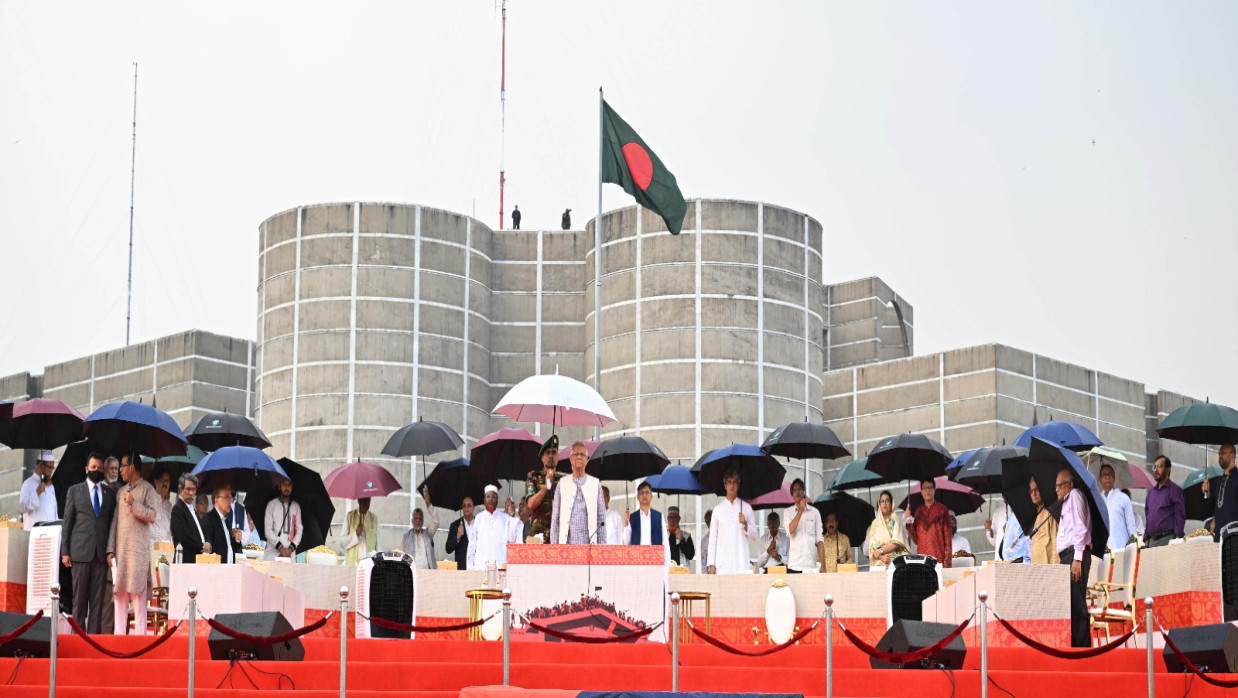
On July 17, 2025, the afternoon, South Plaza in Bangladesh’s National Parliament was turned into a podium of history. Under a monsoon sky, Bangladesh’s political parties, which had long been separated by animosity, violence, and vengeance, stood side by side to sign what will go down in history as the July National Charter, or Sanad. It was more than a piece of paper; it was the ethics regeneration of a country.
Interim regime’s Chief Adviser, Professor Muhammad Yunus, addressed the gathered leaders and statesmen and declared the words that would ring down the years: “We are new mothers and fathers it’s a new Bangladesh’s birth.” His pronouncement was in the same moral certitude that had characterized 1971’s freedom and 1990’s democratic renaissance. This was the third birth the beginning of Bangladesh’s long odyssey from insurgency to reconstruction.
Signing of the Sanad was an unprecedented act of political will convergence. The Bangladesh Nationalist Party (BNP), Jamaat-e-Islami, Amar Bangladesh Party, and other political parties joined forces facilitated by the National Consensus Commission, headed by scholars and civil society leaders such as Professor Ali Riaz. Political legitimacy was being taken in its own name, for the first time in decades, and it was being taken neither with bayonets nor with fiat, but with consensus.
Dr. Yunus referred to it as “the second phase of our revolution” a revolution of conscience, not blood. The July Sanad was an attempt to rebuild what years of authoritarianism had destroyed: faith between those who govern and those who are governed.
From Uprising to Renewal: The July Spirit
“Revolutions are not caused; they arrive.” Wendell Phillips
July–August 2024 uprising that swept Bangladesh was no moment of choreographed uprising; it was an eruption of morality caused by years of anger. It was triggered by students who protested against corruption, joblessness, and policemen brutality and soon it set the entire country ablaze. Millions packed the streets with a single refrain: Hasina must go. By the time the regime was ousted, its demise looked more like the end of a dynasty than the loss of a political party.
The global world was watching how Sheikh Hasina, who had been touted as a beacon of endurance, escaped her own republic after sixteen years of dictatorship. In Bangladesh, the uprising was a reckoning and a renaissance all at once its youth retaking control of the state from an-existential system that had consumed its democratic potential.
When Dr. Yunus was made Chief Adviser, it was not by political maneuver but by morale legitimacy. A Nobel laureate, international reformer, and all-life-long promoter of social business, he represented exactly what Bangladesh yearned for a clear break with the culture of vengeance and vanity that had corrupted its politics.
“The July Charter,” wrote Professor Ali Riaz, “is not a polycular agreement between parties, rather it’s a social contract between citizen, political forces and the state.” It was the architectural manifestation of the revolution turning revolutionary fervor into reformist architecture.
Charter and Social Contract: A Synthesis?
“Man is born free, and everywhere he is in chains.” Jean-Jacques Rousseau
In order to grasp the scale of the July Sanad, it has to be viewed in the context of the social contract that holy agreement which spells out how a populace agrees to be in charge. Bangladesh’s contract had been violated for a long while. The courts surrendered to politics, elections were exercises in manipulation, and governance was done on behalf of the few in the name of the many.
The July Sanad tried to reinterpret that contract binding citizen, state, and political forces into a new framework of accountability. It foreheads an inclusive republic where power no longer issued from personal loyalty but from institutional legitimacy.
As Dr. Yunus had the country remember: “The signing of this charter is not the end of our journey it is only the beginning.” It was a promise that Bangladesh democracy would come back not only as protocol, but culture based on ethics, equality, and accountability.
In its first since the 1972 Constitution, the Sanad revived the concept of public trust as a fundamental principle. Like South Africa’s post-apartheid charter, it rose from the rubble of injustice to create consensus among foes. But, in the voice of Professor Riaz, it was also fraught with skepticism: “No document can guarantee itself with success in itself. We have to act together to ensure its promise.” His utterances had the weight of historical memory Bangladesh had scripted so many promises and failed to deliver on so few.
The Resumption of the Caretaker Administration
“Eternal vigilance is the price of liberty.” Thomas Jefferson
Among Sanad’s most significant reforms was reviving the caretaker government system Bangladeshi’s only creation that was at its inception referred to as the provider of electoral neutrality. Adopted unanimously in 1991, it ensured that power was briefly transferred to a non-partisan government in times of elections. Removed in 2011 by Awami League, it was the end of a period of electoral crisis and state capture that lasted until this year.
In calling for its restoration, the July Sanad recognized an unpleasant truth: Bangladesh institutions aren’t quite mature enough to conduct a truly neutral election with such a device. Commented Professor Tawfique M. Haque of North South University, “In Bangladesh, a truly neutral election is unthinkable without a non-partisan caretaker government. That’s our reality: our Election Commission is non-neutral, our judiciary hasn’t gained full independence, and our administration gets politically motivated.”
This new system is significantly more advanced compared to those in the past. It embodies multi-level selection modes of the Chief Adviser, protection against unilateralism, and even contingency measures with ranked choice votes a proof of gained lessons from previous crises. In this, observers contend, Bangladesh finds its trial with institutionalized consensus between the poles of military guidance and party monopoly.
Dr. Yunus’s dream of the next election “celebration, festival, example to the world” was not idealism but direction. He refused to let “anybody have to tell us the way; we can and should have our own fair and Lovely Election.” The subtle but authoritative utterance was equally to domestic skeptics and foreign doubters: Bangladesh was to get its democracy back on its own terms.
Balancing Power: Rebalancing the Presidency and the Prime Ministership
“Power corrupts, and absolute power corrupts absolutely.” Lord Acton
While the caretaker system could be described as Sanad’s heart, its redistributive power between the Prime Minister and the President constitutes its backbone. Bangladesh’s politics was distorted over years by the brutality of concentration a prime minister who had all authority extending to the executive and also extending to the legislature, to the judiciary, and even to the Election Commission.
This violates the pattern of July Sanad. It advocates limiting the PM’s exoneration powers, imposing a two-term or 10-year tenure, and disconnecting party leadership from office in the governments. The President, previously a figurehead with only ceremonial authority, shall acquire real powers — in selecting the Election Commission, Human Rights Commission, Anti-Corruption Commission, and the Bangladesh Bank Governor — on the basis of independent search panels.
Dr. Nizam Ahmed, who teaches parliamentary affairs, added that “the limiting of the PM’s authority would pose no issues it would, in fact, level the playing field that has so long been tilted in favor of dictatorship.” His opinion betrays a universal consensus that excessive power in any hand destroys democracies.
This devolution of power also sends a signal to South Asia’s democrats in pretense, where such distortions hold. In India, centralization in the Prime Minister’s Office has undermined federal equilibrium. In Pakistan, successive bouts of military intervention have eroded civilian institutions. In Sri Lanka, executive extravagance has undermined fiscal discipline. Bangladesh’s new model — if it comes to pass — could thus act as a regional balancer, holding out the promise of a template on equilibrium in a region characterized by personalist rule.
Just like Professor Ali Riaz so aptly summarized: “To prevent in the future the rise of a fascist regime, all power has to have a balance.” Bangladesh, in short, was learning to institutionalize modesty the least common virtue in politics.
Laws of a Just Republic: From Promise to Practice
“Justice too long delayed is justice denied.” Martin Luther King Jr.
Whether the July Sanad succeeds or fails will depend on its enforcement and not on how it sounds. As Transparency International Bangladesh’s and the National Consensus Commission’s member Iftekharuzzaman put it: “These laws are largely with reference to institutions of the state that ought to work in public good and not in the interests of those who wield power.”
In order to fulfill its vision, Sanad requires at least a dozen new legislation and eight existing ones in amendments. Among them are reform of sectors that have long bred corruption and impunity — the Right to Information Act, Anti-Corruption Commission Act, Public Service Commission Act, and laws relating to the judiciary’s administrative self-governance.
Among the most radical proposals is the setting up of an Independent Criminal Investigation Service to strip law enforcement of political intervention. Another is the setting up of a Supreme Court Secretariat to give financial and administrative control to the judiciary a step long in coming toward real separation of powers.
Sanad also foresees a Beneficial Ownership Law to uncover illicit wealth, a new Legal Aid and Mediation Services Ordinance, and yearly public signings of assets by all elected officials. All these reforms, if ever it comes to pass, could disassemble the systemic structure of patronage that has tainted politics and bureaucracy.
Revamping laws on information and secrets — especially in revising the colonial age Official Secrets Act of 1923 may even democratize access to information more, turning recipients into vigilant watchdogs of governance. But no amount of reform happens with any sense of moral purpose. Dr. Yunus cautioned: “What is the use of making promises if we do not act on them?” Saned July then becomes at once a mirror and a mandate reflecting the failed past of the country and mandating a accountable future.
Beyond Bangladesh: A Model of South Asian Democracy
“Democracy is not a Western attire to be cut and worn; it’s a global aspiration.” Amartya Sen
July Sanad’s significance goes much deeper than Padma’s banks. It’s not only Bangladesh’s reinvention bid it’s regional news that South Asia’s democracy could potentially be rebuilt from scratch.
All over the subcontinent, the same ailments recur: weaponization of justice, politicization of institutions, erosion of press freedoms, and jailing of dissidence. But the moral symbolism of Bangladesh’s bloodless transition — from the removal of an established regime to a coalition-based interim regime — questions the fatalism that in South Asia, democracy always has to be cyclical and weakened.
In Pakistani Punjab, where militarily sponsored Islamists have clashed with civilian democrats, Bangladesh’s consensus-based caretaker arrangement might promote a clearer transition procedure. In Sri Lanka, where it’s struggling to end post-crisis governance, Sanad’s institutional changes could guide how to put politics apart from patronage. In India, where electoral institutions suffer strain from centralization and communality, the Bangladeshi experiment holds up a cautionary mirror that unbridled executive authority in the end devours its own democracy.
Dr. Yunus’s call for a “beautiful, festive election” one that necessitates no outside observers and no coercive policing betrays a fundamental philosophical revolution. It’s democracy and not showdown; it’s power play and not collective caretaking.
The South Asian experiments in democracy, conceived in the aftermath of decolonization but throttled by dynasty politics, finds in the July Sanad a new moral lexicon — a discourse that talks of institutional modesty, popular accountability, and ethical governance.
With Bangladesh set to have elections under this new morality architecture, the world sits up and takes notice. Not because its politics has always been volatile, but because, after all these years, they have the potential to promise change and not barter.
Second Liberation: From Fear to Freedom
“If the soil was liberated in 1971, then 2025 aims to liberate the soul.” Dr. Muhammad Yunus
July Sanad Signing Ceremony was no politico-moral event — it was a solemn promise, a declaration that Bangladesh shall henceforth no longer be identified with fear, factionalism, or lie. At the threshold of history, the interim regime led by Dr. Yunus has done something only a few nations have done in the absence of blood: consensus-based peaceful revolution.
The July uprising’s spirit has been grown into maturity in the form of the reform discipline. What started with the anger of streets now gets translated into the discourse of institutions. Bangladesh has started its transition from vengeance to reconstruction, from uprising to comprehension, and from charisma to character.
Whether this July Sanad survives or corrodes will depend on how the nation holds on to its unity and polishes its ideals into practice. But its impact is already irrevocable for it has changed the moral DNA of Bangladeshi politics. It has substituted cynicism with hope and despair with design.
As the President was appraised by the Nobel Laureate Chief Adviser to the nation that night, “In the future, let political parties conduct elections so beautifully that we shall have pride in them. Let no one on earth have any opportunity to say to us, ‘You didn’t get it right.”
In those sentences was the meaning of Bangladesh’s second liberation a republic that was winning its conscience back.
Epilogue: Towards a South Asian Spring
“The arc of the moral universe is long, but it bends toward justice.” Martin Luther King Jr.
History goes quietly before it storms. Bangladesh’s July Sanad could in the future be looked upon not so much as a homegrown reform but as the catalyst of a South Asian Spring a native process of movement toward ethical, accountable, and participatory governance.
From Karachi to Kathmandu, Delhi to Colombo, the region bears witness to a small country that had long been written off as politically turbulent presume to redefine democracy in the idiom of morality.
Bangladesh’s transition from the collapse of authoritarianism to consensual rebuilding is at once a cautionary tale and an inspiration: no such thing as die-in-a-day or resurrect-in-one-democracy exists. It’s rebuilt – word by word, law by law, and conscience by conscience. With the July Sanad marking this new dawn, one lesson stands forth with shining light through the storm clouds of the past: the liberty of a people’s existence is never finished until its democracy finds a way to guard itself against its own authority.


0 Comments
LEAVE A COMMENT
Your email address will not be published