

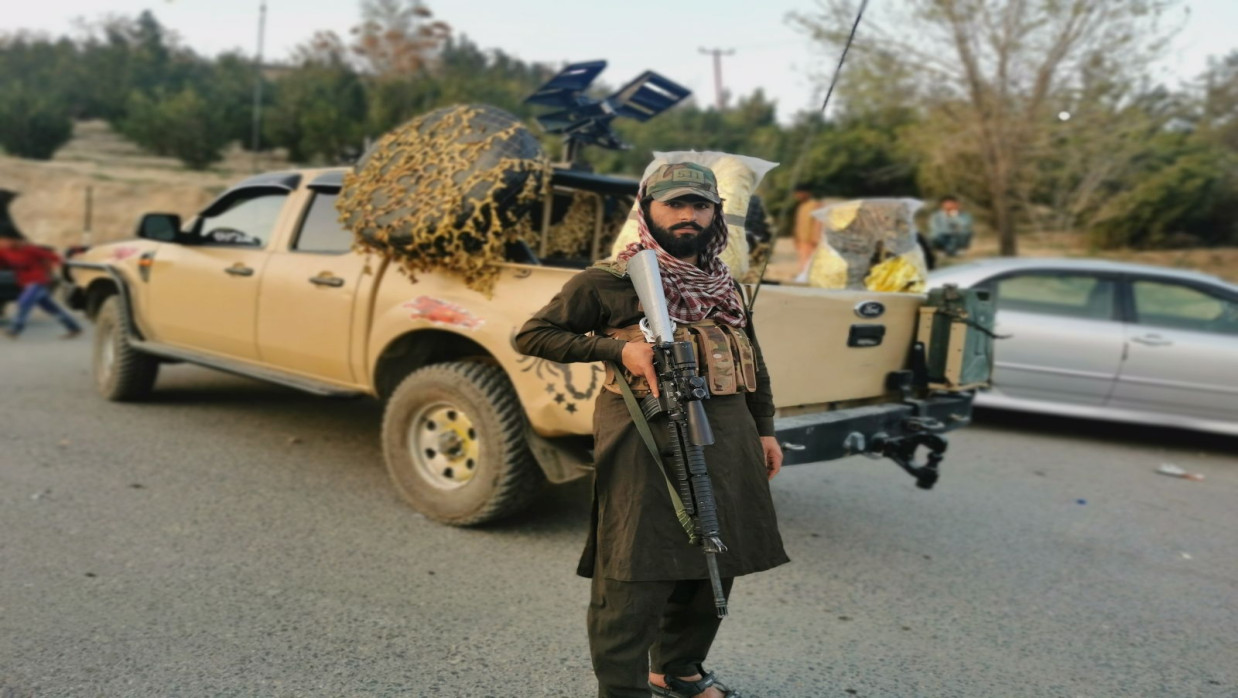
For many years, the international community has viewed Afghanistan in terms of political transition, humanitarian suffering, and economic isolation. However, as per the latest findings from the United Nations, there is another factor which needs to be considered. Afghanistan continues to pose a major threat in terms of regional terrorism dynamics. While it is not only a problem of the existence of terrorist organizations in the country, it also has a number of organizations that continue to have connections across the borders.
In his interview conducted recently, Colin Smith, Coordinator of the United Nations Security Council’s Analytical Support and Sanctions Monitoring Team stated that at least 20 terrorist organizations are still active in Afghanistan and there are Taliban connections to a number of those organizations. In particular, Smith underlined that the connections exist between the Taliban and Tehrik-e-Taliban Pakistan (TTP), the presence of Al-Qaeda and ISKP threat.
However, these comments become even more important in the context of 38th Report of UN Monitoring Team, which was published in August 2026. According to the report, there was an increase in cross-border incidents in Pakistan and Afghanistan, especially in connection to the attacks conducted by TTP against Pakistan and the Taliban support to TTP. In addition, the report pointed to an increase in the connections between TTP, Al-Qaeda, ISKP and BLA.
The significance of these findings lies in their ability to shed light on the changing nature of the militant landscape in Afghanistan. The challenge here is no longer about the independent organizations but rather an interconnected ecosystem of them. Terrorist organizations do not need to come together in one organizational structure in order to be able to leverage each other. Through training, ideological indoctrination, logistical support, funding, recruitment, and territory access, they can create a system of informal cooperation that will make every network stronger.
This is especially obvious when looking at the interconnections between Al-Qaeda and TTP. According to the last United Nations report, Al-Qaeda has been providing ideological indoctrination, training, and support to TTP, while recording information regarding the fact that Al-Qaeda trainers have trained TTP and BLA militants. This interconnection is important in that it helps to transfer the knowledge among organizations that have different aims but operate in the same field.
The issue takes on added complexity with the presence of linkages related to ISKP. While ISKP has faced considerable counter-terrorism pressure in Afghanistan, the report of the United Nations shows that its activities in Afghanistan have been reduced, but its activities in Pakistan have increased. Still, the group maintains its capacity to mount some high-profile operations, and remains equipped with advanced technology and skills. As Smith says, ISKP is one of the most active terrorist groups operating in Afghanistan, having up to 2,000 members capable of conducting large-scale operations on Afghan soil.
The issue goes further than just affecting Pakistan. The geography of the country makes its security situation inherently regional. In such circumstances, the concept of Regional Security Complex proposed by Barry Buzan and Ole Wæver is very relevant. This concept argues that security threats are grouped geographically due to the geographical interdependence among states and non-state actors of the region. The example of Afghanistan illustrates this principle in almost perfect way. The instability in Afghanistan is not limited to it, as it affects the internal security of Pakistan, stability of Central Asia, border security of Iran and interests of China concerning Xinjiang and Western borders.
However, for Pakistan, the impacts are more immediate. The ability of TTP to launch operations from within Afghanistan makes the problem of terrorism not one of domestic counter-insurgency but a security issue that is transnational in character. Indeed, the latest UN report directly links continued Taliban support for TTP with an increased rate of terrorist attacks in Pakistan. This is significant in terms of strategy, since continued terrorist attacks can eventually escalate the situation from a purely terrorist problem to one of interstate security. Pakistan responds with heightened border control, intelligence and military pressure due to attacks, while Kabul sees this as a problem of sovereignty and territorial integrity on their part. This cycle, in turn, will continue to create distrust between the parties despite the fact that neither of the sides is seeking an interstate conflict.
There is, furthermore, an international aspect of this problem as well. The continued existence of Al-Qaeda indicates that the Afghan problem is not simply about the capabilities of ISKP. According to Smith, Al-Qaeda continues to exist and its connection with TTP is very much a worry. The significance of Al-Qaeda is the fact that it is not just a territorial organization, but also an ideological and operational network. This means that even in the absence of battlefield activities, there is a potential to re-ideologize and assist the movement.
Similarly troubling is the apparent issuance of Afghan ID papers to members of foreign terror organizations. According to Smith, the UN had intelligence on how members of various groups were obtaining Afghan identity documents, which was also highlighted in the reports produced by the Monitoring Team. If these practices exist, they could pose problems for international efforts to differentiate between ordinary Afghan citizens and foreign terrorists, facilitating their movement. This is not merely a bureaucratic matter, as identity documentation becomes a tool of security when used by transnational networks.
Moreover, China has a strategic interest in what is going on in northern Afghanistan. The presence and activities of the ETIM/TIP in northern Afghanistan, particularly in regions near Central Asia and the Wakhan corridor, present a problem for Beijing in terms of militant mobility in this geography that overlaps with China's western security environment. The more fundamental implication here is that this is not about just Xinjiang, but concerns the security of regional connectivity and corridors, as well as Chinese personnel in the region.
The critical issue is not whether Afghanistan is turning into a terrorist base in the exact same way as it was before 2001. The security environment has become more fragmented and much more complicated than that. The issue is whether Afghanistan is becoming a permissive operating environment for different militant groups to survive, adapt, train, recruit and organize themselves transnationally. As the latest UN report reveals, it would be irresponsible to dismiss the likelihood of this possibility.
In terms of policy for the international community, the message is clear. Afghanistan cannot be treated only from the perspective of humanitarian aid, diplomacy and recognition. Countering terrorism will have to continue to be a key component of international interaction with Kabul. But it does not mean that diplomacy has to be abandoned. On the contrary, diplomacy is all the more important because the neighboring states need a means through which their security concerns can be conveyed and discussed.
The findings of the United Nations have re-emphasized for Pakistan the need to integrate border control and intelligence cooperation with diplomatic and counter-terrorism efforts. This is because the security concerns of Pakistan cannot be explained in terms of domestic politics when the militant organizations that are attacking Pakistan have connections spanning an international border.
In other words, Afghanistan's problem of terrorism is no longer a problem of just Afghanistan. The most recent assessment of the United Nations clearly reflects a regional security structure where militant organizations have been able to use borders and associations with greater efficiency than states themselves. Disregarding this reality is likely to repeat the strategic blunder of considering Afghanistan's problems to be limited to Afghanistan itself. It is clear from the facts that this is not the case and Afghanistan remains an important hub of transnational terrorism.


0 Comments
LEAVE A COMMENT
Your email address will not be published