

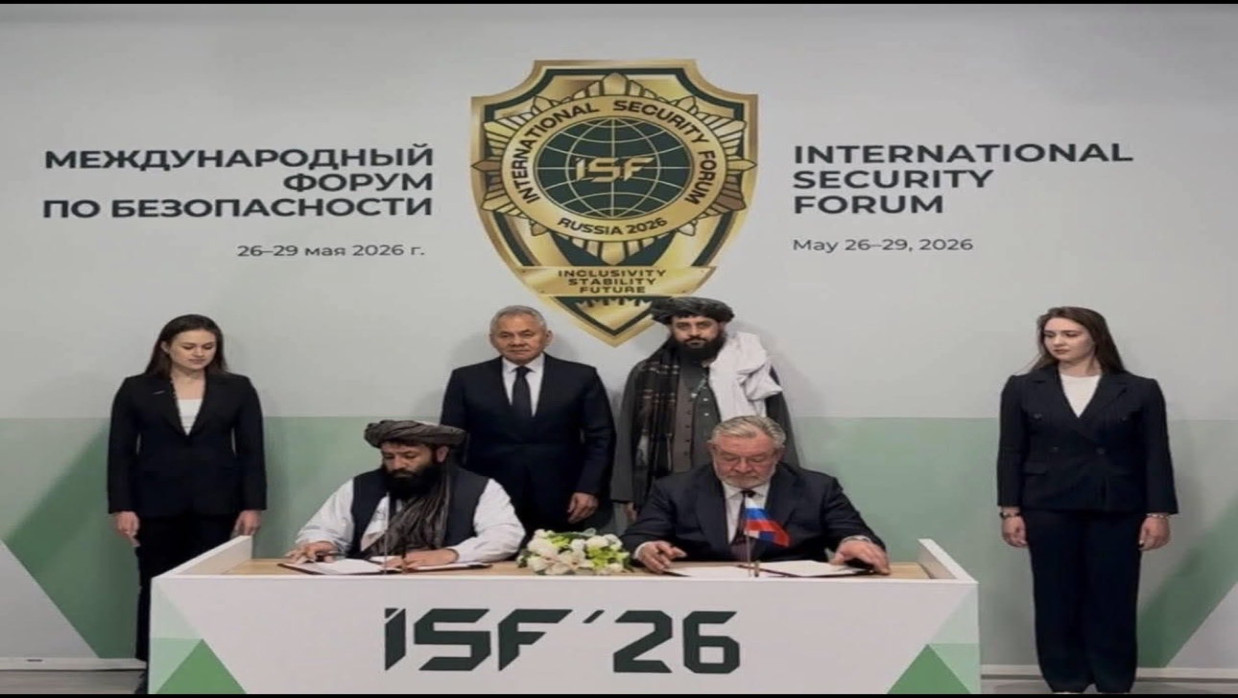
Russia’s growing involvement with the Taliban has become, kind of, one of the more striking strategic contradictions in today’s Eurasian security politics. At the same moment when Moscow’s own security apparatus is talking up escalating terrorist dangers coming out of Afghanistan, the Kremlin is also pushing ahead with wider political, military, and technical coordination with the Taliban regime. That odd mismatch between how the threat picture is described and what policies are actually chosen, it just doesn’t sit right, and it creates tough questions about what happens over the long haul if a government is being strengthened one that still presides over territory where some of the world’s most dangerous extremist organizations operate and regroup.
Recent developments have made this contradiction kind of loud. The Taliban Defense Minister, Mullah Mohammad Yaqoob, going to Moscow and signing military plus technical cooperation arrangements really points to a relationship that is getting tighter between Russia and Afghanistan’s de facto rulers. Russian and Taliban officials have, in public, stressed continuing security involvement and wider bilateral cooperation. Still, all of this lands just days after senior Russian security officials talked about threats from terrorism getting worse and, yes, they said it’s coming out of Afghanistan.
Alexander Bortnikov, who leads Russia’s Federal Security Service (FSB), has said before, and again, that he’s worried about the activities of Islamic State Khorasan Province (ISIS-K) in Afghanistan. In Russian assessments, ISIS-K is not just sitting around, it is actively recruiting militants from Tajikistan, Uzbekistan, Kyrgyzstan, Kazakhstan and also from migrant communities living inside Russia. Russian intelligence officials have also warned that terrorist networks, funding pathways, and working cells connected to Afghanistan are spreading across the Commonwealth of Independent States.
These concerns were also echoed by Russian Security Council Secretary Sergei Shoigu. He was pointing to thousands of terrorists, supposedly operating out of Afghan territory and he cautioned that extremist infrastructure, or at minimum its sway, is widening across the entire region. Honestly, these warnings are not just random thoughts. Many international reviews, including work tied to the United Nations Monitoring Team and other regional security groups, have kept noting the ongoing presence of several terrorist organizations inside Afghanistan.
The estimates go further, suggesting that over twenty extremist factions keep some kind of active foothold within the country. They cover ISIS-K, Tehreek-e-Taliban Pakistan (TTP), Al-Qaeda, the Eastern Turkestan Islamic Movement (ETIM), and the Islamic Movement of Uzbekistan (IMU), among others. Even if the Taliban says it has managed to improve security conditions, the fact that these groups still persist, means Afghanistan still functions as a major place for transnational militancy.
The core problem is not only that there are separate terrorist groups, it’s more like the entire ecosystem around them, as if they are stitched together in a messy way. Afghanistan, still under Taliban control, keeps functioning like a sanctuary sort of place, a recruiting hub, a logistical platform and even an ideological greenhouse for a range of extremist movements. When you end up with thousands of militants, from different factions, packed into one geopolitical area it turns into a very uniquely touchy security setting.
Some accounts talk about roughly 5,000 to 7,000 TTP fighters, and maybe around 2,000 to 3,000 ISIS-K operatives too so the overall scale of the challenge is pretty big. And when Al-Qaeda linked elements keep appearing, it just makes the concern stronger that Afghanistan is sustaining broader cross-border jihadist networks, even if indirectly.
On this backdrop, military collaboration with the Taliban, it comes with pretty serious risks, even if it sounds pragmatic at first. Since they came back to power in 2021, the Taliban have effectively inherited huge stockpiles of military gear, left behind after the withdrawal of international forces. There have been documented worries by several international monitoring organizations, about the diversion, transfer, or potential spread of weapons. So, if external partnerships are used to strengthen the Taliban’s fighting ability, it could end up unintentionally enlarging what’s already available in a setting that is basically already thick with extremist actors. And even if the intention is to bolster stability, in practice Afghanistan’s security reality is such that it is hard to promise that any upgraded military capacity can stay sealed off from the wider militant ecosystem, for long.
Then there is the money side, which adds yet another complication. Afghanistan still receives significant international assistance, despite the Taliban’s political isolation. At the same time, the regime is looking for new routes to military collaboration, and procurement. Naturally questions pop up about what it could mean when resources flow into a country where governance is fragile, oversight tools are limited, and terrorist groups continue to function. You cant just dismiss the risk that financial support and military capabilities, indirectly help fuel additional militarization, even if nobody says that out loud.
The regional aftereffects of Afghanistan’s security situation are already showing up, like you can see it, pretty clearly. Pakistan keeps dealing with cross-border terrorism that doesn’t really slow down, and there are hundreds of attacks that are linked to militants allegedly moving from Afghan territory. Central Asian governments also keep worrying about extremist penetration and recruiting webs that stretch across their borders, it’s not just one place either. Russia, for its part, is worried about ISIS-K influence spreading into Russia, and China has talked again and again about militant groups that could threaten Chinese interests, and also undermine regional connectivity projects. Tajikistan and other nearby countries have strengthened their border protection too, kind of as a reaction to worries that instability might move northward from Afghanistan.
From Moscow’s viewpoint, dealing with the Taliban could be pushed by practical reasons. Russian decision-makers might assume that staying in touch in Kabul supports wider geopolitical aims, reduces Western sway, and gives Russia more room for regional bargaining power. Also, the Taliban’s international isolation might make the group into a more willing partner for Russia’s strategic plans. Still, these kinds of estimates come with serious dangers. If Moscow offers political recognition, diplomatic engagement, and maybe even thicker security collaboration, it could end up reinforcing a regime that is still, or remains, unable or just unwilling to wipe out the terrorist networks that operate on its own soil.
Ultimately, Russia seems to be running some kind of high risk gamble, and tbh its security people keep issuing warnings about an enlarging threat from extremist groups rooted in Afghanistan. But at the same time, its foreign policy, kind of oddly, is getting more and more friendly with the authorities who govern that same environment. That contradiction is really the core of the whole discussion. If Afghanistan stays a haven for terrorist organizations, then bolstering the regime that controls it might end up doing the opposite, as in, increasing instead of reducing regional security threats. For Russia, and also for the broader stretch of region from South Asia through Central Asia, the fallout from this gamble could end up being extensive, not easy to undo, and frankly quite hard to reverse later.


0 Comments
LEAVE A COMMENT
Your email address will not be published