
Donald Trump and Binyamin Netanyahu are two peas in a pod.
They both crave others’ land.
They are ethno-nationalists with a particular dislike for Muslims.
They blur the lines between the civilisational and the national.
They opt for indiscriminate violence despite available alternatives.
They are autocrats who hollow out democracy.
They have a healthy disregard for the law, a distorted definition of human rights, and a warped sense of the truth.
Both men have faced misconduct charges in court, with the International Criminal Court issuing an arrest warrant for Mr. Netanyahu on charges of war crimes and crimes against humanity.
Both are proponents of regime change, with Mr. Netanyahu emphasising Iran and Mr. Trump focussed on Venezuela.
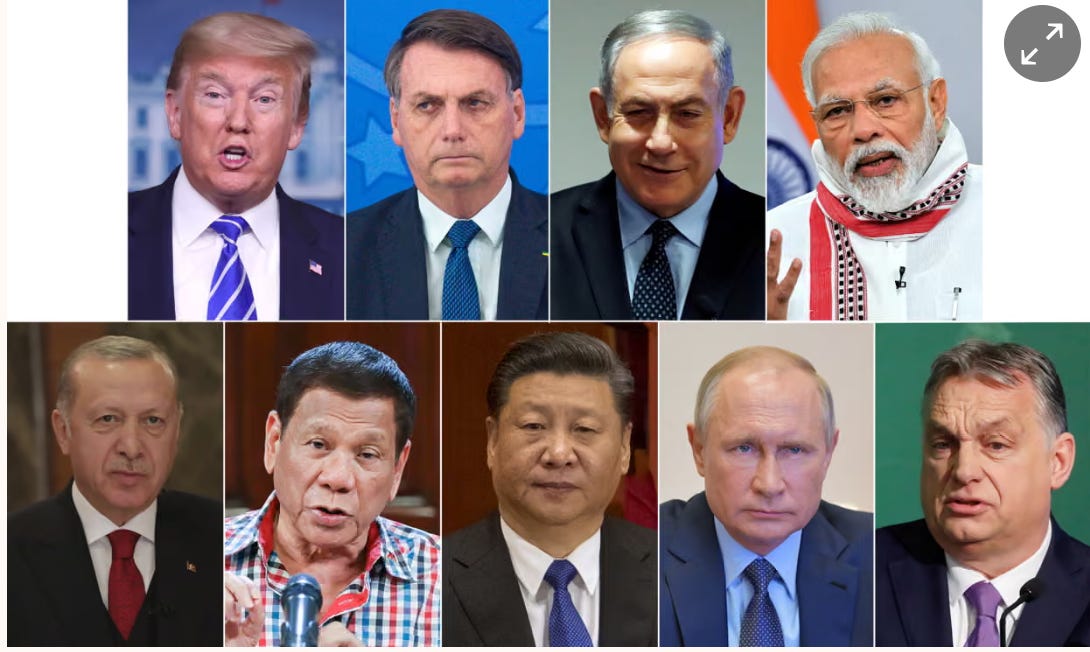
Messrs. Trump and Netanyahu’s commonalities fit a pattern.
Credit: The Guardian
They are integral to
the rise of a critical mass of authoritarian world leaders who think in civilisational rather than national terms, use physical or mental maps that portray their countries’ frontiers far beyond their internationally recognised borders, and prioritise ethnic, cultural, or religious affinity.
Their club includes Chinese President Xi Jinping, Russian President Vladimir Putin, Indian Prime Minister Narendra Modi, Hungarian Prime Minister Viktor Orban, and the global far right.
The most significant difference between the two men is that Mr. Netanyahu, unlike Mr. Trump, is singularly focussed on his problematic perception of Israel’s national security and his political survival.
Moreover, at least for now, Mr. Trump is more firmly entrenched in his saddle than Mr. Netanyahu, even if factions on the far right challenge some of their realpolitik, particularly as it relates to the future of Israeli-occupied Palestinian territories.
The bottom line is that Messrs. Trump and Netanyahu have more in common than meets the eye.
Their commonalities shape their approach towards tactical differences regarding potential annexation of the West Bank, conquered by Israel in the 1967 Middle East war, ending the Gaza war, and the Strip’s future.
For Mr. Netanyahu, a cat with nine lives and a master of American politics, resolving tactical differences with Mr. Trump is a waiting game.
Mr. Netanyahu is convinced that his time will come when Mr. Trump’s attention will be diverted by the multiple domestic and other foreign issues on his plate, leaving the prime minister to deal with Gaza and Lebanon as he wishes.
Mr. Trump’s out may be
splitting Gaza into Israeli and Hamas-controlled areas. However, that is likely to be a
hard sell to the Gulf states and much of the international community, and difficult to project as an unqualified win.
Even so, with their basic political inclinations and instincts aligned, differences in Messrs. Netanyahu and Trump’s focus are defined by their countries’ positioning in the geopolitical pecking order and their political priorities.
Mr. Netanyahu’s envisioned land grabs are limited to neighbouring countries and territories, including, in a maximalist interpretation, Gaza, the West Bank, southern Lebanon, and parts of south Syria.
Mr. Trump’s ambitions are global. They stretch from the Panama Canal and Greenland to the Bagram Air Base in Afghanistan.
Mr. Netanyahu sees himself as the protector of embattled Middle Eastern minorities, including Kurds, Druze, Alawites, Yazidis, and Assyrians threatened with persecution by Islamist forces.
Mr. Netanyahu’s senior foreign affairs and defence officials have justified Israeli military strikes in southern Syria and Damascus as steps to
protect the country’s embattled Druze community.
They have described Syrian Kurds, who are at odds with the government of President Ahmed al-Sharaa, as
Israel’s natural allies.
Last month, Middle Eastern minority figures, many of whom live in exile, gathered in Tel Aviv for a
conference entitled “The Future of Minorities in the Middle East,” organised by Edy Cohen, a Lebanese-Israeli journalist and researcher whose father was
kidnapped and murdered in Lebanon in 1985 by Shiite militants.
Even so, some activists, including Druze from France and Kurds from Germany and Poland, were denied entry into Israel to attend the conference, despite their willingness to publicly associate themselves with the Jewish-majority state.
In contrast to Mr. Netanyahu, Mr. Trump’s notion of minority protection is, so far, focused on Africa, singling out black Nigerian Christians who are on the defensive against Muslim militants and white South African Afrikaners.
In the past week, Mr. Trump threatened to come to the aid of beleaguered Nigerian Christians militarily and closed the United States’ door for asylum seekers except for white South Africans.
“If the Nigerian Government continues to allow the killing of Christians, the U.S.A. will immediately stop all aid and assistance to Nigeria and
may very well go into that now disgraced country, ‘guns-a-blazing,’ to completely wipe out the Islamic Terrorists who are committing these horrible atrocities,” Mr. Trump thundered on Truth Social, his social media platform.
A day earlier, Mr. Trump capped the number of refugees to be allowed entry into the United States in fiscal year 2026 at 7,500, the lowest refugee admission cap in US history, with
white South Africans enjoying priority.
The cap is a fraction of the 125,000 refugees allowed to enter under former President Joe Biden during his final year in office.
Mr. Trump has
repeatedly said white South Africans are being persecuted in the Black-majority country, a claim rejected by South Africa’s government and top Afrikaner officials.
In the ultimate analysis, Messrs. Trump and Netanyahu’s commonalities and tactics dampen hopes that the US president’s flawed
20-point Gaza proposal is the Strip and Palestine’s panacea.
Despite the proposal’s multiple problems, it is the only game in town.
The risk is that the proposal will join a long list of failed Middle East peace propositions, not because of merit, but because of lack of political will and/or opportunism and partisanship.
Dr. James M. Dorsey is an Adjunct Senior Fellow at Nanyang Technological University’s S. Rajaratnam School of International Studies, and the author of the syndicated column and podcast, The Turbulent World with James M. Dorsey.





0 Comments
LEAVE A COMMENT
Your email address will not be published