

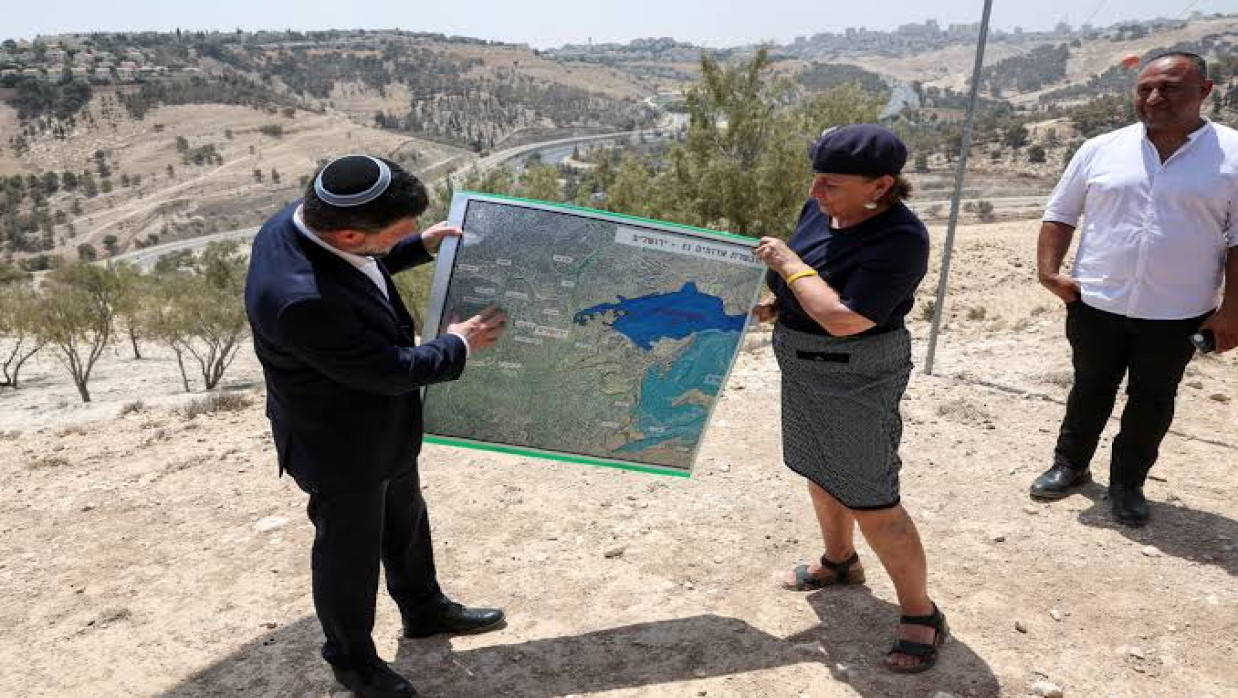
The decision to move forward with the tender for 2,167 settlement housing units in the E1 area of occupied East Jerusalem is a major step forward with regards to Israel’s settlement expansion. This has brought international attention to the impact of Israeli settlement expansions in occupied West Bank. The E1 expansion will cause major issues with regards to Palestinian statehood due to its location between East Jerusalem and the Ma’ale Adumim settlement. This will cause Palestinian land to be divided further, making movement between areas difficult and impacting the possibility of a sovereign and connected Palestinian state.
The E1 expansion is very significant due to its location in a strategic area connecting occupied East Jerusalem with the eastern parts of the West Bank. Many Palestinian officials and international groups have highlighted that building settlements within this area could cause major issues with regards to dividing Palestinian land between the North and South West Bank whilst also causing East Jerusalem to become more isolated. This will cause major issues with regards to Palestinian statehood due to there being many political, geographical and administrative obstacles. The E1 expansion must be considered as part of a larger issue to do with gaining control over Palestinian land and causing demographic changes.
The new tenders have caused major concerns. The new 2,167 housing unit tender will begin on the 1st December 2026 (closing on the 28th December 2026) according to Israeli monitoring groups Ir Amim, Bimkom and Peace Now. This follows a previous tender for 1,234 housing units in August (closing October). This means there will be a total of 3,401 housing units to be built as part of the E1 expansion. There have been reports of demolitions and more demolition notices to a Palestinian Bedouin community in the area meaning there are major concerns that Israel are moving forward with their expansion plans despite international opposition.
The legality of this issue has been highlighted by the United Nations Security Council. On the 23rd December 2016, United Nations Security Council Resolution 2334 was passed stating that Israeli settlements in Palestinian territory occupied since 1967 (including East Jerusalem) are illegal. This also demands that all settlement activities are stopped immediately. It also states that unilateral actions to change the demographic and character of Palestinian occupied territories are unacceptable. It also states that any changes to the 1967 borders will not be recognised without negotiation. The E1 expansion therefore poses legal concerns.
On the 19th July 2024, an Advisory Opinion was given by the International Court of Justice. It was concluded that Israeli continued existence in the Occupied Palestinian Territory is illegal and they must end their illegal presence as soon as possible. It also states that Israel must stop all new settlement activity immediately. It also highlights the responsibilities of other states to not recognise or assist with the illegal situation caused by Israel. This shows how much responsibility the international community have to ensure they are not assisting with illegal land changes.
The E1 expansion poses many problems for Palestinian statehood. Dividing Palestinian land can cause issues with accessibility between areas, difficulties with transportation, issues with economic integration and difficulty with managing public services. East Jerusalem is very significant as Al-Quds Al-Sharif is seen as the capital of Palestine by Palestinians. If Israel continue to expand settlements around this area it will make it harder for them to integrate into a sovereign Palestinian political system. The relationship between Gaza and the West Bank is also important to maintain politically and geographically.
Governments should put pressure on Israel to stop the E1 tender and abide by Resolution 2334. They should also ensure that they follow the responsibilities set by the ICJ such as not recognising illegal land changes and not assisting with illegal situations. This must be done by increasing monitoring for trade, investment, procurement and business related to settlements in occupied Palestinian territories. International institutions must ensure their policies separate Israel’s internationally recognised territories from those occupied since 1967. Without holding Israel accountable, they will continue to break international decisions which will cause the credibility of the international law system to decrease.
Pakistan has always supported the Palestinian people’s right to self determination and the creation of an independent sovereign Palestinian state with the 1967 borders and Al-Quds Al-Sharif as the capital. Islamabad do not support the expansion of settlements and any changes to the demographics and land of occupied Palestinian territories. This shows how much they support United Nations resolutions and a two state solution through negotiation. It also shows how they do not believe Palestinian statehood can be meaningful if their land is being divided through unilateral settlement expansions.
Overall, the E1 settlement expansion poses a major issue with regards to Palestinian statehood. Building 2,167 housing units (along with the 1,234 from the previous tender) will cause many issues for the future of East Jerusalem and the West Bank. The international community must take action and hold consistent diplomatic, legal and economic actions to enforce international law. Gaza and the West Bank must remain connected and the Palestinians must have the ability to exercise their right to self-determination. To achieve a fair and lasting peace, Palestine must be an independent sovereign and connected state with Al-Quds Al-Sharif as the capital.


0 Comments
LEAVE A COMMENT
Your email address will not be published