

A New Eurasian Land Bridge Challenges the Primacy of Maritime Trade
For centuries, geography dictated that most commerce between East Asia and the Middle East traveled by sea. Modern container shipping reinforced that reality. Ships could move enormous quantities of oil, machinery, manufactured goods, and raw materials more cheaply than any railway. Yet recent geopolitical upheavals are forcing China, Iran, and the states of Central Asia to reconsider an old proposition: whether the Eurasian landmass itself can become a dependable commercial highway.
The emerging China–Central Asia–Iran railway corridor should be understood in that context. It is not about replacing maritime trade. No railway stretching across Kazakhstan, Uzbekistan or Turkmenistan can reproduce the enormous capacity of tankers and container ships. Rather, the corridor represents something increasingly valuable in an unstable world: strategic redundancy.
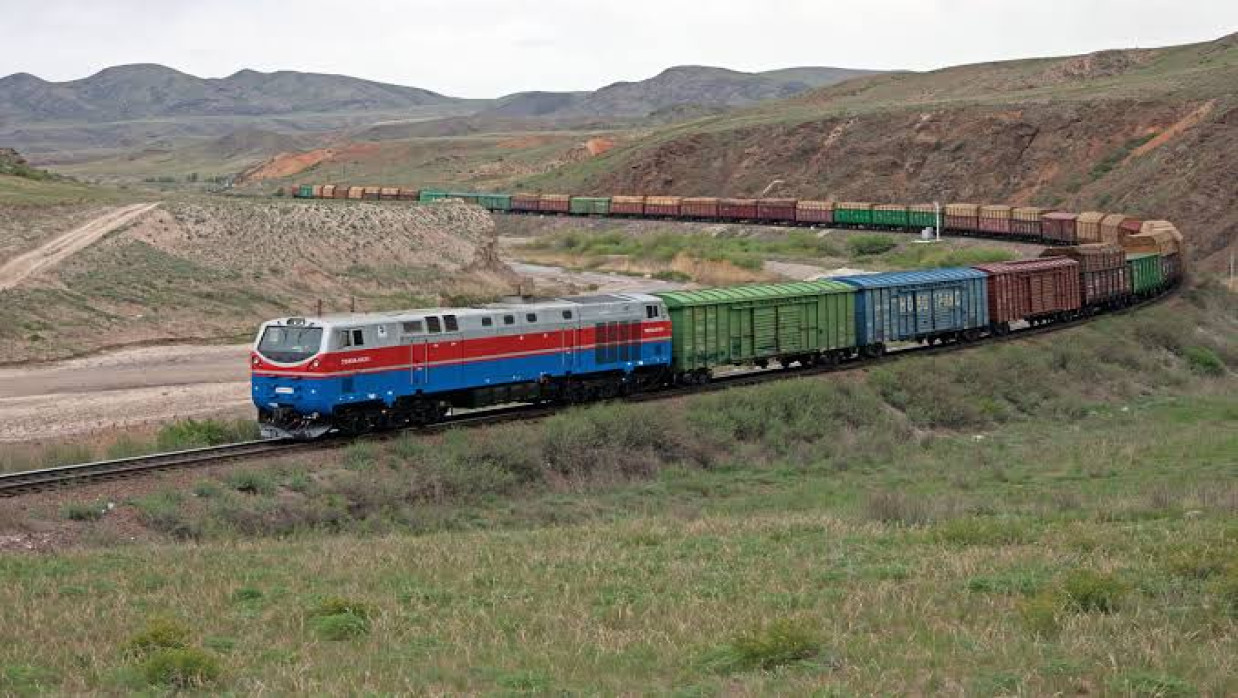
Until recently, the idea of regular rail transportation between China and Iran existed more convincingly on maps than in commercial reality. Trains occasionally crossed the old Soviet railway networks of Central Asia, but traffic was sporadic. Since 2025, however, China, Iran and the Central Asian republics have begun converting those occasional journeys into something resembling a permanent transport system.
This is reflected in the number of trains. Iranian Railways said at the beginning of 2026 that 43 freight trains from China had entered Iran over the past 9 months. Over the previous 7 years, only 7 block trains ran. Before the recent disruption, sea trains would leave every week. Now they are leaving every 3-4 days.
This is significant when talking about a commercial route. Just because a train can travel from point A to point B doesn't make it a commercial route. Businesses will want consistent train schedules and rates. Once you have consistent schedules and rates, along with container facilities, dry ports, customs facilities, and enough rolling stock, then it can be considered commercial.
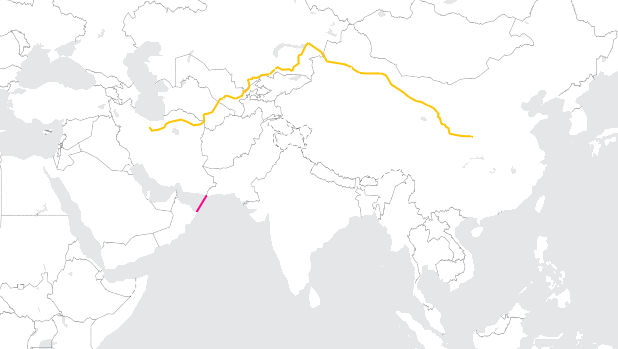
At the heart of the system is the China–Kazakhstan–Turkmenistan–Iran route. Its physical infrastructure is not entirely new. Kazakhstan, Turkmenistan and Iran completed the Uzen–Bereket–Gorgan connection more than a decade ago. What has changed is the political determination to use that infrastructure as part of a broader east–west trading system.
Another example came in 2025, when a cargo train from Xi'an traveled through Kazakhstan and Turkmenistan to reach the Aprin dry port, near Tehran. Routes also run via Kazakhstan, Uzbekistan, and Turkmenistan, with hopes of one day reaching Europe through Iran and Turkey. Rail officials have agreed on similar pricing between China, Kazakhstan, Uzbekistan, Turkmenistan, Iran, and Turkey.
Under favorable conditions, freight can reportedly travel between China and Iran in approximately 15 to 18 days, considerably faster than many maritime alternatives.
The greatest technical difficulty is hidden beneath the trains themselves.
China and Iran predominantly use the international standard railway gauge of 1,435 millimeters. The Central Asian republics inherited the Soviet 1,520-millimeter gauge. Consequently, freight traveling from China through Kazakhstan and Turkmenistan to Iran encounters two gauge breaks.
At the China–Kazakhstan frontier, containers normally must be transferred to wagons compatible with the wider Central Asian railway system, or railway bogies must be changed. At the Turkmenistan–Iran border, the process occurs again as freight returns to the 1,435-mm Iranian network.
The container may therefore travel from China to Tehran, but the wagon underneath it usually does not.
Every transfer adds cost, handling requirements and potential delay. Cranes, terminals, customs personnel and different railway companies must work together. A bottleneck at one frontier can erase much of rail's speed advantage.
Iran and Turkmenistan have consequently sought to expand facilities at Sarakhs, including additional tracks representing both gauges and improved container-handling capacity. The planned China–Kyrgyzstan–Uzbekistan railway similarly demonstrates how seriously governments now regard the gauge problem.
Yet the most important forces driving this railway are geopolitical rather than technical.
For Iran, dependence upon maritime trade has become an increasingly obvious strategic vulnerability. The Strait of Hormuz and Bab al-Mandeb are among the world's most politically sensitive waterways. Conflict, naval pressure, insurance restrictions, or sanctions can transform maritime geography into an economic weapon.
An overland connection with China provides Tehran with another door.
That door is narrow compared with the ocean, but it may remain open when other routes become dangerous. Machinery, industrial components, electronics, spare parts and higher-value manufactured products can move effectively by rail. In periods of crisis, maintaining the flow of such strategically important goods may matter considerably more than the percentage of total Iranian trade carried by trains.
Rail transport also reduces exposure to maritime interdiction. A container crossing Kazakhstan and Turkmenistan is beyond the reach of warships patrolling the Persian Gulf or Arabian Sea. Financial sanctions remain another matter. Banks, insurers, freight companies and logistics providers can still face sanctions-related risks even when goods travel overland. Rail therefore gives Iran geographical resilience, not economic immunity.
China's calculation is somewhat different.
For Beijing, the Iranian connection fits naturally within the larger Belt and Road vision. China has spent years financing roads, railways, pipelines and logistics facilities throughout Central Asia. Originally, much of this infrastructure was associated with Central Asian resources and China's ambition to develop alternative connections with Europe.
Iran introduces another dimension.
From Central Asia, Chinese cargo can move westward toward the Caspian and Caucasus, southwest toward Iran and Türkiye, or south through Iran toward ports on the Persian Gulf and Gulf of Oman. The emerging network therefore resembles less a single railway than a continental web.
This also explains the strategic importance of the China–Kyrgyzstan–Uzbekistan railway. Although its name suggests a three-country project, its eventual significance could be much greater. Once western China gains more direct rail access to Uzbekistan, freight can continue through Turkmenistan into Iran and potentially onward toward Türkiye, the Middle East and Europe.
Central Asia may ultimately be the greatest geographical beneficiary.
Kazakhstan, Uzbekistan, Turkmenistan, Kyrgyzstan and Tajikistan share a fundamental disadvantage: they are landlocked. Their economic security consequently depends upon obtaining multiple outlets to world markets.
Iran offers access to the Persian Gulf, the Gulf of Oman, and the Indian Ocean. Kazakhstan has explored expanded use of Iranian ports, including Bandar Abbas, Shahid Rajaee and Chabahar. Such connections complement Kazakhstan's east–west routes through China and the Caspian as well as its traditional northern links through Russia.
The objective is diversification, not political exclusivity. Central Asian governments do not necessarily want to choose between China, Russia, Iran or the West. Their interests are better served by having usable connections in every direction.
Turkmenistan occupies an especially important position because it provides the principal railway bridge into Iran. Transit can become an economic asset, generating freight revenue, logistics investment and political relevance.
Nevertheless, claims that the railway could fundamentally replace maritime trade should be treated cautiously.
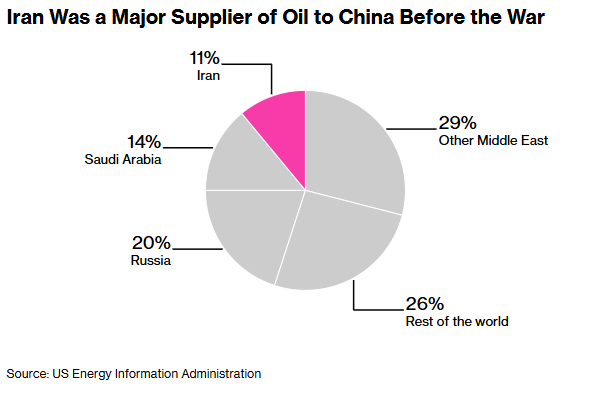
The mathematics of oil transportation illustrates the problem. Iran's crude exports to China have historically been measured in very large daily volumes. A Very Large Crude Carrier can transport roughly two million barrels in a single voyage. A railway oil train carries only a fraction of that quantity. Reproducing tanker-scale oil flows across thousands of kilometers of railway would require an impractical number of trains, specialized loading facilities and enormous additional track capacity.
Sea transport therefore remains vastly more efficient for bulk commodities.
The railway's strategic importance lies elsewhere.
Imagine a maritime crisis in which Iranian ports face severe restrictions. Iran may be unable to redirect millions of barrels of crude by rail, but trains could continue bringing machine tools, industrial components, telecommunications equipment, vehicle parts, chemicals and other essential supplies from China. Even relatively small quantities of high-value goods could sustain industries that otherwise might shut down.
The corridor is therefore better understood as economic insurance.
Its emergence also reveals something larger about the changing geography of world power. For several centuries, maritime supremacy has been central to Western geopolitical influence. Britain built an empire around control of the seas. The United States inherited much of that strategic logic after the Second World War, maintaining powerful naval forces capable of operating around the world's major shipping lanes and chokepoints.
China cannot easily replicate American naval reach. It can, however, reduce its dependence upon vulnerable sea lanes by constructing alternative routes across Eurasia.
This does not mean that railways will overturn maritime power. More than 80 percent of world merchandise trade by volume still moves by sea, and the economics of ocean transportation remain overwhelming. But geopolitical resilience does not require replacing maritime trade. It requires alternatives.
That is what makes the China–Central Asia–Iran corridor significant.
Its ultimate success will depend less upon inaugural trains and political declarations than upon mundane questions of logistics. Can customs clearance be accelerated? Can railway tariffs remain competitive? Can the two major gauge changes be handled efficiently? Will enough wagons and containers be available? Can national railway companies coordinate dependable schedules? Can financing continue despite sanctions and geopolitical pressure?
If those problems are resolved, a profound geographical transformation could gradually occur.
Central Asia would cease to be viewed merely as an isolated collection of landlocked former Soviet republics or as a transit region between China and Europe. It could become the central interchange of a wider Eurasian transportation system connecting China, Iran, Türkiye, Russia, the Caucasus, the Persian Gulf, the Indian Ocean and Europe.
The transformation will not happen overnight. Nor will steel rails make the oceans irrelevant. Ships will continue to dominate global commerce for the foreseeable future.
But geopolitics increasingly rewards countries that possess more than one route to the outside world.
The emerging China–Iran railway matters not because it can replace the sea, but because it ensures the sea is no longer the only option. In an era of sanctions, blockades, wars and contested maritime chokepoints, that distinction may prove far more consequential than the relatively modest number of trains presently crossing the vast plains of Central Asia.


0 Comments
LEAVE A COMMENT
Your email address will not be published