

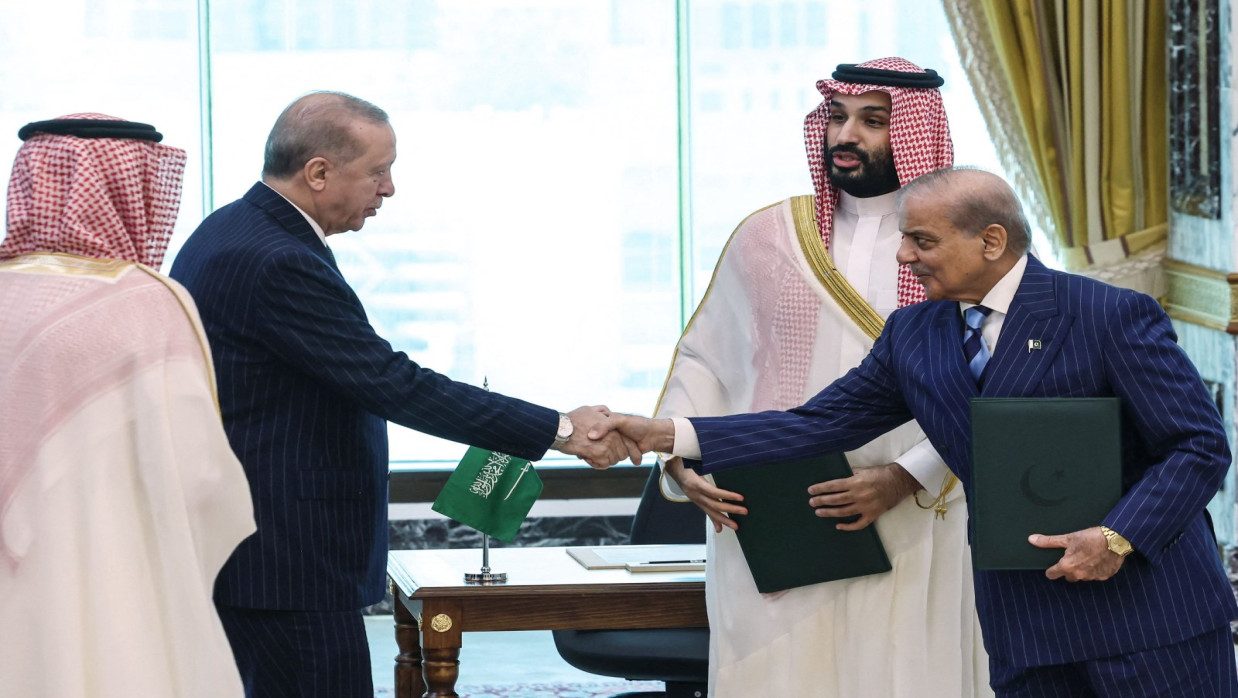
Saudi Arabia, Türkiye, and Pakistan’s August 7, 2026 signing of the Mecca Joint Defense Agreement is one of the most significant shifts in regional security dynamics in recent history. The pact’s primary clause states that an armed attack on any member state will be treated as an attack on all three; in theory, this collective-defense agreement functions like NATO’s Article 5.
Signed by Saudi Crown Prince Mohammed bin Salman, Turkish President Recep Tayyip Erdoğan and Pakistani Prime Minister Shehbaz Sharif, the agreement transforms a network of bilateral military relationships into a formal trilateral framework. It also provides for a permanent secretariat in Saudi Arabia and mechanisms for political and military coordination. Future cooperation is expected to include joint exercises, defense production, technology transfers, cyber capabilities, artificial intelligence and unmanned weapons systems.
Although the parties describe the agreement as purely defensive and insist that it is not directed against any particular country, the pact inevitably affects the strategic calculations of Iran, Israel, India and the United States.
From Informal Cooperation to Collective Defense
Defense ties were already strong between the three countries. Pakistan has long had defense links with Saudi Arabia. For years, Pakistan has trained Saudi forces and provided security assistance to Saudi Arabia. The Strategic Mutual Defense Agreement they signed in September 2025 laid the groundwork bilaterally for the new agreement. Türkiye and Pakistan have also cultivated robust ties in defense production, shipbuilding, and military training in aerospace.
A key element of the Mecca agreement is its institutional nature. Regular consultations between foreign and defense ministers, military commanders, and a permanent secretariat could help transform political statements into long-term working relationships. Potential exercises could include land, sea, air, cyber, and electronic warfare, reports say.
Each member contributes a different form of power. Saudi Arabia brings financial strength, energy influence and a central position in the Arab and Islamic worlds. Türkiye brings NATO experience, a substantial defense industry, and growing expertise in drones, naval platforms, and electronic warfare. Pakistan provides a large and battle-experienced military, a strategic location linking the Middle East and South Asia, and the distinction of being the Muslim world’s only nuclear-armed state.
Nevertheless, the agreement should not yet be described as an “Islamic NATO.” NATO has an integrated command structure, established operational procedures and decades of institutional development. The precise military obligations and decision-making arrangements of the Mecca pact remain uncertain. Its real importance will therefore depend on how the agreement is implemented during an actual crisis.
Saudi Arabia at the Center, Türkiye as the Catalyst
Türkiye appears to have played an important role in promoting the trilateral arrangement, reflecting President Erdoğan’s ambition to make Ankara a leading security actor across the Middle East and the wider Muslim world. Yet Saudi Arabia’s position is equally decisive. Locating the secretariat in the kingdom places the alliance firmly within the Gulf and Red Sea security environment.
The timing is also significant. Saudi Arabia faces missile and drone threats from Iran-aligned armed groups, particularly the Houthis in Yemen. Maritime insecurity in the Red Sea and continuing instability surrounding Iran have exposed the limitations of relying almost entirely on American protection.
The pact does not necessarily establish Iran as its official enemy. Pakistan and Türkiye retain important political and economic relations with Tehran, and representatives of the agreement have stated that it is not directed against Iran. Reports that Iran may have been invited to participate, although this has not been officially confirmed by all the parties, also caution against presenting the arrangement simply as a Sunni coalition against a Shia power.
The agreement is better understood as an attempt by three regional states to build greater strategic autonomy amid uncertainty about the reliability and direction of American policy.
Washington’s Opportunity and Dilemma
For President Donald Trump’s administration, the pact presents both an opportunity and a challenge. It advances the American preference for regional burden-sharing by encouraging allies to assume greater responsibility for their defense. All three countries maintain important ties with Washington, and Türkiye remains a NATO member.
A capable regional alliance could reduce the need for direct American military intervention and help protect vital energy routes. At the same time, an independent security structure may weaken Washington’s ability to determine regional outcomes. The pact demonstrates that important American partners no longer intend to depend exclusively on U.S. security guarantees.
The agreement could therefore deepen an existing debate in Washington. Supporters of retrenchment may see it as evidence that regional powers can provide for their own security. Traditional strategists may regard it as another sign that the American-led Middle Eastern order is losing its authority.
A Complicated Development for Israel
The pact also creates a more complex regional environment for Israel. Türkiye’s relations with Israel have become increasingly contentious, while Pakistan does not recognize the Israeli state. Saudi Arabia, despite maintaining discreet contacts with Israel, has not joined the Abraham Accords.
Saudi participation in a defense structure with Türkiye and Pakistan may reduce the immediate prospects for normalization with Israel, particularly while the Palestinian question remains unresolved. It also challenges the idea of a regional security system organized around cooperation between Israel and the Arab Gulf states.
However, describing the agreement as an explicitly anti-Israel alliance would go beyond the available evidence. Saudi Arabia, Türkiye and Pakistan do not have identical policies toward Israel. Their shared interest lies more clearly in preventing any single outside power, whether Israel, Iran, or the United States, from dominating the regional security order.
Pakistan’s Return to Strategic Relevance
Pakistan may be the pact’s most immediate beneficiary. India has sought to develop strong economic and diplomatic relationships with Saudi Arabia and other Gulf states while limiting Pakistan’s international influence. The Mecca agreement brings Islamabad back into the center of Middle Eastern security calculations.
Pakistan may now gain wider access to Turkish defense technology and Saudi financial support. This could reduce, although not eliminate, its heavy strategic dependence on China. It also strengthens the international position of Pakistan’s military establishment and Army Chief Field Marshal Asim Munir.
Yet diplomatic prominence cannot conceal Pakistan’s internal vulnerabilities. Economic instability, political polarization, weak civilian institutions and militant violence continue to constrain the country. A defense alliance can enhance Pakistan’s external leverage, but it cannot substitute for domestic political legitimacy or economic reform.
India’s Strategic Challenge
India has reason for concern, although it should not assume that Riyadh and Ankara will automatically support Islamabad in every India-Pakistan confrontation. New Delhi has cultivated substantial commercial, energy and investment relationships with Saudi Arabia and the United Arab Emirates. These interests will not disappear because of one defense agreement.
Nevertheless, the pact strengthens Pakistan’s position and complicates India’s military calculations. During a future crisis, New Delhi would have to consider whether an attack on Pakistani territory could trigger political, logistical, or military assistance from Türkiye and Saudi Arabia.
Nor does this necessarily negate India's capacity to retaliate against cross-border terrorism. The critical issue would be whether any specific Indian act was viewed as self-defense, restrained retaliation, or aggression that would invoke the treaty's collective-defense clause. Without clarity on the treaty's fine-print rules, ambiguity itself could deter action.
There is also a danger that militant organizations could misread the pact as protection for Pakistan and therefore become more adventurous. Pakistan’s government and military leadership must ensure that the alliance does not inadvertently encourage non-state groups or weaken accountability for attacks launched from Pakistani territory. Collective security cannot succeed if state and non-state actors are permitted to operate under different rules.
An Alliance Whose Meaning Will Be Tested
The Mecca Defense Pact signals the emergence of a more autonomous and multipolar regional order. It enhances Pakistan’s geopolitical relevance, advances Türkiye’s leadership ambitions, and gives Saudi Arabia additional security options beyond its traditional reliance on the United States.
But here the similarities largely end. The countries face very different threats. Pakistan’s main security focus is India; Saudi Arabia’s is the Gulf, Iran-affiliated actors, and the Red Sea; Türkiye’s spans Syria and the eastern Mediterranean to NATO and Central Asia. It isn’t clear whether each country can translate its individual priorities into mutual defense commitments.
In that sense, the alliance’s most significant short-term capability may be political and psychological rather than tactical. The agreement will raise the price of aggression against any member, broaden each country’s options, and clearly show that regional powers don’t want outside actors dictating their security. Whether the GCC+3 morphs into a robust collective-defense mechanism or stays a potent statement will depend not on the ceremony in Mecca but on how it responds to the first major crisis.


0 Comments
LEAVE A COMMENT
Your email address will not be published