

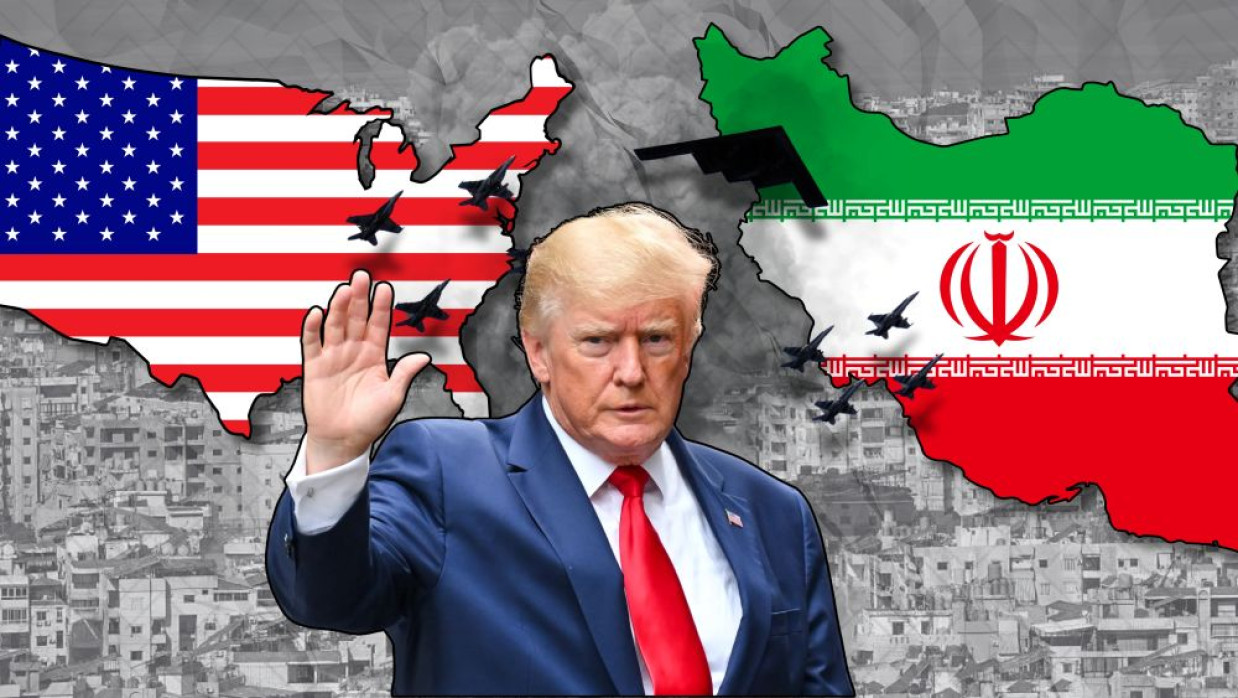
Within a few days of the much-publicized US-Iran Memorandum-of-Understanding (MoU) having expired, President Donald Trump announced on Truth Social an unprecedented economic war against Iran. Describing it as “most crushing economic cooperation against any country,” Trump stated that any country that allows “any type of lifeline to Iran will itself face tremendous economic consequences.” Ironically, on June 17, the MoU was inked for 60 days and was expected to lead to a permanent ceasefire. The limited attention being paid to it having expired and with practically no importance accorded to its renewal, followed by Trump’s announcement of economic war against Iran, raises questions about American President’s aims.
Seriously speaking, if Trump had really willed, the war against Iran may not have ever started. The question is not simply that of his stand having weakened against that of Israel insistent on adopting an aggressive – war-oriented – policy against Iran, but perhaps it having not been peace-oriented. It seems impossible to believe that Trump was never really unaware of Israeli Prime Minister Benjamin Netanyahu’s “ambitions.” Netanyahu has never hidden these as his secret plans. He has never refrained from publicly stating his plans about targeting Iran. So did Trump really err while considering ceasefire? Did he miscalculate? Or should apparent changes in his plan be viewed as part of having been deliberately planned moves with the set aim of ensuring Iran’s defeat? Undeniably, Trump seems willing to be convinced by nothing else than Iran’s defeat, giving little thought to the limited possibility of this being actually implemented in near future. In fact, this “strategy” appears to have guided all his moves regarding Iran, including the MoU signed on June 17.
Trump chose to opt for a strategy that gave importance primarily to his and perhaps his advisors’ views and strategies on war against Iran. These apparently rested on assumption that defeating Iran and overthrowing this country’s government was a simple task. This rested probably on the belief that nothing could last for too long against the command as well as power of the one and only superpower- United States. Guided by this belief, US and Israel began war-strikes against Iran on Feb 28. Days turned into weeks and then months as Iran continued to resist. Iran has certainly not won the war. But neither has US. What perhaps stands out is the failure of the superpower to defeat Iran. Yet, Trump remains convinced that Iran has been, is being and/or will be defeated.
From day one, interestingly, US allies have refused to be convinced by such “logic” of Trump. This also explains their decision to refrain from joining US (and Israel) in the war against Iran. They have justified their stand by saying that they were not consulted regarding United States’ decision to opt for anti-Iran war. Their decision not to join this war also suggests their being against it. A number of them are certainly wiser and have apparently learned a lot from not displaying the stand they did in wars US engaged in earlier. In other words, they have chosen to exercise extreme diplomatic caution by not being moved to join US in war against Iran.
Ironically, diplomacy appears to have been accorded minimum importance by Trump in taking decisions on the Iran front. Of course, at times, it has seemed as if diplomatic options were being considered by Trump. But now, particularly after MoU expired on Aug 17, all diplomatic options seem a part of the same strategy of Trump. These options include the pauses/ceasefires in the war, of which certainly the most significant has been the MoU inked on June 17 for a period of six months. It was supposed to be converted into a permanent ceasefire. However, it has been marked by repeated violations. Though the only saving grace is that violations have not been marked by any full scale resumption of war, the risk of this happening remains.
Be it MoU or other signs of ceasefires, neither would have probably been given any importance without support of United States. It is possible, these moves were deliberately initiated to convince Iran into seriously considering diplomatic options. Perhaps, Iran was expected to be “won” by the same and stop being on guard. In other words, it is possible, these – particularly the MoU – may be viewed as a trap for Iran, as US and Israel probably planned to use the time period to prepare for future attacks. The stand displayed by Trump, soon after the MoU expired, only suggests that it was probably supported by him only to secure some time for strengthening anti-Iran moves. His announcement of economic war against Iran, soon after MoU expired, is certainly suggestive of this.
Trump has also called for support from allies “to isolate and defeat Iran,” or else as mentioned earlier, they will face “tremendous consequences.” A day before Trump posted this, UAE announced an indefinite trade embargo on Iran. UAE accused Iran of firing two ballistic missiles at its territory. Dismissing this accusation, Iran described the reported attack as “false flag operation” by Israel and United States.
Chances of Trump’s sanctions affecting Iran’s trade with all countries, particularly China are limited. China is largest market for Iran’s export, purchasing 80%-90% of its crude oil. If US chooses to take action against China, it is likely to affect its trade with it. China is a major exporter of vital rare earth minerals to US.
At present, there is no guarantee that Trump will retain his stand of waging economic war against Iran and its allies. Trump has certainly opted for this option after having failed to defeat Iran militarily. This war has been marked by few pauses/ceasefires, of which the most significant has been the MoU. Yet, as suggested even the much-publicized MoU has remained marked by violations. It seems Trump is adamant on unilaterally pushing for the stand in which Iran accepts its own defeat and acknowledges United States’ victory. If this were possible, at least at present, the war would not have extended for months. Besides, as suggested earlier, Trump has refrained from adopting a consistent attitude towards Iran, which has wavered between strikes and pauses. Iran has chosen to retaliate similarly. What stands out is that apparently Trump is adamant on not accepting any other policy of Iran, except that which amounts to latter submitting to US, in other words acknowledging defeat. On its part, Iran believes that Trump’s comment on Truth Social only marks “defeat” of US.
Iranian Foreign Minister, Seyed Abbas Araghchi has written on X, “The so-called ‘Economic D-Day’ is a diversion from America’s own crisis: unprecedented debt & surging interest costs. Doubling down on failed policies will only bring further defeat- and enmity of Iranians. US economic terrorism threatens global economy and sovereignty worldwide.”
Clearly, Trump is giving importance to only prospects of Iran’s submission and latter appears to have no inclination, at least at present, of yielding to US on this front. Perhaps, Trump has opted for anti-Iran strikes, the ceasefires- including MoU- only hoping as well as expecting that Iran would submit soon. This would have been possible if only Trump’s moves had the desired impact. But this, at present, seems more like a mirage!


0 Comments
LEAVE A COMMENT
Your email address will not be published