

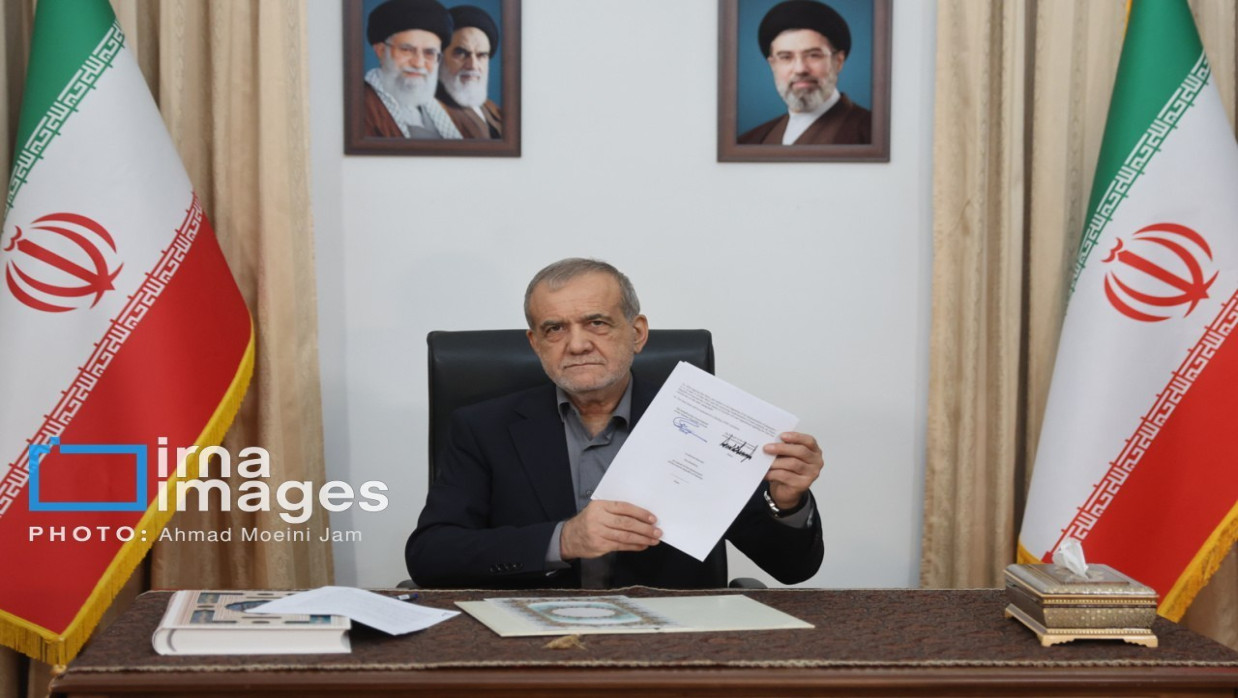
With US-Iran Memorandum of Understanding (MoU) having finally been inked, highlighting 14 points, it is imperative to review it from several angles. First, this is an interim, that is temporary agreement, with the subsequent period (60 days or more) being used to work on the final agreement. It may be noted that earlier this interim agreement was expected to be signed on June 19. However, it was preponed and signed on June 17. President Donald Trump signed it in Versailles, France, where he had gone to attend the G7 Summit. In Iran, it was signed by President Masoud Pezeshkian.
It is possible, the signing was deliberately preponed and it seems, this decision was not revealed till virtually the last minute. Initially, coverage, along with diplomatic moves, was accorded to signing being scheduled for June 19. It may be worth taking note of as to why was it probably preponed? Perhaps, US apprehended possibility of Israel taking steps to disturb the signing on June 19. Israel conducted strikes against Lebanon, in which 83 people were killed and 141 wounded on June 19, according to Lebanon Ministry of Health. If the US-Iran deal had not been inked earlier in the week, it is possible, Israel’s strikes may have prevented this from happening. This apparently implies that both US and Iran did not want this deal to be further postponed and/or even cancelled, because of apparently negative moves of Israel. And so, they signed the deal earlier than it appeared to have been scheduled for. This clearly is a strong indicator of US being against its deal with Iran being hampered because of Israel being opposed to it as well as its strikes against Lebanon.
A key point of the 14-day MoU is “immediate and permanent termination of military termination of military operations on all fronts, including Lebanon, and undertake from now on not to initiate any war or any military operation against each other…” This is supposed to be declaration of USA, Iran and their allies in the war. Clearly, this includes end of Lebanon being subject to Israel’s strikes, though these two countries are not signatories to MoU. But yes, US and Iran are with the latter having led stress on end to Israel’s strikes against Lebanon.
After the MoU was inked, US and Iran were supposed to hold further talks on Sunday (June 21 in Switzerland. However, this schedule was disturbed owing to Israel’s strikes against Lebanon. Describing this as violation of ceasefire, Iran announced the closure of Strait of Hormuz. President Trump was compelled to speak to Israeli Prime Minister Benjamin Netanyahu, regarding ceasefire with Lebanon. Trump, according to reports, spoke in a very strict tone. Subsequently, this led to US-Iran talks this Monday (June 22). These were not held on Sunday, apparently due to Israel-Lebanon conflict. It is possible, Trump was compelled to adopt a strict tone, at least diplomatically, against Netanyahu, to ensure continuation of US-Iran diplomatic efforts. He didn’t want these to be disturbed because of Israel choosing to target and occupy Lebanon.
What stands out is that US and Iran officials did hold talks for around 18 hours at Lake Lucerne, Switzerland. Washington-delegation led by JD Vance included Trump’s son-in-law Jared Kushner and special envoy Steve Witkoff. Iran’s delegation led by Parliament Speaker Mohammad Bagher Ghalibaf also had Foreign Minister Abbas Araghchi. Talks also included Pakistani and Qatari mediators. The key point here is that a crucial process, following the signing of US-Iran interim-deal by the two presidents has been initiated. It has not been called off or postponed indefinitely because of Israel-Lebanon conflict and/or any other issue.
Equally significant is the apparent change in Trump’s approach towards Iran. Who knows this may be temporary, but that at present this spells a marked contrast to what it was earlier cannot be missed. Earlier, prospect of him speaking well of Iran government didn’t prevail. Well, earlier there prevailed literally no chance of US-Iran even considering any MoU. The present period may certainly be viewed as a MoU-phase. After all, it has been inked, even though this is a temporary agreement. But that it has been inked and talks have begun for their inking a permanent agreement bears significance. And this also perhaps explains the major change in Trump’s apparent image of Iran government. At least, this phase has not been marked by his displaying anger towards Iran and its government. He displayed this approach earlier and even talked of a regime change in Iran. Now, during the present phase, he claims to have never considered Iran’s “regime change,” has nothing against them and has also described its leaders as “strong” and “smart.”
Interestingly, Trump appears to have been quite cautious about ensuring that his own former approach towards Iran and US ties with Israel do not disturb progress in US-Iran agreement being worked upon. This probably explains the difference noted in his attitude on these two fronts. As mentioned earlier, he has been critical about Israel’s strikes against Lebanon. Clearly, he doesn’t want this to disturb the present phase of US-Iran ties, however fragile they may be. With MoU having been reached, he seems serious about two countries continuing talks on issues they have agreed to focus on. The change in his attitude towards Israel cannot be missed. However, within such short a period of time, this cannot be assumed to be reflective of a major change in US relations towards Israel. It is as yet too early to assume this.
Seriously speaking, what can be said about US policy towards Iran? Is it suggestive of any major change? From one angle, it is certainly too early to even assume this. At the same time, the moves being made are certainly reflective of US-Iran ties displaying a new turn. That they have backtracked from the war-stage cannot be dismissed. That ties are being considered on issues outlined in US-Iran MoU cannot also be ignored. At least, they have taken the first step towards this, which has been marked by their Switzerland meeting, held this Monday (June 22).
US-Iran MoU also marks their decision to deliberate on taxing issues. It seems, irrespective of what Israel or in other words, Netanyahu maybe keen for, Trump is opposed to continuation of war against Iran. Trump has probably grown wiser after the experience of targeting Iran for 100+ days. This also points out to this phase being suggestive of apparently change in Trump’s attitude towards Israel as well as Iran. Trump seems hardly keen to yield to Netanyahu’s stand of targeting Iran, waiting for its surrender and/or collapse of its government. Undeniably, US-Israel strikes against Iran failed to have the impact which had probably been expected by him (and Netanyahu). Trump has given up assuming along this line. This certainly is marked by his opting for the US-Iran MoU, even if this has prompted him to adopt an anti-Netanyahu stand for some time.
Irrespective of differences entertained by US and Iran regarding latter’s nuclear policy, its uranium enrichment policy and other issues, the fact that as per the MoU, the two countries will be engaged in discussions on these and other subjects bears importance. This probably also explains the importance as well as urgency accorded to inking of MoU by both US and Iran. And why Trump hasn’t refrained from showing a hard stand towards Netanyahu, regarding Israel’s Lebanon-stand. Trump did not want signing of US-Iran MoU to be postponed. Now, that it has been inked, it is to be watched as to how is the same given the shape of a permanent agreement in the coming days!

0 Comments
LEAVE A COMMENT
Your email address will not be published