

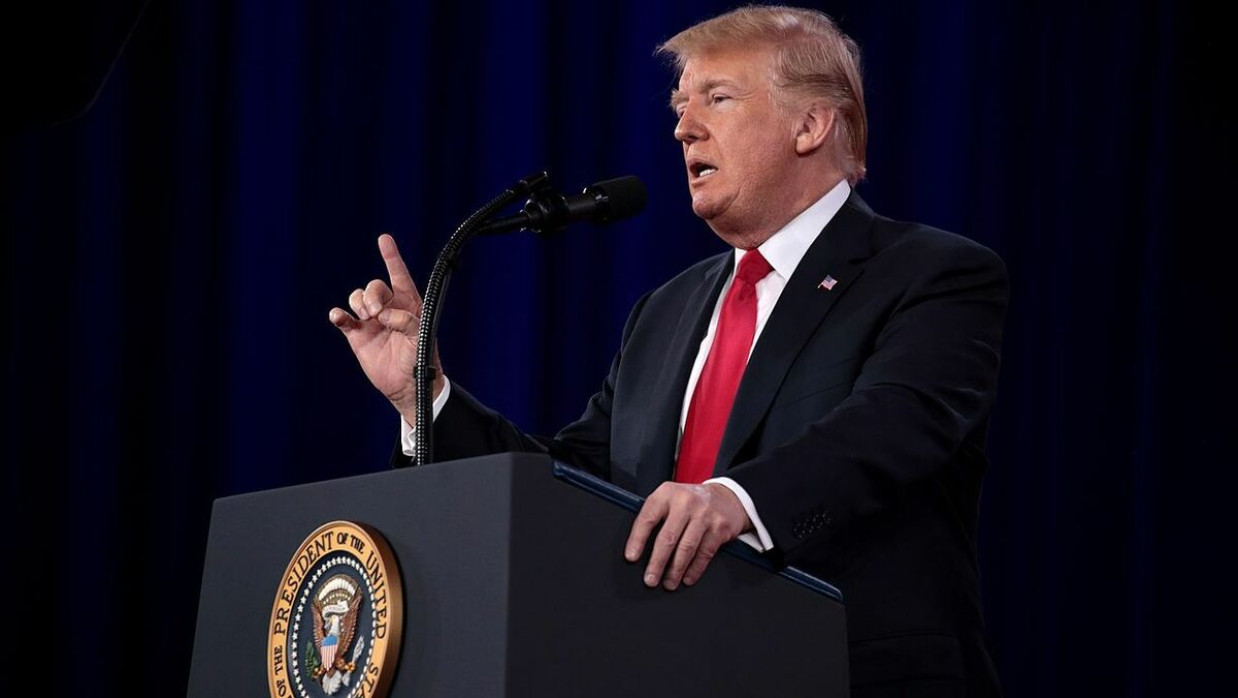
No American President has probably faced the dilemma which President Donald Trump seems to be caught in at present. It is no secret that Trump wants the world, particularly Iran, to say yes to his diplomatic dictates without raising a single question. But that era seems to be history. And yet, Trump remains probably convinced that he, that is the US President can still have his way. He apparently loves believing this and yet is faced with the reality which he can only hate. Ironically, the Iran-war has brought him face to face with these politico-diplomatic parameters in a fairly unexpected as well as realistic manner than was probably envisaged before initiating the war against Iran.
Undeniably, US and Israel began strikes against Iran on February 28 guided by assumptions that within a matter a few days, they’d have their way. In addition, Trump was probably over-confident about it still being easy for the superpower to convince and also win over greater part of world to what US desires. But there is no guarantee that what happened earlier would be repeated in future too. True, US had support of other countries when it chose to engage in Afghanistan or tried having its way in certain countries in the name of Arab Spring.
Instead, since Trump has assumed office for the second term, certain of his key diplomatic moves haven’t pleased even his old committed allies. Most were apparently shocked by his decision to go for the Alaska-Summit with Russian President Vladimir Putin (August 15, 2025).
Trump’s decision to go for tariff-war during his second term hardly pleased the other countries. It seems, to a degree, certain policies of Trump have played their own part in compelling his once committed allies from choosing not to support some of his key moves. The highlight of this has been his war against Iran. Trump was perhaps too sure that US would easily and instantly secure their support as and when needed as well as decided by him. This hasn’t happened and is least likely to in the coming days. Trump may have finally accepted this diplomatic reality or not but this is the scenario that has surfaced.
In other words, the limitations of Trump’s own diplomatic reach are apparently more obvious now than perhaps they had ever been before. His tariff-war, Alaska-summit, the so-called Gaza-peace plan (signed on October 9, 2025), arrest of Venezuelan President (January 3, 2026), initiation of war against Iran (February 28, 2026) followed by negotiations though third parties to reach an agreement to end the war have hardly enhanced his diplomatic importance. The same may be said about Israel-Lebanon ceasefire (signed on April 16, 2026).
It isn’t surprising, when Trump sought support from his European allies against Iran, their response was negative. Their opinion had not been taken prior to initiating the strikes, so they’d rather keep themselves at a distance from this war. Realistically speaking, having becoming wiser by having joined US earlier, quite a few nations are no longer willing to take the same risk again. Similarly, quite a few Americans are also against the Iran-war. The Arab countries in all probability never expected their strong ally to take steps which would only disrupt peace and economic life in their own region. The whole course of war has clearly displayed what was probably never desired and/or pictured by Trump. It does not spell either clear victory of US or total defeat of Iran. Options of either end seem extremely limited. The simple message is that even superpower has its diplomatic limitations in this age. The question of other countries being expected to simply and blindly go by its dictates is thus non-existent.
Begun on February 28, the strikes haven’t led to collapse of Iran. Neither have they forced Iran to yield to whatever offer is placed before it during the negotiations. Just before Trump announced the ceasefire-phase, which began on April 8, he had threatened to bomb Iran back to “Stone Ages.” Trump also warned that Iran’s infrastructure would be obliterated and a “whole civilization” would die if Strait of Hormuz was not reopened. He threatened to take such stands if Iran did not respond as he desired. Trump apparently expected his aggressive stand displayed against Iran to turn diplomatic cards in his favor. This did not happen. Little importance was given by Iran to threats posed before it by the superpower. Instead, Iran chose to respond only by choosing not to agree to terms placed before it by the superpower. Clearly, Iran understood the limitations of the threats voiced by Trump. Prospects of Trump of actually ensuring their being implemented were as good as non-existent. There prevailed several reasons for this, the key ones being Iran’s defense as well as its potential to target military facilities of US and Israel in the region.
Though Trump is going to be last person to acknowledge this but his own diplomatic tone signals his tacit acknowledgement of superpower’s limitations. Please take note of aggressive tone voiced by Trump ahead of the ceasefire announced in the war with Iran. He had talked of pushing Iran to Stone Ages and so forth. There has hardly been any sign of Iran yielding. Recently, when asked about talks with Iran, Trump told reporters at White House that negotiations were going on “very well” and could yield results soon. This attitude seemed devoid of aggression displayed so strongly earlier. Irrespective of whether they yield results soon or not, what cannot be missed is the difference in diplomatic tone displayed by Trump while talking about war with Iran. His attitude ahead of the ceasefire was a total contrast to what has been displayed now. He also said this week that he would be “honored” to meet Iran’s Supreme Leader Mojtaba Khameini if Washington and Tehran agree to a deal. Trump also seems fairly conscious of possibility of talks with Iran being disturbed because of Israel’s attacks on Lebanon. On this, Trump has voiced his perturbance to Israeli Prime Minister Benjamin Netanyahu.
Trump’s diplomatic dilemma on the Iran-front appears to be pushed towards greater complication because of Israel’s attacks on Lebanon. Prospects of diplomatic cards going only by his desire being quite limited appears to have been apparently understood fairly well by him. Perhaps, Trump never expected the Iran-war to bring him face-to-face with a hard diplomatic reality: other powers can no longer be expected to be guided only by dictates of the superpower. In other words, Iran-war has also led to display of diplomatic limitations faced by the superpower!


0 Comments
LEAVE A COMMENT
Your email address will not be published