

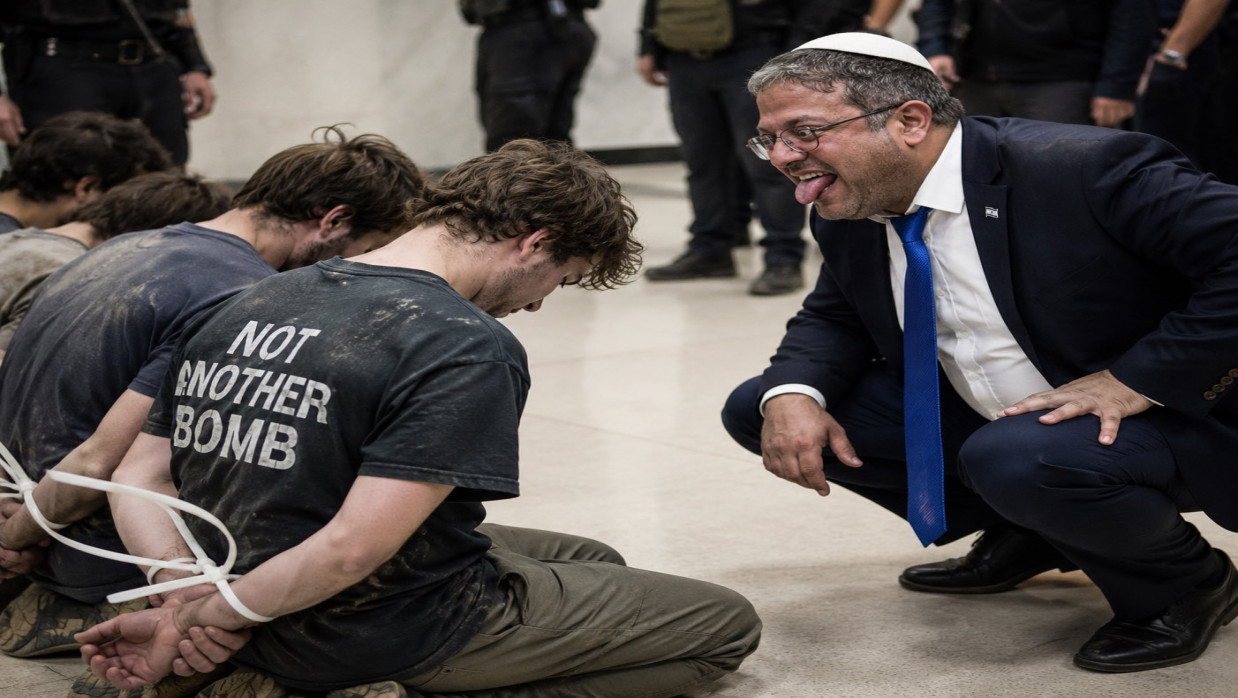
The treatment of the flotilla activists by Israel’s National Security Minister Itamar Ben Gvir was shocking only to those who continue to clothe colonial violence in the soft language of security. There is now a mountain of evidence before humanity: Gaza has become not merely a place under siege but a geography of calculated despair, where starvation and bombardment have been converted into instruments of political management. The activists aboard the flotilla were not armed combatants, nor were they soldiers threatening invasion. They were international volunteers, human rights advocates, doctors, parliamentarians, and organisers attempting to break the siege imposed on Gaza. Their journey was political, moral, and humanitarian. Yet the Israeli state met them with humiliation, detention, and theatrical violence.
Ben Gvir understood precisely the symbolic function of his actions. The politics of the Israeli far right is not merely about security; it is about pedagogy. The violence must be seen and the humiliation must circulate publicly. Domination must constantly reproduce itself through spectacle. The public degradation of Palestinians and their allies is central to the ideological machinery of the Israeli far right. Every arrest becomes a lesson in obedience, every beating becomes a message, every detention becomes a declaration that resistance, even symbolic resistance, will be met with overwhelming force.
The flotilla activists entered a geography already transformed by blockade and devastation. Gaza today is not merely occupied territory; it is a laboratory of punishment. For years, Israel has controlled the movement of food, medicine, fuel, electricity, and people into the strip. The blockade has produced not security but social suffocation. International organisations have repeatedly warned about catastrophic humanitarian conditions. Yet the siege continues because it serves a political purpose: to fragment Palestinian life and break collective morale.
When activists attempted to challenge this order through the flotilla, Ben Gvir and his allies responded as colonial powers often do when confronted by moral witness. The activists were presented not as human beings motivated by conscience but as enemies of the state. Their detention was accompanied by taunts and intimidation. The aim was not merely to stop the flotilla but to discourage future acts of solidarity. This pattern is older than the present crisis. Colonial systems survive not only through military superiority but through rituals of domination. The British Empire practiced it in India and Kenya, French colonial authorities employed it in Algeria, and South African apartheid institutionalised it with bureaucratic precision. Humiliation becomes part of governance.
Ben Gvir’s rhetoric reveals the depth of this political culture. He speaks of Palestinians not as a people with rights but as a demographic threat to be controlled and contained. In this worldview, solidarity itself becomes criminal. Humanitarianism is recast as terrorism. International law becomes an inconvenience. The flotilla activists were therefore dangerous not because they carried weapons but because they carried testimony. They threatened to expose the architecture of siege before a global audience. Their mere presence undermined the carefully manufactured narrative that Gaza’s suffering is unavoidable collateral damage rather than a political choice. What Ben Gvir fears most is not armed resistance alone. He fears political imagination and the possibility that ordinary people across the world may see Palestinians not through the language of security briefings but through the language of shared humanity. And so, the brutality directed at the flotilla activists was not an aberration. It was entirely consistent with the ideological world that Ben Gvir inhabits: a world in which domination must constantly reproduce itself through force, humiliation, and fear.
The Politics of Erasure
Long before the flotilla activists were detained and brutalised, Ben Gvir directed his fury toward one of the most important Palestinian political prisoners of the modern era: Marwan Barghouti (born 1959).
Marwan Barghouti occupies a singular place in Palestinian political life, not because he is untouched by political contradiction but because he embodies the continuity of a national struggle that many powerful actors wish to erase. To many Palestinians, he represents a figure capable of unifying fragmented political tendencies. Emerging from the ranks of Fatah during the First Intifada, Barghouti became associated with grassroots political mobilisation and the demand for national liberation. Even among those who disagree with aspects of his political strategy, there is widespread recognition of his symbolic importance. Israel understands this symbolism well. That is why Barghouti’s imprisonment since 2002 has never been merely judicial. It is deeply political.
Ben Gvir’s hostility toward Barghouti reflects a broader Israeli strategy: the systematic destruction of Palestinian political leadership. Colonial systems frequently attempt to criminalise leadership because organised political consciousness poses a threat greater than spontaneous unrest. A people without leadership can be fragmented. A people without political memory can be managed.
Barghouti’s imprisonment became a site through which the Israeli far right could perform its politics of vengeance. Ben Gvir repeatedly advocated harsher prison conditions for Palestinian detainees. Under his political influence, there were intensified crackdowns on prisoners’ rights, restrictions on family visits, and punitive measures designed not simply to incarcerate but to degrade. Reports from Palestinian prisoners and human rights organisations have described conditions marked by isolation, overcrowding, physical abuse, and psychological pressure. Prison raids became spectacles of domination. Books were confiscated. Collective punishment intensified. The prison, in this system, is not only a place of detention; it is an instrument of colonial management.
Barghouti’s case reveals something essential about Ben Gvir’s worldview. He does not merely oppose Palestinian armed groups, but he opposes Palestinian political existence itself. This is why figures like Barghouti are so threatening. Barghouti speaks the language of national liberation. He invokes anti-colonial traditions familiar across Asia, Africa, and Latin America. His political symbolism connects Palestine to a wider history of struggle against occupation and racial domination. For Ben Gvir, such figures must be broken psychologically. Their dignity must be shattered publicly. Their image must be transformed from political leader into criminal inmate.
Yet history offers many examples of imprisoned leaders becoming more powerful symbols through incarceration. Nelson Mandela spent twenty-seven years in prison under apartheid South Africa. States imprison those they fear politically. Barghouti’s endurance has therefore become deeply symbolic. His imprisonment is not simply about one man. It represents the broader Palestinian condition under occupation: confinement, fragmentation, and the attempt to erase political agency.
In 2025, Ben Gvir posted a 13-second video clip of him taunting a very gaunt Barghouti in a prison and said, ‘You won’t win. Whoever messes with the nation of Israel… we will wipe them out’. A dignified Barghouti tried to interject several times to hold his own. The clip showed the desperation of Ben Gvir, trying to overcome the man who had helped draft the Prisoner’s Document in 2006 that called for the revitalisation of Palestinian politics, and which continues to circulate today. The prison cell can become a school of resistance. The attempt to erase memory can instead strengthen it. Barghouti remains, despite years of imprisonment, a reminder that Palestinian political identity has survived every attempt at fragmentation.
The Long History of Israeli Fascistic Politics
To understand Ben Gvir, one must move beyond the comforting fiction that he is an aberration. He is not an interruption in Israeli political history, but is one of its logical outcomes. Ben Gvir did not emerge from nowhere. He is the product of decades of radicalisation within sections of Israeli society shaped by settler colonialism, militarisation, and ethno-nationalist ideology.
As a young man, Ben Gvir was associated with the banned Kach movement founded by Rabbi Meir Kahane. Kahanism openly advocated Jewish supremacy and the expulsion of Palestinians from historic Palestine. Even the Israeli state once regarded Kach as too extreme, banning it as a terrorist organisation. But ideas once considered fringe have steadily migrated into the political mainstream. Ben Gvir built his career through provocation. He became known for inflammatory rhetoric, public incitement, and confrontational appearances in Palestinian neighbourhoods. For years he cultivated the image of a militant street activist who viewed compromise as weakness.
One infamous episode occurred in 1995 when Ben Gvir appeared on Israeli television holding the emblem from Prime Minister Yitzhak Rabin’s car. ‘We got to his car’, he declared, ‘and we’ll get to him too’. Weeks later Rabin was assassinated by a far-right Israeli extremist opposed to the Oslo Accords.
This history matters because it reveals the political atmosphere from which Ben Gvir emerged: a culture in which hatred against Palestinians, and often against peace advocates themselves, became normalised. Over time, Israeli politics shifted steadily rightward. Settlement expansion accelerated. Military occupation hardened. The peace process collapsed into ritualised diplomacy disconnected from realities on the ground. Within this environment, figures like Ben Gvir gained legitimacy. His rise also reflects deeper structural realities. Colonial systems frequently generate extremist political formations because domination requires ideological justification. Violence must be moralised and inequality must be rationalised. Ben Gvir provides precisely this ideological function. He transforms structural violence into nationalist virtue. His political language relies heavily on fear. Palestinians are depicted not as a colonised population but as existential enemies. Human rights organisations are portrayed as traitorous. International criticism becomes evidence of conspiracy.
This is not unique to Israel. Similar political patterns can be observed globally. From Narendra Modi’s Hindutva nationalism in India to the authoritarian ethnonationalism visible in parts of Europe and the Americas, contemporary far-right movements rely on a politics of permanent fear. Minorities become scapegoats, and dissent becomes treason.
What makes Ben Gvir especially dangerous is not merely his rhetoric but his access to state power. As National Security Minister, he has influence over policing, prison administration, and internal repression. The extremist street politics of previous decades have now entered the machinery of governance.
This transformation carries grave consequences. The treatment of the flotilla activists and of prisoners like Marwan Barghouti are not isolated incidents. They are symptoms of a broader political trajectory in which cruelty itself becomes policy. Yet history also reminds us that systems built upon permanent domination eventually confront crises of legitimacy. Colonial regimes often appear invincible until suddenly they do not. French Algeria seemed permanent. South African apartheid appeared deeply entrenched. Portuguese colonialism in Africa looked immovable. Repression contains contradictions, violence generates resistance, and humiliation produces solidarity.
The global outrage over Gaza, the continued symbolic power of Palestinian prisoners, and the persistence of international solidarity movements all indicate that the Palestinian struggle remains profoundly alive. Ben Gvir represents the hardening edge of a political project attempting to preserve domination through fear. But fear alone cannot produce justice, legitimacy, or peace. And that is ultimately the tragedy of the present moment: a political class incapable of imagining coexistence except through the language of force. The flotilla activists understood this, and so does Marwan Barghouti. Millions across the world understand it as well. The question now is whether the international system will continue to normalise such brutality, or whether global public opinion will finally recognise that what is unfolding is not merely a conflict between two equal sides, but a struggle over the basic meaning of freedom, dignity, and humanity itself.

0 Comments
LEAVE A COMMENT
Your email address will not be published