

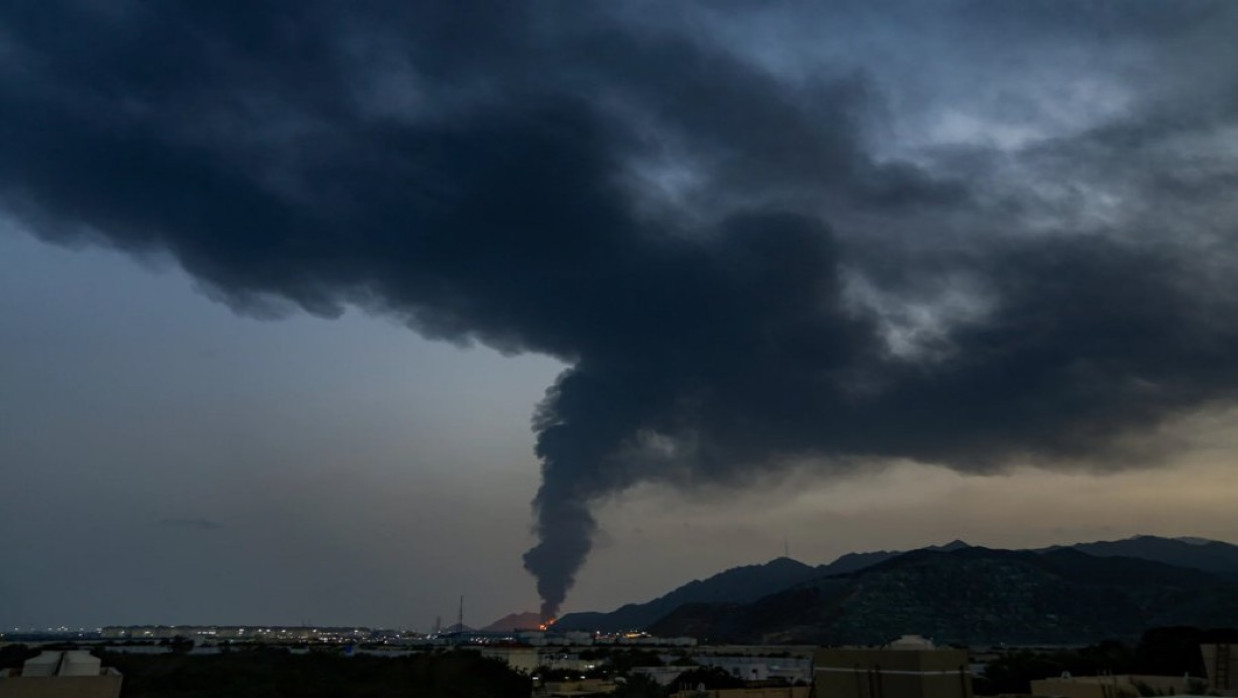
In a development on Monday morning, Iran attacked the UAE through cruise missiles and armed drones targeting the Fujairah Oil Industry Zone, which wounded employees, destroyed the fuel infrastructure, and tore apart the remaining fragile ceasefire in the area. The calculation in Abu Dhabi has changed, and the world needs to take note of that.
However, this is no ordinary escalation. For one, the assault on Fujairah is an operationally meticulous gesture. Fujairah happens to be at the end of the strategically vital pipeline constructed by the UAE specifically to circumvent the Strait of Hormuz, since Iran has shut down this sea lane to international ships.
Since February 28, when the United States and Israel jointly carried out strikes that resulted in the martyrdom of Iran’s Supreme Leader Ayatollah Ali Khamenei and prompted retaliation across the Gulf region, the UAE has been balancing a very thin rope. Since the start of the conflict, UAE air defense systems have intercepted more than 414 ballistic missiles, 15 cruise missiles, and 1,976 drones. The ADNOC refinery, which has the capacity to refine 922,000 barrels a day, had to close following a strike.
By striking the Fujairah Oil Industry Zone, Tehran has signaled that it will not allow the Emirates to act as a quiet facilitator of American and Israeli strategic goals. Iran's foreign ministry had previously warned that alignments between Gulf states and Israel increase the risk of retaliatory action. Monday's strike was the delivery of that threat.
The UAE Ministry of Foreign Affairs declared that “These attacks represent a dangerous escalation and an unacceptable violation.” Those words carry weight. UAE President Mohamed bin Zayed Al Nahyan and Saudi Crown Prince Mohammed bin Salman had jointly warned in March that continued Iranian attacks on Gulf states may force a regional escalation.
The strategic danger of this moment is not simply that more missiles are flying. It is that the architecture of the conflict is fundamentally changing. Until now, this war had a reasonably legible geometry as the United States and Israel on one side, Iran and its proxies on the other. Iran explicitly targeted a UAE state-owned energy vessel, the ADNOC tanker, and described it as a terrorism target. Therefore, the language of warfare is here, regardless of whether the bullets actually have arrived yet. The United Arab Emirates, which was a signatory to the Abraham Accords with Israel in 2020 and has since increased its military relationship with Israel, does not remain a neutral party when viewed from the perspective of Iran. The Iranian rationale is based on the logic that the nations that provide shelter for American troops or coordinate defenses with Israel will pay for it.
What makes this so dangerous is the cascade potential. The Strait of Hormuz remains closed to non-Iranian-approved shipping, choking roughly 20 percent of global oil and liquefied natural gas shipments. Trump's 'Project Freedom', the US naval initiative to escort commercial vessels through the strait, has now directly collided with Iranian force. CENTCOM confirmed Monday that US destroyers sank six Iranian small boats in the strait. Two commercial vessels transited safely, but Iran has simultaneously attacked an ADNOC tanker, bombed Fujairah, and fired on a South Korean-operated ship. The ceasefire, such as it was, is functionally dead on the water. If the UAE retaliates, or even quietly upgrades its participation in the American naval campaign, the conflict morphs from a US-Iran proxy confrontation into a broader Gulf war.
In the midst of this gathering storm, one country is doing something remarkable as it is still building bridges while everyone else is burning them.
Pakistan's emergence as the central mediator in this conflict is one of the most consequential geopolitical developments of the decade, and it is unfolding in real time, on this very day. Even as missiles flew over the UAE on Monday morning, Pakistan's Foreign Ministry was announcing that it had facilitated the transfer of 22 Iranian crew members from the US-seized container ship MV Touska, flying them to Islamabad and handing them back to Tehran as a confidence-building measure. The ship itself is being towed to Pakistani waters for repair before being returned to its Iranian owners, an arrangement coordinated simultaneously with both Washington and Tehran.
The Islamabad Talks of April 11–12, where Vice President JD Vance sat across the table from Iranian Foreign Minister Abbas Araghchi for the first time in nearly five decades of broken relations, were a diplomatic miracle that almost nobody predicted. Pakistan brokered the April 8 ceasefire. Pakistan delivered proposals between the parties. Pakistan's Army Chief Field Marshal Asim Munir traveled to Tehran; Prime Minister Shehbaz Sharif shuttled between Doha, Riyadh, and Ankara. As the Council on Foreign Relations noted, Pakistan achieved something many diplomats from wealthy democracies and leading global organizations had failed at for nearly five decades, producing direct talks between Washington and Tehran. Islamabad is not content merely to hold that space passively. Pakistan adopted official neutrality from day one, simultaneously condemning US-Israeli strikes on Iran and Iranian attacks on Gulf states, while launching Operation Muhafiz-ul-Bahr to protect its own commercial shipping.
The smoke over Fujairah will clear by nightfall. The fires will be contained. The number of missiles intercepted will be counted and publicized by the ministry, but the reality behind their interception will not go away so quickly. The Gulf region is moving into a new and more perilous era, an era in which even the most careful, most internationalist Arab country finds itself under threat, and an era in which the structure of the ceasefire begins to crumble under conflicting pressures. It is the time for peacemakers. Pakistan has proved that. The question is if anyone is listening.


0 Comments
LEAVE A COMMENT
Your email address will not be published