

By Aung Marm Oo
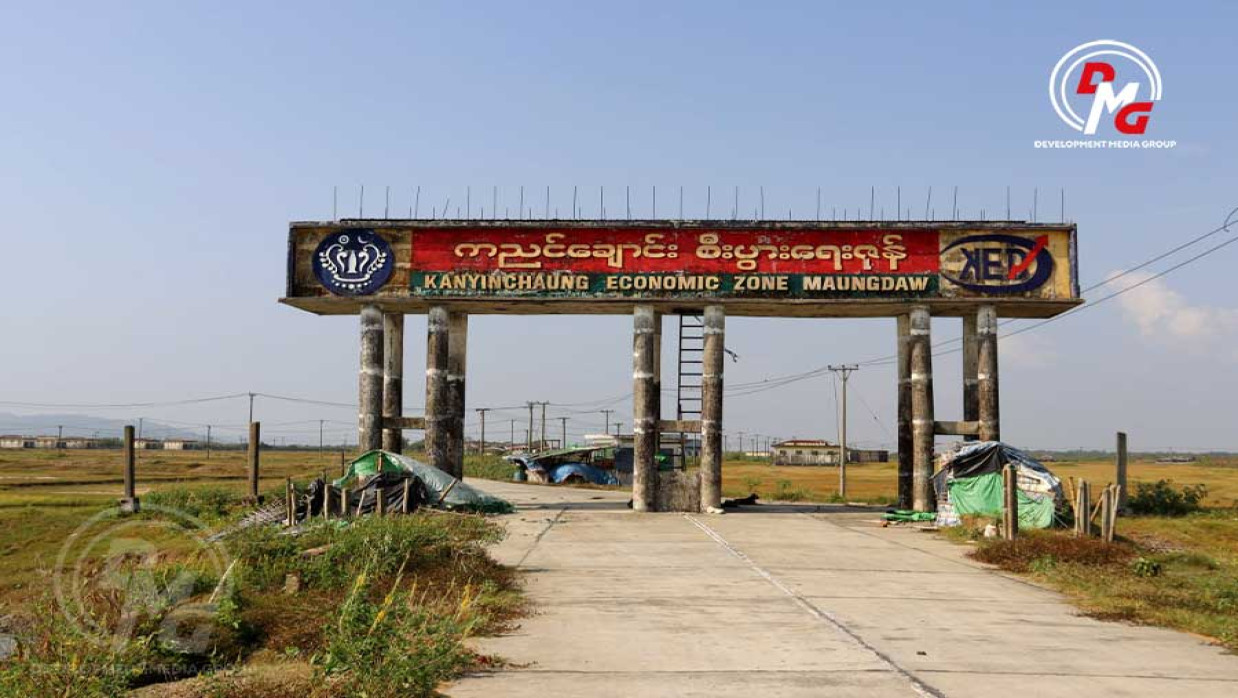
“Border trade exists, but at the same time it doesn’t fully exist.” That observation from a Maungdaw resident may be the most accurate description of today’s Bangladesh-Arakan (Rakhine) frontier. Boats once again cross the Naf River. Goods move between Teknaf and Kanyin Chaung. Potatoes, onions and other basic commodities are reaching Arakan after months of severe shortages. Yet for many local traders, entrepreneurs and consumers, the reopening of border trade has not translated into the broader economic recovery they had hoped for. Commerce has resumed, but prosperity has yet to follow.
This contradiction reflects the larger transformation taking place across Arakan. Over the past two years, the region has experienced one of the most significant political and military shifts in Myanmar’s recent history. The United League of Arakan/Arakan Army (ULA/AA) now exercises de facto administrative control over most of the Bangladesh-Arakan frontier, while the Myanmar military has lost effective control over nearly all border areas. That new reality has reshaped not only the security landscape, but also Arakan’s economic geography.
As one border trader told Development Media Group (DMG), “When we buy goods from the Bangladesh side, sometimes the tax is almost equal to half the purchase price, around 50 percent. Under the current official system, ordinary people are not really in a position to engage in cross-border trade.” Another trader explained that commerce continues largely through informal arrangements: “People on our side don’t necessarily have to cross into Bangladesh. Bangladeshi traders bring the goods to the border and sell them there.”
These observations point to the central issue. The question is not whether trade exists, but who is able to participate.
Although goods are crossing the border again, many ordinary merchants remain excluded from meaningful participation. High import duties reportedly imposed on the Bangladesh side, combined with restrictions limiting formal trade largely to recognized business associations, continue to constrain wider commercial activity. The result is a border economy that functions only partially: goods move, but many local businesses remain spectators rather than beneficiaries.
For post-conflict societies, such an arrangement is unlikely to generate sustainable recovery. Economic reconstruction cannot rely solely on a handful of large traders or officially recognized commercial groups. Lasting growth requires opportunities for farmers, fishermen, transport operators, warehouse owners, wholesalers, retailers and small family businesses. When participation remains narrow, the benefits of trade remain equally limited. Yet the Bangladesh-Arakan frontier has always represented far more than commerce.
Only months ago, it was one of the most volatile borders in South Asia. Military operations, armed group activity, restrictions on movement and insecurity had virtually paralyzed cross-border trade. Humanitarian access became increasingly difficult, while local livelihoods deteriorated alongside the wider conflict. Conditions today are far from ideal, but they have improved noticeably.
A trader from Buthidaung recently told DMG, “The route used to be much more dangerous. Now that the AA has established more security checkpoints, the threat posed by ARSA [the Arakan Rohingya Salvation Army] has decreased to some extent.”
That observation carries significance beyond commercial activity. Border security forms the foundation upon which both humanitarian access and economic recovery depend.
For Bangladesh, stability along the Naf River has long been intertwined with concerns over the Rohingya refugee crisis, transnational crime, narcotics trafficking, irregular migration and the activities of armed groups operating near the frontier. For Arakan, secure border management has become equally important as the ULA assumes growing responsibilities that extend beyond military operations into civilian administration. Stable borders serve both societies.
For Bangladesh, improved security reduces pressure on communities in Teknaf and Cox’s Bazar while creating conditions for legitimate commerce. For Arakan, secure border routes ensure the continued movement of humanitarian assistance, essential goods and commercial supplies into communities still recovering from years of conflict and blockade.
The humanitarian dimension should not be overlooked. Even as fighting has subsided in many areas, large numbers of civilians continue to face shortages of medicine, employment and basic commodities. Border trade therefore serves not only economic interests but also humanitarian needs. Reliable supply routes strengthen community resilience while reducing the economic vulnerabilities that often accompany prolonged conflict. Recent developments suggest that both sides increasingly recognize these shared interests.
Although Bangladesh continues to conduct commerce within the framework of official Myanmar-Bangladesh trade, practical engagement with the authorities exercising effective control along the frontier has gradually expanded. Trade has resumed. Communication has continued during humanitarian and security incidents. Bangladeshi fishermen detained in Arakan waters have been returned through coordinated arrangements. Working-level contacts have developed despite the absence of formal political recognition. Such pragmatic cooperation deserves greater attention.
International diplomacy often moves more slowly than realities on the ground. Whatever formal positions governments continue to maintain, effective border management increasingly depends upon practical cooperation rather than political symbolism. Geography, economics and humanitarian necessity have a way of creating relationships that politics alone cannot prevent. At the same time, security alone cannot guarantee lasting stability.
No frontier remains peaceful simply because more checkpoints are established or patrols become more frequent. Durable stability usually emerges when local communities possess economic opportunities worth protecting. This is where border trade becomes central to Arakan’s future.
As the ULA expands its governing responsibilities across much of Arakan, public expectations are changing. Military success alone is no longer sufficient. Increasingly, residents judge governance by everyday realities: whether markets remain supplied, medicines are available, schools function, roads stay open, businesses operate freely and families can afford basic necessities. Trade has therefore become one of the clearest measures of governance.
The reopening of border commerce represents an important first step, but reconstruction cannot end there. Before conflict disrupted regional commerce, official figures indicated that annual Bangladesh-Arakan border trade approached US$260 million, illustrating the natural economic complementarity between the two neighboring regions.
The next phase should focus not only on imports but also on rebuilding Arakan’s productive economy.
Agriculture, fisheries, marine products, livestock, forestry and small-scale manufacturing once formed the backbone of local livelihoods. Reviving these sectors would allow Arakan not merely to import essential goods but also to export products competitively, creating a genuinely two-way trading relationship that benefits communities on both sides of the border.
Equally important is expanding participation. Transparent customs procedures, predictable regulations, reasonable transaction costs and wider access for local entrepreneurs would encourage investment while creating employment throughout border communities.
Such reforms would also serve Bangladesh’s long-term interests. A stable and economically recovering Arakan offers greater prospects for lasting border security than one characterized by economic isolation, humanitarian dependence and continuing instability. Trade alone cannot resolve complex political questions, including refugee repatriation or diplomatic recognition. Nevertheless, sustained economic cooperation can build confidence, strengthen livelihoods and reduce many of the structural conditions that fuel insecurity.
Looking further ahead, the Bangladesh-Arakan frontier has the potential to become more than a border crossing. Together with growing connectivity with India—via the route linking Paletwa in Myanmar’s Chin State with India’s Mizoram—it could evolve into one of the Bay of Bengal’s emerging regional economic corridors. Whether that opportunity is realized will depend upon continued stability, infrastructure investment, predictable commercial regulations and sustained cooperation across borders.
For decades, the Bangladesh-Arakan frontier has been viewed primarily through the lenses of conflict, displacement and humanitarian crisis. Today, it has an opportunity to become something very different: a bridge connecting neighboring societies through commerce, stability and shared economic interests.
That transformation will not be achieved simply by reopening ports or allowing cargo boats to cross the Naf River. It will require policies that broaden commercial participation, reduce unnecessary barriers, strengthen cross-border cooperation and recognize that security and economic development are mutually reinforcing rather than competing objectives.
As one Maungdaw resident told DMG, “Border trade exists, but at the same time it doesn’t fully exist.”
The challenge for both Bangladesh and the authorities administering Arakan is to ensure that, in the years ahead, border trade exists not merely as a limited commercial arrangement, but as the foundation for a more prosperous, interconnected and peaceful frontier. Ultimately, the success of the Bangladesh-Arakan border will be measured not by the number of trucks or boats crossing each day, but by whether trade creates opportunity, strengthens public institutions and offers people on both sides of the Naf River a genuine stake in lasting peace.
The article appeared in the irrawaddy

0 Comments
LEAVE A COMMENT
Your email address will not be published